
You think high mileage killed your Sprinter’s value. It hasn’t.
A well-maintained Mercedes Sprinter with 200,000 miles on the clock is not a liability. It is a van with a proven engine. The 2.1-litre and 3.0-litre CDI diesels in these vans are engineered to run well beyond 300,000 miles when serviced correctly. If you want to sell a high mileage Mercedes Sprinter, you need to understand what buyers actually price — and it is not just the odometer reading.
- High mileage alone does not disqualify a Sprinter from commanding a fair price — service history and mechanical condition matter more
- Sprinters are built to exceed 300,000 miles; buyers who know vans know this
- Specific faults — DPF issues, injector wear, rust — cause steeper deductions than mileage itself
- A clean, documented van will always outperform a low-mileage van with gaps in its history
- You can get a fast, fair cash offer without needing to fix everything first
Why the Sprinter Is Different From Every Other Van
Most vans depreciate on a predictable curve. The Sprinter does not follow that curve past 150,000 miles.
The reason is the engine. Mercedes-Benz designed the OM651 and OM642 diesel units for commercial longevity, not just warranty periods. Fleet operators, ambulance services, and courier companies run these vans to extraordinary distances precisely because the drivetrain holds up. A Sprinter that has been serviced on schedule at 150,000 miles is often in better mechanical shape than a neglected rival at 80,000.
This is the fact most private sellers do not know — and most online guides do not tell them. High mileage Sprinter value is not simply a function of distance travelled. It is a function of how that distance was covered and what evidence exists to prove it.
Buyers in the trade price Sprinters differently from generic used-van databases. If you are using a generic valuation tool, you are likely seeing a figure that underestimates what a specialist will pay.
What Buyers Actually Deduct — and Why
Mileage creates a deduction. But it is rarely the biggest one.
Here is what experienced buyers look at when pricing a high-mileage Sprinter:
Mechanical condition
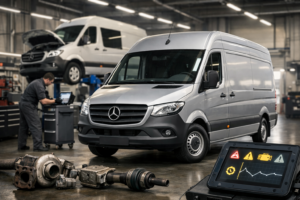
- DPF (Diesel Particulate Filter) status — a blocked or deleted DPF is a significant red flag and triggers a meaningful price reduction. Replacement costs run into hundreds of pounds.
- Injector condition — worn or leaking injectors on high-mileage CDI engines are expensive to fix. Buyers price this in immediately.
- EGR valve and turbo wear — both are common wear points on high-mileage Sprinters. Known faults here reduce offers.
- Gearbox and clutch — manual gearboxes on heavily worked vans show wear. Automatic variants are assessed for selector and fluid condition.
Bodywork and corrosion
Rust is a bigger enemy than miles. Sill corrosion, wheel arch rust, and chassis rot cause steeper deductions than an extra 50,000 on the clock. A 300,000-mile Sprinter with clean bodywork will outsell a 180,000-mile example with serious rust every time.
Service history
This is where sellers leave money on the table. A full, stamped service history — even partial — meaningfully increases what a buyer will pay. It converts a high-mileage Sprinter from a risk into a known quantity. Known quantities are worth more.
Tyres and brakes
Buyers notice worn tyres and low brake pads. These are cheap to flag but expensive to ignore. If you have recently replaced them, say so.
How Mileage Bands Affect Sprinter Resale Price
Sprinter mileage and resale price do not move in a straight line. The sharpest drops in value happen between 0 and 100,000 miles. After that, the curve flattens considerably — particularly for buyers who understand the platform.
Here is a rough picture of how mileage bands tend to affect offers:
- Under 100,000 miles — strong retail and trade demand; condition and spec drive the price
- 100,000–150,000 miles — solid trade demand; service history becomes increasingly important
- 150,000–200,000 miles — specialist buyers remain active; mechanical condition is the primary variable
- 200,000–300,000 miles — the market narrows to trade and fleet buyers, but fair offers remain available for well-documented vans
- Over 300,000 miles — niche but not worthless; a running, documented Sprinter at this mileage has real value to the right buyer
If your Sprinter sits in the 200,000–300,000-mile bracket with a clean history and no major faults, do not accept the first offer you receive. Get multiple quotes. The spread can be significant.
Selling a Sprinter Over 200k Miles — What to Do Before You Sell
You do not need to spend money to get a better price. You need to present the van honestly and completely.
Gather your service records
Find every receipt, stamp, and invoice you have. Even partial history is better than none. Organise them chronologically and have them ready to show any buyer. A buyer who can see the last three services completed on schedule will price the van more confidently.
Fix what is cheap — leave what is expensive
Replace worn wiper blades. Top up fluids. Clean the interior. These cost almost nothing and signal that the van has been cared for. Do not, however, spend £800 on a new DPF hoping to recover it in the sale price. Buyers will factor in the repair cost regardless.
Get an honest assessment of known faults
If the engine management light is on, find out why before you sell. A buyer will find it. Knowing the fault code and being upfront about it keeps the negotiation rational. Hiding it and having it discovered during inspection costs you more than the fault itself.
Get more than one offer
The market for high-mileage commercial vehicles is not uniform. A general used-car buyer will price a 250,000-mile Sprinter very differently from a specialist van buyer who moves dozens of them a month. Specialist buyers understand Sprinter mileage and resale price dynamics. They will pay accordingly.
If you want a direct comparison point, you can get a fast cash offer for your Mercedes Sprinter from a specialist who prices on condition, not just mileage — no obligation, no pressure.
The Honest Truth About Condition vs. Mileage
Here is the test that matters: would a mechanic who inspects the van find surprises?
If the answer is no — if the van runs cleanly, the history is documented, and the known faults are declared — you have a sellable asset. The mileage is a data point, not a verdict.
The vans that lose the most value at sale are not the high-mileage ones. They are the ones where the seller hoped the buyer would not look too closely. Buyers always look. And when they find something undisclosed, they do not just deduct the cost of the fault. They deduct for the uncertainty of what else might be hidden.
Do not attempt to reset or obscure fault codes before a sale. Any competent buyer will perform an OBD diagnostic check. A cleared code with no explanation is a bigger red flag than the original fault.
Frequently Asked Questions
Is it worth selling a Sprinter with over 200,000 miles?
Yes — provided the van is mechanically sound and you have some service history. Sprinters are built for high mileage, and specialist buyers know this. You are unlikely to get retail money, but a fair trade offer is realistic. The key is finding a buyer who understands the platform rather than one applying generic depreciation rules.
What is the biggest factor affecting a high mileage Sprinter's value?
Mechanical condition and service history outweigh mileage in most cases. A well-documented Sprinter at 250,000 miles will often attract a better offer than a neglected one at 130,000. Buyers are pricing risk. Reduce the risk with evidence, and the offer improves.
Does a DPF problem significantly reduce the offer on a high mileage Sprinter?
Yes, meaningfully. DPF replacement on a Sprinter is not cheap — costs can run from £500 to over £1,500 depending on the unit and labour. Buyers deduct this in full, and sometimes add a margin for uncertainty. If your DPF is faulty, declare it upfront. The deduction will be the same either way, but your credibility will not take a hit.
Should I repair the van before selling it?
Only for low-cost, high-visibility items — cleaning, fluid top-ups, worn wipers, a missing wheel nut. For major mechanical work, the maths rarely add up. Buyers will not pay full credit for repairs you have made. You are better off declaring the fault, getting an honest offer, and letting the buyer handle the repair through their own supply chain.
How do I get the best price when selling a Sprinter over 200k miles?
Get multiple offers from specialist van buyers, not general car buying services. Have your service records ready. Be upfront about faults — it builds trust and keeps negotiations clean. And do not anchor on retail valuations. The trade market for high-mileage Sprinters is active, but it prices on trade logic, not forecourt logic.
Can a Sprinter with 300,000 miles still get a cash offer?
Yes. A running Sprinter at 300,000 miles with documented history is not worthless — it has real value to the right buyer, whether for continued use or parts. The offer will reflect the mileage and condition honestly. What it will not do is come back at zero simply because the number is high.
If your Sprinter has the miles but has been looked after, do not undersell it. Get a proper specialist valuation, have your history ready, and let the van’s record speak for itself. A fair offer is there — you just need to find the buyer who knows what a Sprinter is actually worth.