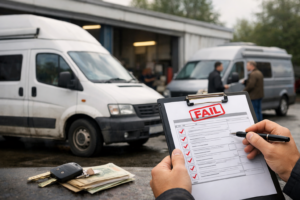
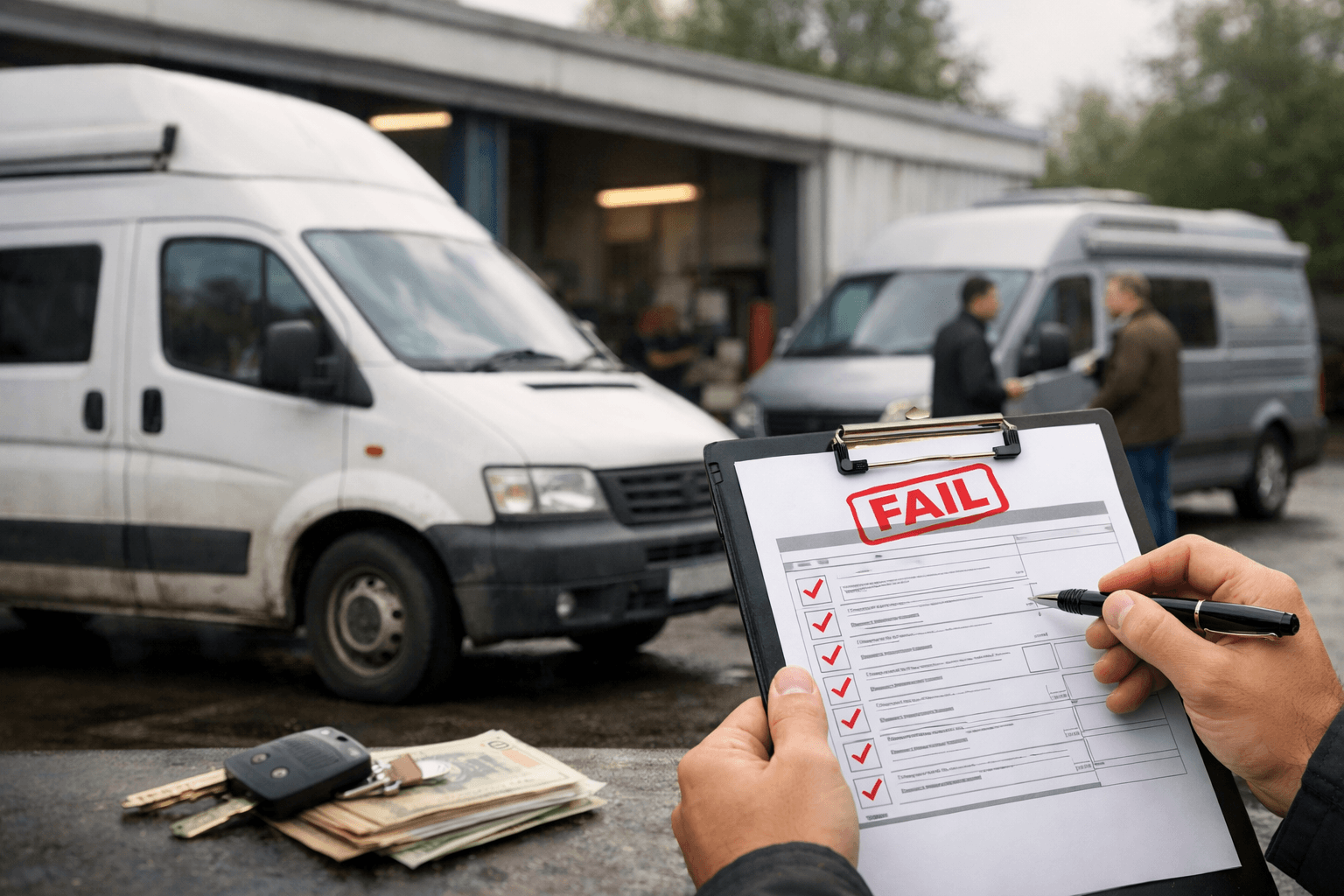
Yes, you can sell a camper van with no MOT in the UK. Selling a vehicle without a valid MOT is entirely legal. What is illegal is driving it on a public road without one. That single distinction changes everything — and most sellers never hear it clearly stated.
If your camper van has been sitting on the driveway for two years, MOT lapsed, tyres slowly deflating, you are not stuck. You have more options than you think. This article tells you exactly what they are, what your vehicle is worth in its current state, and how to decide whether repairing it first makes financial sense.
- Selling a camper van with no MOT is legal in the UK — driving it on public roads without one is not
- You must disclose the lack of MOT to any buyer; misrepresentation is a legal risk under the Consumer Rights Act 2015
- Buyers will discount your asking price to cover MOT costs and anticipated repairs — knowing the numbers lets you negotiate from strength
- A pre-sale inspection report can protect your asking price without the full cost of an MOT
- Whether to repair before selling depends on the vehicle’s age, conversion quality, and current market value — a simple cost-benefit framework helps you decide
Is It Legal to Sell a Camper Van With No MOT in the UK?
Selling a camper van without a valid MOT is perfectly legal. The law restricts driving an unroadworthy vehicle on public roads — it says nothing about changing ownership. Private sellers and trade sellers alike can legally transfer a no-MOT vehicle.
The rules do differ slightly between private and trade sales. A private seller is not required to guarantee roadworthiness, but must not misrepresent the vehicle’s condition. A trade seller — a dealer or business — faces stricter obligations under the Consumer Rights Act 2015 and must ensure goods are of satisfactory quality. Either way, honesty about the MOT status is not optional; it is a legal safeguard for both parties.
Telling a buyer the vehicle “should pass an MOT” when you have no basis for that claim is misrepresentation. If the vehicle subsequently fails and the buyer suffers financial loss, you can face a legal dispute. State the facts. Nothing more.
If your camper van has no MOT and is not being driven, you may need to declare a SORN — Statutory Off Road Notification — with the DVLA. A SORN tells the government the vehicle is kept off public roads. Without it, you remain liable for Vehicle Excise Duty (road tax). A SORNed vehicle can still be sold; the SORN simply transfers to the new keeper or is cancelled when they tax the vehicle.
What Counts as a Camper Van for MOT Purposes?
The DVLA classifies vehicles by body type and weight, and this affects which MOT test category applies. A standard camper van or motorhome under 3,500kg gross vehicle weight falls under Class IV — the same test used for cars and most vans.
Larger conversions over 3,500kg are tested under Class VII, which requires a different test station and slightly different inspection criteria. If you have converted a heavy panel van or a coach-built motorhome, check the V5C logbook for the gross vehicle weight before assuming which class applies.
Home conversions add another layer. A converted van may still be registered as a panel van on the V5C rather than a motorhome. The MOT class follows the registration category, not how you use the vehicle. Check the “body type” field on your V5C — if it reads “motor caravan”, you are in motorhome territory; if it reads “van”, the standard van test applies.
Vehicles manufactured before 1 January 1960 are exempt from MOT requirements entirely. If you own a classic camper van from that era, you can sell and drive it without an MOT — though roadworthiness remains your legal responsibility.
How Does No MOT Affect the Value of Your Camper Van?
No MOT reduces your asking price. Every buyer knows they will need to spend money before they can drive the vehicle legally, and they will subtract that cost — plus a buffer for the unknown — from whatever you are asking.
Here is what a buyer typically calculates:
- MOT test fee: Around £54.85 for a Class IV vehicle (the maximum a test station can charge). Class VII tests are similar in price.
- Minor repairs: Advisories from a previous MOT — worn wiper blades, a cracked light lens, low brake pad thickness — might cost £100–£400 to rectify.
- Major repairs: Structural rust, brake failure, suspension issues, or emissions failures can run into £1,000–£3,000 or more on an older vehicle.
- Risk premium: Buyers who cannot see the vehicle’s current mechanical state add a further discount for uncertainty. Expect 10–20% off market value on a vehicle with no recent MOT history.
The age and conversion quality of the camper van matter enormously here. A well-maintained, high-quality conversion on a relatively modern base vehicle — say, a Mercedes Sprinter or Volkswagen Crafter — loses less value without an MOT than a tired, ageing conversion on a high-mileage base. Buyers can see the quality of the habitation fit-out; it signals how the previous owner treated the mechanical side too.
A pre-sale inspection from an independent mechanic costs £50–£100 and produces a written report. It is not an MOT, but it tells buyers the engine runs, the brakes work, and there are no catastrophic structural issues. That report can protect hundreds of pounds of your asking price.
Where Can You Sell a Camper Van With No MOT?
You have six realistic routes to sale, each with different trade-offs on speed, price, and effort.
Private sale platforms — Facebook Marketplace, Gumtree, and Auto Trader — reach the widest audience. Facebook Marketplace is particularly active for camper vans and costs nothing to list. The downside: private buyers are often nervous about no-MOT vehicles, and you will field time-wasters alongside serious enquiries. Be explicit in the listing title: “Camper van — no MOT, sold as seen.”
Specialist classifieds such as Campervan Finder and Motorhome Fun attract buyers who understand the market and are more comfortable with project vehicles. Listings here tend to attract fewer tyre-kickers.
Part-exchange at a dealership is straightforward. Dealers buy vehicles without MOTs regularly — it is part of their business model. You will not get the best price, but you will get a fast, clean transaction.
Specialist vehicle buying services offer online instant valuations and will collect the vehicle from your driveway. If you want to sell your camper van quickly without the friction of private viewings, this is often the most practical route for a no-MOT vehicle. The price will reflect the vehicle’s condition, but the process is simple.
Auction houses — physical and online — will take a no-MOT vehicle with no questions about roadworthiness. BCA and Manheim run regular commercial vehicle auctions. You pay a seller’s fee, and the price is determined on the day, but the sale completes quickly.
Scrap or salvage buyers are the last resort. If the vehicle has significant structural rust, a seized engine, or repairs that exceed its market value, a scrap buyer will pay based on kerb weight. Expect £150–£400 for a typical camper van shell.
How to Disclose No MOT Status Honestly and Safely
State the no-MOT status in the listing title, not buried in the description. Buyers who find out at the viewing feel misled — and misled buyers either walk away or hammer your price.
Provide the full MOT history via the DVLA’s free online checker at gov.uk/check-mot-history. This shows the date of the last test, the result, any failure reasons, and advisory notices. Sharing this link costs you nothing and demonstrates transparency.
If you know why the MOT lapsed — the vehicle sat unused while you were abroad, or you bought it with an expired MOT — say so. Context reassures buyers. “MOT expired two years ago while in storage; last test passed with only advisory for rear wiper” is far more reassuring than silence.
Use a written bill of sale. Record the vehicle’s registration, the sale price, the no-MOT status, and a statement that the buyer accepts the vehicle in its current condition. Both parties sign. This is your paper trail if any dispute arises later.
“Sold as seen” is not a magic shield. In a private sale it reduces your exposure significantly, but it does not protect you if you have actively misrepresented the vehicle’s condition. Accuracy is your best legal protection.
Can the Buyer Drive the Camper Van Away After Purchase?
No — not legally, unless they are driving directly to a pre-booked MOT test. That single exemption is specific: the vehicle must be going to a test appointment that has already been booked. The buyer cannot make detours or use the vehicle for any other purpose on that journey.
Practical options for your buyer:
- Arrange a transporter or recovery vehicle to collect the camper van
- Tow it on a trailer if the vehicle’s weight and the towing vehicle’s capacity allow
- Book an MOT at a nearby garage and drive directly there under the legal exemption
Being helpful here costs you nothing and smooths the transaction. Knowing a local garage that can fit the vehicle in quickly is a genuine selling point.
Trade buyers may use trade plates — temporary registration plates that allow a vehicle without a valid MOT to be driven on public roads for business purposes. This is relevant only if you are selling to a dealer or trader, not a private individual.
Should You Get an MOT Before Selling?
Sometimes yes. Sometimes no. The answer depends on three numbers: the cost of getting the vehicle to pass, the increase in sale price a valid MOT will deliver, and the vehicle’s current market value.
Here is a straightforward decision framework:
Get the MOT if:
- Repairs needed are minor (under £400) and the vehicle is worth more than £5,000 in good condition
- The base vehicle is modern and desirable (e.g., VW Transporter, Mercedes Sprinter conversion) where a valid MOT significantly widens the buyer pool
- You can afford to wait — a valid MOT attracts buyers who want to drive away immediately, which means more competition and a stronger final price
Sell as-is with no MOT if:
- Estimated repair costs exceed £1,000 and the vehicle’s market value is under £4,000
- The base vehicle is old, high-mileage, or has a history of recurring mechanical issues
- You need a fast sale and cannot absorb the time and cost of repairs
A camper van failed MOT sale is not a distress sale by definition. If the vehicle has a quality conversion, full service history, and only minor mechanical issues, selling with no MOT might cost you £300–£500 off the price. Spending £600 on repairs to recover £300 is the wrong trade.
The no MOT camper van value equation only works in your favour when the repair cost is materially lower than the price premium a valid MOT delivers. Run the numbers for your specific vehicle before booking a mechanic.
If you do decide to repair and test, fix only what is needed to pass. Cosmetic improvements rarely recover their cost at point of sale.
Tips to Get the Best Price When You Sell a Camper Van With No MOT
Price is not set by the MOT status alone. Presentation, documentation, and timing all move the needle.
- Gather every document: service history, conversion receipts, habitation equipment manuals, any recent work invoices. A thick folder of paperwork tells a buyer this vehicle was owned by someone who cared.
- Print the DVLA MOT history. Hand it to every viewer. It removes uncertainty before they ask.
- Clean the vehicle properly — inside and out. A dirty camper van signals neglect. A clean one signals pride of ownership. The difference in buyer perception is disproportionate to the effort.
- Price against comparable no-MOT listings, not against vehicles with a valid certificate. Research Facebook Marketplace and Auto Trader for similar age, base vehicle, and conversion quality.
- Time your sale. Demand for camper vans peaks in spring and early summer — March through June. A no-MOT vehicle listed in April attracts more buyers than the same vehicle listed in November, which can offset the no-MOT discount entirely.
- Highlight recent work. New tyres, a fresh service, new habitation equipment — itemise these in the listing with costs. They justify your asking price and signal mechanical attention.
Avoiding Scams When Selling a No-MOT Camper Van
No-MOT vehicles attract opportunistic buyers. Know your floor price — the minimum you will accept — before you take a single call. Lowball offers are not negotiating; they are a test of whether you are desperate. Do not be.
Watch for fake payment confirmations. A screenshot of a bank transfer is not the same as money in your account. Wait until the funds clear before handing over the keys and V5C logbook.
Meet buyers at your home or a busy public location during daylight hours. A buyer who insists on meeting somewhere remote or at night is a red flag.
Be cautious of buyers who want to send a courier or third party to collect the vehicle without a personal viewing. This is a common scam vector, particularly for vehicles listed at lower prices where the buyer claims to be abroad. Legitimate buyers view before they buy.
Verify identity. Ask to see a driving licence. Note the name and keep a copy of the bill of sale signed by both parties.
Frequently Asked Questions
Is it illegal to sell a camper van without an MOT in the UK?
No. Selling a vehicle without a valid MOT is legal in the UK. It is driving the vehicle on a public road without a valid MOT that is restricted. You must disclose the lack of MOT to the buyer, but the sale itself is entirely lawful.
Can a buyer drive a camper van home if it has no MOT?
Not legally, with one exception. A buyer may drive a vehicle with no MOT directly to a pre-booked MOT test appointment. They cannot use the vehicle for any other purpose on that journey. The practical alternatives are arranging a transporter, towing the vehicle, or booking a nearby MOT and driving there directly under the exemption.
How much does no MOT reduce the value of a camper van?
It depends on the vehicle’s age, condition, and the estimated cost of repairs needed to pass. As a rule of thumb, expect buyers to discount your asking price by the MOT test fee (around £55), estimated repair costs, and a further 10–20% risk premium for uncertainty. A quality conversion on a modern base vehicle loses less value than an older, tired example.
Do I need to tell the buyer my camper van has no MOT?
Yes. Failing to disclose the lack of MOT is misrepresentation and can expose you to legal disputes under the Consumer Rights Act 2015. State the no-MOT status clearly in your listing, at the viewing, and in the written bill of sale.
Can I sell a camper van that is SORNed?
Yes. A SORNed vehicle — one declared off-road with the DVLA — can be sold. The SORN transfers to the new keeper when ownership changes. The buyer will need to either tax the vehicle or declare their own SORN before driving it on public roads.
Does a converted van need an MOT as a camper van or as a van?
The MOT class follows the vehicle’s registration category on the V5C, not how it is used. If the V5C body type reads “motor caravan”, it is tested as a motorhome. If it reads “van”, the standard van test applies. Check your V5C before assuming which class your vehicle falls under.
Are pre-1960 camper vans exempt from MOT requirements?
Yes. Vehicles manufactured before 1 January 1960 are exempt from the MOT requirement in the UK. You can sell and drive a classic camper van of that age without a valid MOT certificate. Roadworthiness remains your legal responsibility regardless of the exemption.
What happens if I sell a camper van and the buyer gets pulled over with no MOT?
Once the sale is complete and the V5C has been transferred, the buyer is the registered keeper and bears responsibility for the vehicle’s legal status. Your obligation ends at the point of sale, provided you disclosed the no-MOT status accurately and did not misrepresent the vehicle’s condition. Keep your signed bill of sale as evidence of what was disclosed.
Should I repair the camper van before selling or sell it as-is with no MOT?
Repair first if the cost of repairs is materially lower than the price premium a valid MOT will deliver, and the vehicle is worth more than £5,000 in good condition. Sell as-is if estimated repairs exceed £1,000 and the vehicle’s market value is under £4,000, or if the base vehicle is old and high-mileage. Run the numbers for your specific vehicle — the answer is different for a quality modern conversion than for an ageing high-mileage base.
If your camper van has no MOT and you want a fast, straightforward sale without the cost and uncertainty of repairs, get a valuation from a specialist buyer first. Know what your vehicle is worth before you decide whether fixing it makes financial sense. That one step puts you in control of the decision — not the other way around.