The Volkswagen Crafter is a large panel van available in a wide range of body styles, engine outputs, and drive configurations — making it one of the most versatile commercial vehicles in its class. Whether you’re a tradesperson needing a reliable daily workhorse, a fleet manager watching cost-per-mile figures, or a converter building a specialist vehicle, the Crafter has a version engineered for your use case.
That’s the short answer. The longer one — the one that actually helps you decide whether to buy, lease, or spec one — is what this guide is for.
- The Volkswagen Crafter is built on VW’s own MAN TGE platform since 2017, offering front-wheel, rear-wheel, and 4MOTION all-wheel drive options
- Payload reaches up to 1,756 kg and load volume up to 18.4 m³ in XLWB high-roof form
- Four TDI diesel engines (102–177 hp) pair with either a 6-speed manual or 8-speed automatic gearbox
- Total cost of ownership over a 3–5 year fleet cycle is where the Crafter competes hardest — residual values and service intervals matter more than sticker price
- An electric e-Crafter exists but remains limited in range and payload for most commercial operators
What Is the Volkswagen Crafter?
The Volkswagen Crafter is VW’s flagship large panel van, sitting above the Transporter in the brand’s commercial vehicle lineup. It first arrived in 2006 as a joint development with Mercedes-Benz — essentially a rebadged Sprinter built at DaimlerChrysler’s Düsseldorf plant. That partnership ended in 2016, and the second-generation Crafter launched in 2017 on an entirely new platform co-developed with MAN: the TGE (Truck Generation E).
The move to the MAN TGE platform was transformative. VW gained full control over the architecture, which meant it could offer something the Sprinter-based original never could: front-wheel drive, rear-wheel drive, and all-wheel drive from a single model family. It also meant VW could engineer cab ergonomics, driver assistance technology, and load space dimensions entirely on its own terms.
The Crafter competes in the large panel van segment alongside the Mercedes-Benz Sprinter, Ford Transit, Renault Master, Vauxhall Movano, and Iveco Daily. Its target buyers are tradespeople, logistics companies, fleet operators, and specialist converters who need maximum payload and load volume in a vehicle that’s genuinely comfortable to drive every day.
Volkswagen Crafter Model Range and Body Styles
The Crafter comes in more configurations than almost any rival. Getting the spec right from the start saves money and frustration — so here’s what’s actually available.
Panel van is the most common body style, available in four wheelbase lengths:
- SWB (Short Wheelbase): Compact footprint, easier urban manoeuvring, lower load volume
- MWB (Medium Wheelbase): The practical middle ground for most trade use
- LWB (Long Wheelbase): Popular with couriers and multi-drop delivery operators
- XLWB (Extra-Long Wheelbase): Maximum load volume, suits high-volume, lower-weight cargo
Roof heights run to three options — low, medium, and high. Low roof suits drivers who regularly use multi-storey car parks. Medium roof allows standing upright for most people. High roof is the choice for any conversion requiring interior headroom: ambulances, welfare units, and mobile workshops.
Beyond the panel van, the Crafter is available as a chassis cab (a flat-fronted cab with an open chassis behind, ready for bespoke bodywork), a double cab (extra seating for crew), and a platform body (a flatbed). Minibus and Kombi configurations carry passengers — the Kombi splits the load bay between cargo and seating.
Drive options span front-wheel drive (FWD), rear-wheel drive (RWD), and 4MOTION all-wheel drive. FWD suits urban and light commercial use. RWD delivers better traction under heavy payload. 4MOTION is for genuinely demanding terrain — more on that later.
Engine and Performance Specifications
The Crafter’s engine lineup is all-diesel, all TDI, and all Euro 6 compliant. Four power outputs cover the range:
- 102 hp / 250 Nm: Entry-level output, adequate for lighter payloads and urban routes
- 122 hp / 340 Nm: The most popular choice for general trade use
- 140 hp / 340 Nm: Suits heavier payloads and regular motorway running
- 177 hp / 410 Nm: Top-spec output for maximum towing or the heaviest conversion builds
Towing capacity reaches up to 3,500 kg on suitably specced variants — competitive for the class and sufficient for most plant trailers and horseboxes.
Transmission choices are a 6-speed manual or an 8-speed automatic. The automatic is genuinely good — smooth, responsive, and well-suited to stop-start urban delivery work where manual gear changes become fatiguing by mid-afternoon.
Real-world fuel consumption sits roughly 10–15% above official WLTP figures under typical loaded conditions, which is consistent with the class. Expect 30–36 mpg in mixed use depending on payload, spec, and driving style. The AdBlue SCR (Selective Catalytic Reduction) system — a diesel exhaust fluid injected into the exhaust stream to reduce nitrogen oxide emissions — keeps the Crafter within Euro 6d standards. AdBlue consumption is roughly 1 litre per 600–700 miles; the tank requires topping up at service intervals or sooner on high-mileage routes.
Running the AdBlue tank dry will prevent the engine from restarting after the next stop. Monitor the dashboard warning seriously — don’t treat it like a low-fuel light with miles of buffer.
Payload, Load Space, and Practicality
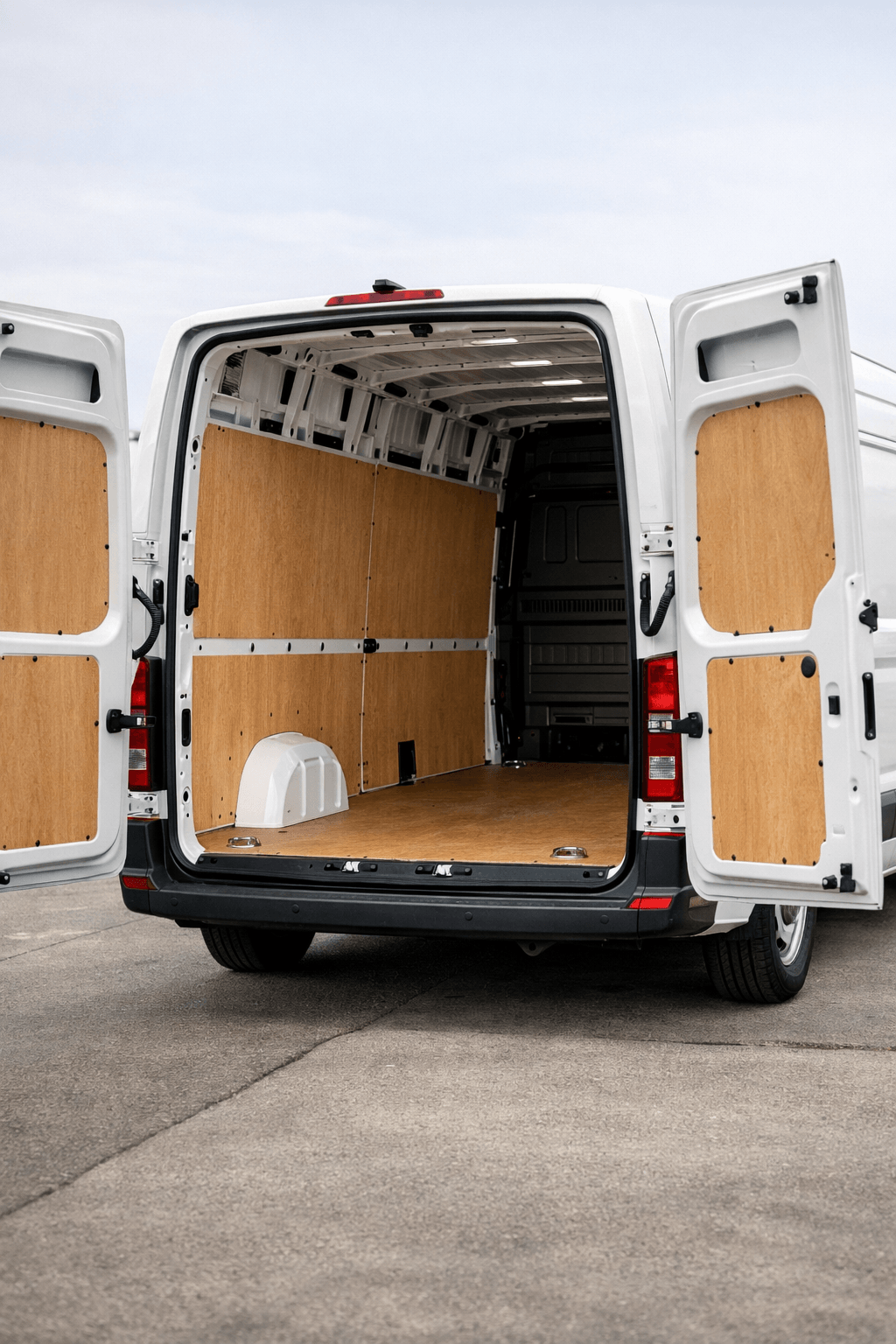
Maximum payload in the Volkswagen Crafter reaches 1,756 kg on specific RWD XLWB variants. That’s class-competitive and sufficient for most trade and logistics applications. Payload varies significantly across the range — FWD models and higher-spec trims with more standard equipment weigh more, reducing available payload. Always check the specific variant’s plate before loading.
Load volume figures:
- SWB low roof: approximately 9.0 m³
- MWB medium roof: approximately 11.3 m³
- LWB high roof: approximately 14.4 m³
- XLWB high roof: up to 18.4 m³ — one of the largest in class
Load bay width between wheel arches is 1,380 mm on FWD models (no rear wheel arch intrusion), which is a genuine practical advantage for sliding in Euro pallets. RWD models have rear wheel arch intrusions that narrow the floor width.
Rear door options matter more than buyers often realise:
- Barn doors (split, opening to 180° or 270°): Better for loading from the rear with a pallet truck; 270° option pins doors flat against the van sides
- Tailgate: More car-like, easier for single-handed operation, but limits rear access width
The sliding side door is standard on the nearside; an offside sliding door is available as an option and is worth specifying for urban multi-drop routes where you’re working from both sides of the vehicle.
Tie-down lashing rings are fitted to the floor, and ply-lining — a wooden panel lining protecting the load bay walls — is either factory-fit or added by converters. It’s worth specifying from new; retrofitting costs more and rarely fits as cleanly.
Cab Technology and Driver Comfort
The Crafter’s cab is where the 2017 redesign made the biggest leap. The previous Sprinter-derived cab felt like a truck. The current generation feels like a premium vehicle — because it largely is.
Infotainment options run from the standard 6.5-inch touchscreen up to the Discover Media (8-inch, with navigation) and Discover Pro (9.2-inch, with higher-resolution mapping and gesture control). All support Apple CarPlay and Android Auto — a basic expectation now, but not universally standard across commercial vehicles even today.
The Digital Cockpit — a fully digital instrument cluster — is available on higher trim levels and replaces analogue dials with a configurable display showing navigation, driver assistance status, and trip data.
Ergonomics are genuinely good. The driver’s seat adjusts for height, reach, and lumbar support. The steering column adjusts for both rake and reach. Drivers who cover 200+ miles daily report significantly less fatigue than in the previous generation — and that matters for operator wellbeing and road safety.
Cab storage is thoughtful: an overhead shelf runs the width of the cab, door pockets are deep enough for a 1-litre bottle, and there’s under-seat storage on the passenger side. It won’t replace a proper van racking system, but it keeps the cab tidy.
Visibility is strong to the front and sides. Rear visibility is limited by the load bay — expected in a panel van — which makes the optional rear-view camera and camera-based mirror system (replacing physical mirrors with external cameras feeding dashboard screens) genuinely useful rather than gimmicky.
Safety Features and Driver Assistance Systems
The Crafter comes with a solid standard safety foundation: ABS, ESP (Electronic Stability Programme), driver and passenger airbags, and seatbelt pre-tensioners. That’s the baseline. The more interesting story is what’s available as standard or optional equipment above it.
Available driver assistance systems include:
- Front Assist with City Emergency Braking: Detects vehicles and pedestrians ahead and can apply emergency braking autonomously
- Lane Assist: Detects unintentional lane departure and provides steering correction
- Adaptive Cruise Control: Maintains set speed and following distance automatically
- Trailer Assist: Guides trailer reversing by detecting jackknife risk and applying corrective steering — genuinely useful for operators who reverse with a trailer infrequently
- Park Assist: Steers automatically into parallel and perpendicular spaces
Crosswind Assist deserves a specific mention. It’s unique to the Crafter in the large van class — the system detects lateral wind forces and applies individual wheel braking to counteract the push. On motorways in exposed conditions, it’s a meaningful safety feature for a high-sided vehicle that catches wind like a sail.
Euro NCAP does not test commercial vehicles under its standard passenger car protocol, so direct star-rating comparisons with cars aren’t possible. However, the Crafter’s driver assistance suite exceeds what most rivals offer at equivalent price points.
4MOTION All-Wheel Drive: Who Actually Needs It?
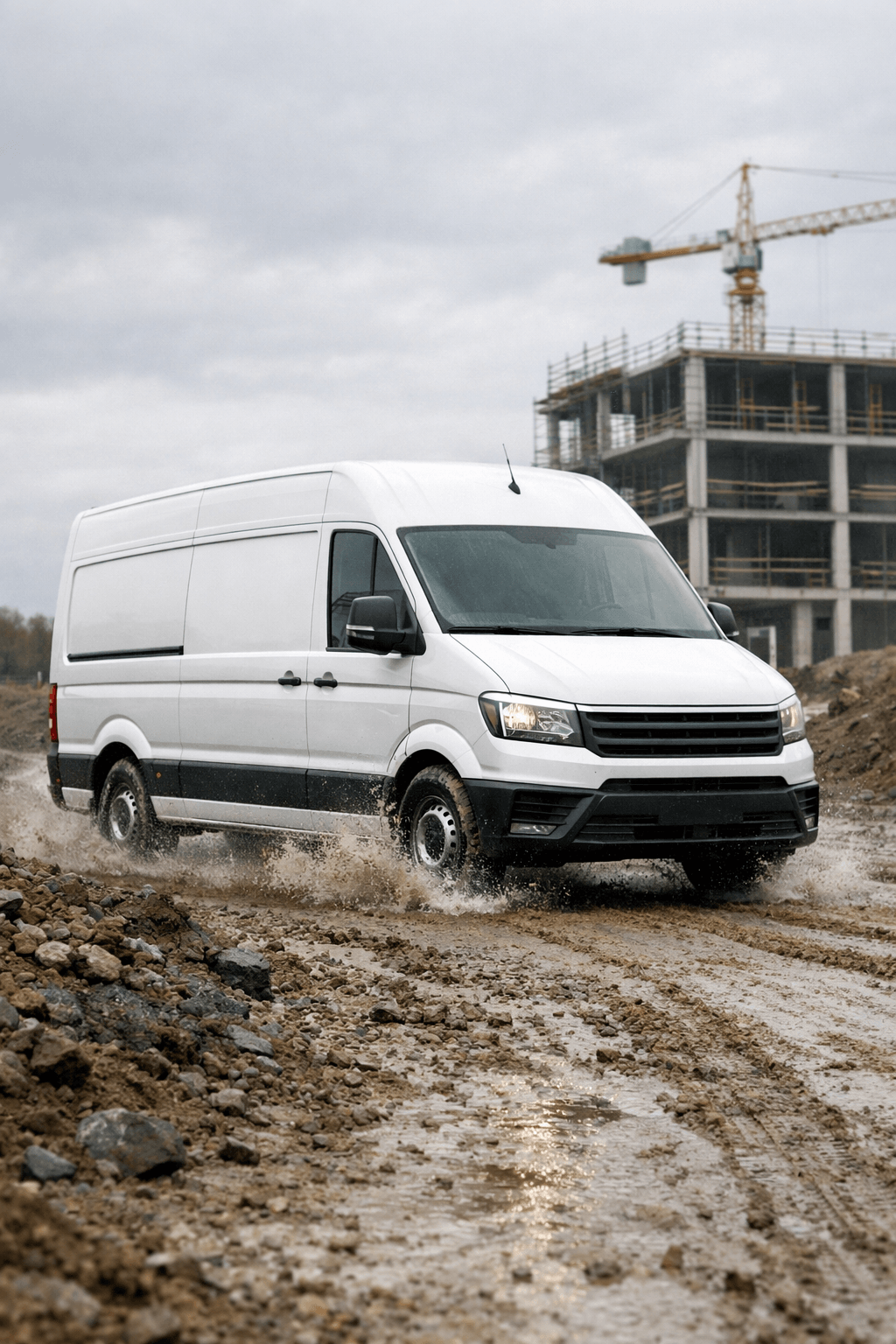
The short answer: fewer operators than you might think — but the ones who do need it, really need it.
The Crafter’s 4MOTION system is a permanent all-wheel drive setup with a Haldex-type multi-plate clutch distributing torque between front and rear axles. It’s not a part-time system you engage manually — it works continuously, biasing drive to whichever axle has the most traction.
Real-world scenarios where 4MOTION earns its place:
- Construction site access: Unmade ground, loose gravel, and soft mud where a FWD or RWD van will spin and sink
- Rural deliveries in winter: Ungritted lanes, farm tracks, and steep inclines with snow or ice
- Utility and infrastructure work: Gas, water, and telecoms engineers working off-road in all conditions
The trade-offs are real. 4MOTION adds weight — reducing payload by approximately 100–150 kg compared to equivalent RWD variants. Fuel consumption increases by roughly 1–2 mpg in typical use. And it’s not available across the full body style range; chassis cab and some specialist configurations don’t offer it.
For purely urban or motorway fleet use, 4MOTION adds cost without adding value. RWD with winter tyres outperforms FWD in most cold-weather traction scenarios and costs less to run. 4MOTION is the right choice when the terrain genuinely demands it — not as a comfort purchase.
Volkswagen Crafter vs. Key Competitors
Here’s where the Crafter sits honestly against its main rivals.
Crafter vs. Mercedes-Benz Sprinter
These two share a common ancestor but have genuinely diverged. The Sprinter retains its rear-wheel drive heritage and a broader engine range including a petrol option. The Crafter’s FWD models offer a flat load floor without rear wheel arch intrusion — a practical advantage for pallet loading. Residual values are close; the Sprinter edges ahead in some used market segments due to stronger brand recognition among private buyers. Dealer network coverage is broadly similar across the UK.
Crafter vs. Ford Transit
The Transit remains the segment benchmark on volume and familiarity. Its payload figures are competitive, its dealer and parts network is arguably the densest in the UK, and its running costs are well-understood by fleet managers. The Crafter counters with a more refined cab, better driver assistance technology as standard, and stronger residual values in the 3–5 year fleet cycle window. The Transit wins on lowest initial list price in some configurations; the Crafter wins on total cost of ownership over time.
Crafter vs. Renault Master and Vauxhall Movano
The Master and Movano (which share a platform) undercut the Crafter on list price and offer competitive load volumes. However, residual values are weaker, and the cab technology feels a generation behind. For operators prioritising upfront cost, they’re credible alternatives. For fleet operators running vehicles for 3–5 years and caring about resale, the Crafter’s stronger residuals close the initial price gap significantly.
Crafter vs. Iveco Daily
The Daily is the payload king — its highest-spec variants exceed 2,000 kg payload, which no Crafter matches. If maximum payload is the primary requirement and cab refinement is secondary, the Daily makes a compelling case. The Crafter wins on driver comfort, technology, and fuel economy. The Daily wins when the job simply requires lifting more weight.
Total Cost of Ownership and Running Costs
This is where most van comparisons fail fleet managers — and where the Crafter’s real competitive case is made.
Residual values are the single biggest variable in fleet TCO calculations. A van that holds its value better costs less to run even if its list price is higher, because the depreciation cost per month is lower. Based on used market data, the Crafter depreciates to approximately 45–50% of list price after 3 years / 60,000 miles under typical fleet conditions. The Ford Transit sits in a similar range; the Mercedes Sprinter can outperform both in certain body styles due to stronger private buyer demand. The Renault Master and Vauxhall Movano typically depreciate to 35–42% of list in the same window — a meaningful difference over a fleet of 20+ vehicles.
Service intervals on the Crafter are up to 2 years or 30,000 miles (whichever comes first) under VW’s flexible service regime. Fixed-interval service plans are available and popular with fleet operators who want predictable cost modelling. Parts pricing sits in the mid-range for the class — not the cheapest (that’s typically the French vans), not the most expensive (that’s the Sprinter for some components).
VW Commercial Vehicles offers service plans that fix the cost of scheduled maintenance at the point of purchase. For fleet operators running 10+ vehicles, locking in parts and labour costs at today’s prices removes a significant budget variable over a 3–5 year cycle.
A simplified TCO model for a single LWB high-roof Crafter 140 hp manual over 3 years / 90,000 miles, versus equivalent Transit and Sprinter:
| Cost Element | VW Crafter | Ford Transit | Mercedes Sprinter |
|---|---|---|---|
| Typical list price (exc. VAT) | ~£35,000 | ~£33,500 | ~£36,500 |
| Residual value (3yr/60k) | ~£16,500 | ~£15,500 | ~£17,000 |
| Depreciation cost | ~£18,500 | ~£18,000 | ~£19,500 |
| Service costs (3yr) | ~£2,400 | ~£2,100 | ~£2,800 |
| Fuel (90k miles @ 33mpg avg) | ~£12,200 | ~£12,500 | ~£12,000 |
| Estimated 3yr TCO | ~£33,100 | ~£32,600 | ~£34,300 |
Figures are illustrative estimates based on publicly available pricing and industry residual value data. Actual costs vary by spec, usage profile, and fuel prices at time of operation. Always model against your specific fleet data.
The Crafter and Transit are effectively neck-and-neck on 3-year TCO. The Sprinter costs more. The French vans cost less upfront but lose more in depreciation. For most fleet operators, the Crafter’s combination of lower depreciation than the Sprinter and better cab technology than the Transit makes it the rational choice when total cost — not just purchase price — drives the decision.
Insurance group ratings vary across the Crafter range. Lower-powered FWD variants attract lower group ratings; the 177 hp 4MOTION models sit at the higher end. Fleet insurance typically negotiates rates below standard market pricing, so individual group ratings matter less for large fleets than for owner-operators.
Volkswagen e-Crafter and the Electric Future
The e-Crafter exists — but it’s honest to say it remains a niche product rather than a mainstream fleet solution at this point.
The current e-Crafter is based on the same MAN TGE platform as the diesel. Its electric motor produces 136 hp and 290 Nm, with a 35.8 kWh battery delivering a WLTP range of approximately 107 miles. Real-world urban range is closer to 80–90 miles under load. Payload is approximately 975 kg — significantly below the diesel’s maximum, because the battery pack adds weight.
Charging capability supports AC charging at up to 7.2 kW (roughly a 5–6 hour full charge from empty) and DC rapid charging at up to 40 kW (approximately 45 minutes to 80%). That’s adequate for urban depot-to-depot operations with overnight charging but insufficient for multi-drop routes covering more than 80 miles per shift.
The e-Crafter suits urban last-mile delivery fleets operating from a fixed depot, covering predictable daily mileages within its range window. Food delivery, local authority services, and city-centre courier operations are the natural fit. For anything beyond that, the diesel remains the practical choice.
Government grants for electric light commercial vehicles in the UK (via the Plug-in Van Grant) currently offer up to £5,000 off qualifying models, reducing the e-Crafter’s significant price premium over the diesel. Operators in Clean Air Zones also benefit from avoiding daily charges — a real operational saving for urban fleets.
VW has confirmed next-generation electric Crafter development as part of its broader commercial vehicle electrification programme, with an updated platform expected to address range and payload limitations. Timing for UK market availability has not been confirmed at the time of writing.
The electric van market is moving quickly. Check current grant availability directly with the Office for Zero Emission Vehicles (OZEV) before making a purchasing decision — grant thresholds and eligibility criteria change.
Popular Conversions and Specialist Uses
The Crafter’s chassis cab and platform body options make it one of the most conversion-friendly large vans on the market. Its flat floor, wide body, and available high-roof variants give converters a genuinely flexible starting point.
Common conversion types:
- Refrigerated van: Temperature-controlled lining and refrigeration unit fitted to the load bay. Popular for food retail delivery, pharmaceutical distribution, and catering supply. The Crafter’s load volume makes it efficient for chilled multi-drop routes.
- Luton box body with tail-lift: A box body extending over the cab, combined with a hydraulic tail-lift at the rear. Standard configuration for removals companies and furniture delivery. The Crafter chassis cab handles the structural demands well.
- Welfare unit / site office: A self-contained unit with seating, heating, toilet facilities, and sometimes a generator. Common on construction sites. The XLWB chassis provides enough length for a practical welfare spec.
- Ambulance and emergency vehicle: The Crafter is a certified base vehicle for ambulance conversions in several European markets. Its structural integrity, available power outputs, and high-roof headroom make it suitable for patient transport and emergency response builds.
- Campervan and motorhome base: The Crafter has become genuinely popular as a campervan base — particularly the LWB and XLWB high-roof variants, which offer enough internal volume for a standing-height living space. The MAN TGE platform’s reliability and parts availability across Europe make it practical for touring use. VW’s own California XXL concept (based on the Crafter) demonstrated the platform’s potential, though production versions remain a niche market.
If you’re buying a Crafter for conversion, specify the chassis cab from new rather than cutting down a panel van body. Factory chassis cabs are structurally prepared for bodywork attachment; modified panel vans can create warranty and structural complications.
Buying Guide: New, Used, or Lease?
New Crafter pricing and trim levels
The Crafter is available in three main trim levels in the UK:
- Startline: Base specification with the essentials — 6.5-inch infotainment, rear parking sensors, and core safety systems. The working van spec.
- Trendline: Adds comfort and convenience features including climate control, upgraded infotainment, and additional driver assistance options
- Highline: Top trim with Digital Cockpit, leather steering wheel, premium audio, and the widest driver assistance suite
New list prices (excluding VAT) start from approximately £30,000 for a Startline SWB FWD and rise to £45,000+ for a Highline XLWB 4MOTION automatic. Significant fleet discounts are available for volume orders — negotiate directly with VW Commercial Vehicles fleet sales rather than accepting dealer list pricing.
What to check when buying a used Volkswagen Crafter
Used Crafter buying requires attention to a specific checklist:
- AdBlue system: Check for warning lights and confirm the SCR system is functioning. Repairs can be costly.
- DSG/automatic gearbox: If buying an automatic, check for smooth shifts across all gears and no hesitation from cold. Early examples had software calibration issues.
- Rust: Check around the rear door hinges, underside of the load bay floor, and wheel arches — particularly on vehicles used in coastal or heavily salted road environments.
- Timing belt/chain: The TDI engines use a timing belt. Confirm service history shows belt replacement at the manufacturer’s recommended interval.
- Conversion history: If buying a converted vehicle, check that the conversion was carried out by a certified converter and that the vehicle’s payload plate reflects the conversion weight.
Common issues and known reliability concerns
The second-generation Crafter (2017 onwards) has a stronger reliability record than the first generation. Known issues to be aware of:
- AdBlue system faults: Sensor failures and SCR catalyst issues have been reported, particularly on higher-mileage examples
- Infotainment software glitches: Early Discover Pro units had occasional software freezes, largely resolved by dealer software updates
- Rear door seal wear: On high-mileage examples, rear door rubber seals can deteriorate, allowing water ingress into the load bay
Overall, the Crafter’s reliability in fleet use is competitive with the class. It’s not the most bulletproof van ever built, but it’s far from the most troublesome.
Finance options for businesses
- Contract hire (operating lease): Fixed monthly payments, no residual value risk, van returned at end of term. Popular for fleets wanting predictable costs and regular vehicle refresh cycles.
- Finance lease: Similar to contract hire but the business retains residual value risk. Can be more cost-effective if the van holds its value well — which the Crafter does.
- Outright purchase: Maximum control, no mileage restrictions, full asset ownership. Best for operators running vehicles beyond 5 years or high-mileage routes where contract hire penalties become expensive.
VAT-registered businesses can reclaim 100% of VAT on a commercial vehicle purchase — a significant real cost reduction versus the headline list price. A £35,000 + VAT Crafter costs a VAT-registered business £35,000, not £42,000. Factor this into any lease-versus-buy comparison.
VW’s Approved Used Commercial Vehicles programme offers used Crafters with a 12-month warranty (extendable), a 112-point inspection, and roadside assistance. It’s worth the slight price premium over an unwarranted private purchase for operators who need reliability guarantees.
Frequently Asked Questions
What is the maximum payload of the Volkswagen Crafter?
The maximum payload of the Volkswagen Crafter is 1,756 kg, available on specific rear-wheel drive XLWB variants. Payload varies across the range — FWD models and higher trim levels with more standard equipment typically offer lower payload figures. Always check the individual vehicle’s plate for the confirmed payload before loading.
What engines are available in the Volkswagen Crafter?
The Crafter is available with four TDI diesel engine outputs: 102 hp, 122 hp, 140 hp, and 177 hp. All are Euro 6 compliant and use an AdBlue SCR system to manage nitrogen oxide emissions. There is also an electric e-Crafter variant with a 136 hp motor, though it remains a limited-availability product.
Is the Volkswagen Crafter available with automatic transmission?
Yes. The Crafter is available with an 8-speed automatic gearbox across most engine and drive configurations. It’s a smooth, well-calibrated unit well-suited to urban multi-drop work. The alternative is a 6-speed manual.
How does the Volkswagen Crafter compare to the Mercedes Sprinter?
The Crafter and Sprinter share a common ancestor (the first-generation Crafter was a rebadged Sprinter) but are now entirely separate vehicles. The Crafter offers front-wheel drive — which the Sprinter doesn’t — giving it a flat load floor advantage on FWD models. The Sprinter has a broader engine range and slightly stronger residual values in some used market segments. On 3-year total cost of ownership, the Sprinter typically costs more to run than the Crafter, primarily due to higher service and parts costs.
Does the Volkswagen Crafter come in 4-wheel drive?
Yes. The Crafter is available with 4MOTION all-wheel drive across a range of body styles and engine combinations. The system is permanent AWD with a Haldex-type multi-plate clutch. It’s best suited to construction, rural delivery, and utility work where terrain demands it — it adds weight and reduces payload by approximately 100–150 kg compared to equivalent RWD variants.
What is the load volume of the Volkswagen Crafter in cubic metres?
Load volume ranges from approximately 9.0 m³ in SWB low-roof form up to 18.4 m³ in XLWB high-roof configuration — one of the largest in the large panel van class.
Is there an electric version of the Volkswagen Crafter?
Yes — the e-Crafter has a WLTP range of approximately 107 miles and a payload of around 975 kg. It suits urban last-mile delivery operations with overnight depot charging. For longer routes or heavier payloads, the diesel remains the practical choice. VW has confirmed next-generation electric Crafter development, though UK market timing is unconfirmed.
What are the most common problems with the Volkswagen Crafter?
On the current generation (2017 onwards), the most reported issues are AdBlue system sensor faults, occasional infotainment software glitches on early Discover Pro units (largely resolved by software updates), and rear door seal deterioration on high-mileage examples. Overall reliability is competitive for the class.
Can the Volkswagen Crafter be used as a campervan base?
Yes — the Crafter is a popular campervan conversion base, particularly in LWB and XLWB high-roof form. The high-roof variants provide standing height, and the MAN TGE platform’s reliability and parts availability across Europe make it practical for touring. Numerous professional converters specialise in Crafter-based motorhome builds.
What is the towing capacity of the Volkswagen Crafter?
The Crafter’s maximum towing capacity is 3,500 kg on suitably specced variants. This is sufficient for most plant trailers, horseboxes, and large equipment trailers. Towing capacity varies by engine, drive configuration, and body style — check the specific variant’s towing limit before hitching.
If you’re ready to explore Crafter options for your business — whether that’s a single trade van or a fleet of 50 — speaking directly with a VW Commercial Vehicles fleet specialist will get you accurate pricing, current availability, and service plan options tailored to your operation. Use VW’s official dealer locator to find your nearest commercial vehicle centre.