
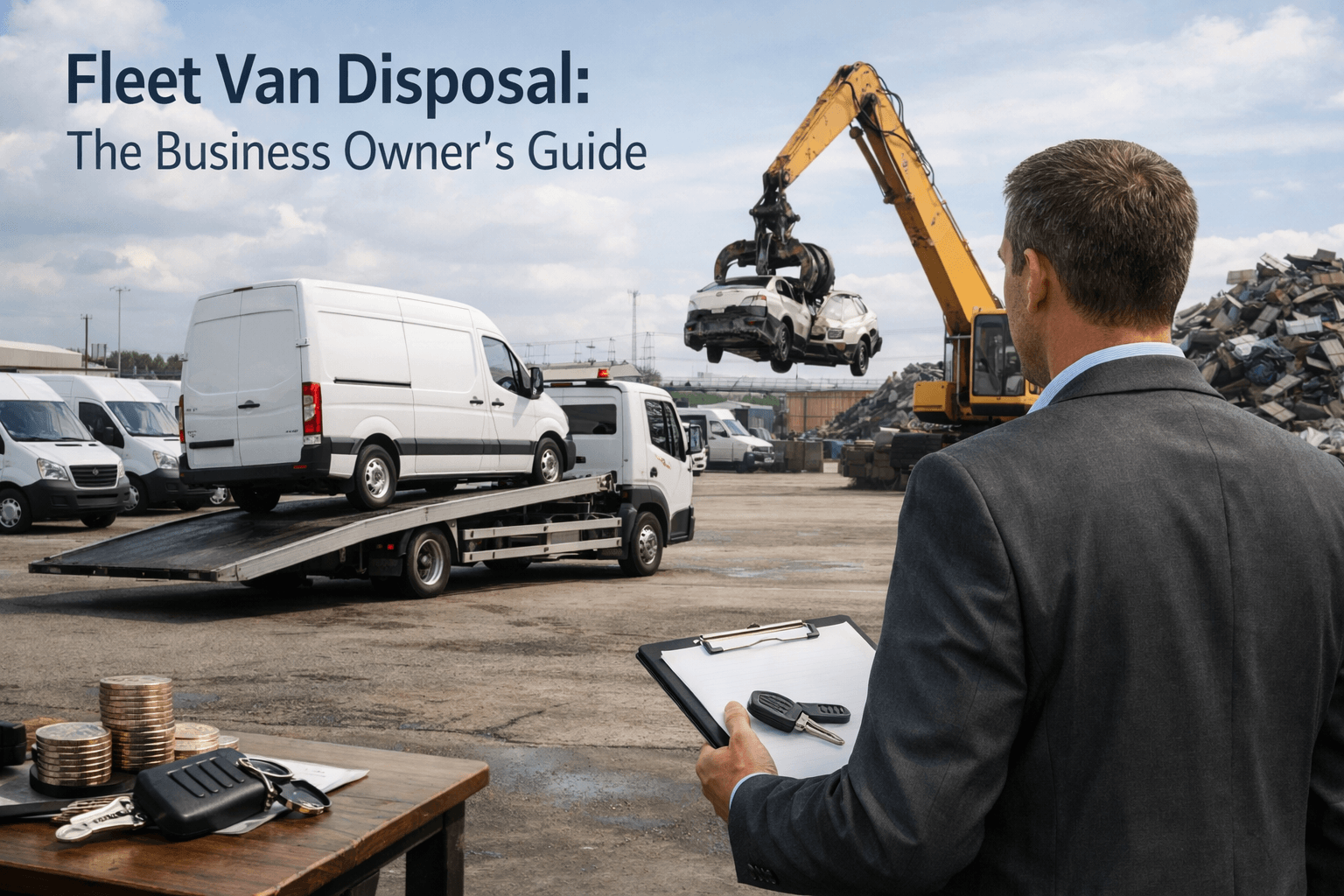
Fleet van disposal in the UK means more than just selling off old vans when you’re done with them. Done well, it’s a structured process that protects your cash flow, keeps you compliant with HMRC and the DVLA, and maximises the return on assets your business has already paid for. Done badly, it costs you money in ways that don’t show up until year-end — and sometimes not until a fine lands on your desk.
This guide covers everything UK business owners and fleet managers need to know: when to dispose, how to value your vans, which disposal route fits your situation, what the taxman expects, and how to handle the growing complexity of mixed ICE and electric fleets.
If you manage more than five vans, the difference between a reactive and a structured disposal policy is typically thousands of pounds per vehicle cycle. The maths compounds fast.
What Is Fleet Van Disposal and Why Does It Matter?
Fleet van disposal is the structured process of removing commercial vehicles from a business’s operational fleet — covering everything from valuation and sale through to DVLA notification, finance settlement and tax treatment. It’s not just “selling a van.” It’s an asset management decision with financial, legal and operational consequences.
Poor disposal timing hits businesses in two directions at once. Hold a van too long and you absorb rising maintenance costs, increased downtime and accelerating depreciation — all while the residual value you could have captured quietly evaporates. Dispose too early and you leave usable asset life on the table and trigger unnecessary replacement spend.
There are also compliance risks most businesses underestimate. Failing to notify the DVLA promptly, disposing through an unauthorised facility, or leaving telematics data on a sold vehicle can each create liability that outlasts the van itself.
This guide covers the main disposal routes — direct sale, trade auction, fleet remarketing specialists, part exchange, and scrappage — along with the tax, legal and operational considerations that apply to each.
When Is the Right Time to Dispose of a Fleet Van?
The right time to dispose of a fleet van is when its total cost of ownership — including maintenance, downtime, fuel and depreciation — exceeds the cost of replacing it with a newer equivalent. That crossover point is earlier than most businesses assume.
Industry benchmarks put the typical fleet van replacement cycle at three to five years, or between 80,000 and 120,000 miles, depending on use intensity. These aren’t arbitrary numbers. They reflect where depreciation curves flatten and maintenance costs begin to accelerate — the two lines cross, and holding on past that point destroys value.
Total cost of ownership (TCO) analysis is the most reliable disposal trigger. When a single repair bill exceeds the van’s monthly depreciation cost, or when unplanned downtime is measurable in lost revenue days, the economics have already shifted.
Timing also interacts with the market. Q1 (January to March) and Q3 (July to September) typically see stronger demand for used commercial vehicles in the UK, as traders and sole traders restock ahead of busy periods. Disposing in Q4, when buyer appetite softens, can shave meaningful value off your achieved price.
Watch for these signals that a van has passed its economically viable point:
- MOT advisories becoming MOT failures within 12 months
- Unplanned workshop visits more than twice per quarter
- Fuel consumption measurably above the manufacturer’s rated figure
- Downtime frequency affecting customer delivery commitments
- Repair estimates exceeding 30% of current market value
Understanding Your Van’s Residual Value Before Disposal
Your fleet van’s residual value is determined by a combination of make and model desirability, mileage, condition, service history completeness, and current market demand for that body type. No single factor dominates — they interact.
For accurate valuations, use CAP HPI or Glass’s Guide — the two industry-standard trade valuation tools used by dealers, auction houses and finance companies across the UK. These give you a realistic trade value rather than the optimistic retail figures you’ll see on AutoTrader. Knowing the difference before you enter any negotiation matters.
Body type and spec affect marketability significantly. A refrigerated van or a Luton with a tail lift has a narrower buyer pool than a standard panel van, which can suppress achieved price at general auction — but may command a premium through specialist remarketing channels where the right buyers are actively looking.
Pre-sale preparation has a measurable return. A full service history pack, a professional valet and minor cosmetic repairs consistently add value — often £300–£800 per unit at trade level, more at retail. The cost of a valet is rarely more than £100.
Common mistakes businesses make when estimating fleet worth:
- Using retail listings as a proxy for trade value (they’re not the same)
- Ignoring condition adjustments — CAP values assume a specific condition standard
- Forgetting that outstanding finance reduces net proceeds, not gross value
- Assuming all vans in the fleet are worth the same because they’re the same model
Fleet Van Disposal Routes: Pros, Cons and Best Fit
The best disposal route depends on how many vans you’re moving, how quickly you need the cash, and how much internal resource you can dedicate to the process. There is no universally right answer — but there are clearly wrong ones for each situation.
Part exchange with a dealer is fast and simple, but you’ll pay for that convenience in the form of a lower return. It works well for volume fleets where administrative simplicity has genuine value, but it’s rarely the highest-return option.
Trade auction houses — BCA and Manheim are the two dominant platforms in the UK — offer genuine market pricing, a large buyer pool and fast turnaround. Expect fees of 5–8% of the hammer price. The achieved price reflects real demand, which is both the strength and the risk: if the market is soft the week your van goes through, you feel it.
Direct private sale offers the highest potential return but is time-intensive and doesn’t scale. Suitable for one or two vans; impractical for a fleet of ten or more without dedicated resource.
Fleet disposal specialists and remarketing companies provide a managed service — valuation, logistics, sale channel selection and administration — typically in exchange for a management fee or margin on achieved price. For fleets above ten units, the time saving usually justifies the cost.
Van buying services — companies that make an instant offer and collect — offer maximum convenience at a predictable, if modest, price. If you’re looking to sell your entire fleet quickly without the overhead of managing multiple channels, this route removes the operational friction entirely. It’s not the highest return, but for businesses where management time is the binding constraint, it’s a rational choice.
Scrappage and end-of-life vehicle (ELV) disposal applies to vans that are beyond economical repair or have failed a structural inspection. You must use an Authorised Treatment Facility (ATF) — more on that in the legal section.
| Disposal Route | Speed | Effort | Likely Return | Best Fleet Size |
|---|---|---|---|---|
| Part exchange | Fast | Low | Below trade | Any |
| Trade auction | Medium | Medium | Trade | 5+ |
| Private sale | Slow | High | Retail | 1–2 |
| Fleet specialist | Medium | Low | Trade–retail | 10+ |
| Van buying service | Very fast | Very low | Below trade | Any |
| Scrappage (ATF) | Fast | Low | Scrap only | Any |
DVLA and Legal Obligations When Disposing of Fleet Vans
When you dispose of a fleet van, you must notify the DVLA immediately — not after the sale completes, not at month-end. For business-registered vehicles, this means completing the relevant section of the V5C (the vehicle logbook) and sending it to the DVLA, retaining your portion as proof of transfer. Failure to do so leaves you legally responsible for anything that happens to that vehicle after it leaves your possession.
If the van is being scrapped, you must use an Authorised Treatment Facility — a DVLA-registered site legally permitted to process end-of-life vehicles. The ATF will issue a Certificate of Destruction (CoD), which formally removes the vehicle from your name and confirms it has been disposed of in compliance with environmental regulations. Keep this document. Without it, you remain the registered keeper.
Outstanding finance is a critical pre-disposal step. A van with a finance agreement cannot be legally sold to a third party without the lender’s consent and settlement of the outstanding balance. Selling a vehicle with undisclosed finance is a criminal offence under the Theft Act 1968. Check with your finance provider before advertising any vehicle.
Data security is an area most businesses overlook entirely. Telematics units, GPS trackers and onboard systems can hold driver behaviour data, route history and even business addresses. Remove or factory-reset all such systems before disposal — both for data protection compliance under UK GDPR and to protect commercially sensitive information.
Before disposal, also check for:
- Outstanding road tax (you can claim a refund for unused full months)
- ULEZ or Clean Air Zone charges registered to the vehicle
- Unpaid Penalty Charge Notices (PCNs) — these transfer with the vehicle if unresolved
Tax Implications of Fleet Van Disposal for UK Businesses
When you sell a fleet van, the proceeds affect your capital allowances position — and getting this wrong is one of the most common year-end surprises for SME owners.
Commercial vans typically qualify for capital allowances under the main pool or special rate pool, depending on their CO₂ emissions and use. When you dispose of a van, the sale proceeds are deducted from the pool value. If the pool goes negative — meaning the disposal value exceeds the remaining written-down value — HMRC treats the difference as a balancing charge, which is added back to your taxable profits. This can create an unexpected tax liability if you haven’t modelled it in advance.
VAT treatment depends on how the van was originally purchased. If your business reclaimed input VAT when it bought the van, you must charge output VAT at 20% when you sell it. If input VAT was not reclaimed (for example, because the van had some personal use), the sale may be VAT-exempt. Get this wrong and you either undercharge VAT — creating a liability — or overcharge it and create an admin problem for the buyer.
Benefit-in-kind (BIK) applies where a van has been made available for private use by an employee. If this is the case, ensure the BIK position has been correctly reported through payroll before disposal, as HMRC may query the asset’s history.
If your business is mid-year and you’re disposing of several vans simultaneously, the combined balancing charges could push your taxable profit materially higher than forecast. Run the numbers with your accountant before committing to a disposal date.
The Annual Investment Allowance (AIA) position should also be reviewed if you’re planning to buy replacement vans in the same tax year — the interaction between disposal proceeds and new AIA claims can be optimised with basic planning.
Preparing Your Fleet Vans for Disposal to Maximise Value
Preparation before disposal consistently produces a better return — and the cost is almost always justified. A professionally valeted van with a complete service history and no visible damage achieves a meaningfully higher trade price than the same van presented poorly.
The ROI of pre-sale preparation is straightforward. A full valet costs £60–£120. Minor cosmetic bodywork repairs — small dents, scuffs, kerbed alloys — typically cost £150–£400 per van through a mobile repair specialist. The uplift in achieved trade price regularly exceeds these costs by a factor of two or three.
Service history is the single most valuable document you can present with a van. A full, stamped service history — or a verifiable digital equivalent — signals to buyers that the vehicle has been maintained correctly and reduces their perceived risk. Buyers pay more for certainty.
Racking and shelving: remove it if it’s standard steel racking with no specialist value, as most buyers don’t want it and it makes the van look used. Leave it if it’s high-quality, purpose-built racking that a trade buyer in the same sector would value — and photograph it clearly.
Livery removal is almost always worth doing before sale. Wrapped livery can be removed relatively cheaply; painted livery is harder, but even a partial removal or a professional wrap-over improves presentation and broadens the buyer pool.
Pre-sale inspection checklist for fleet managers:
- Full valet inside and out
- Tyre condition and tread depth (replace if below 3mm)
- All lights functioning
- Service history pack complete and accessible
- V5C located and correct keeper details confirmed
- Telematics and GPS removed or reset
- Racking/livery decision made and actioned
- Finance settlement figure confirmed
- Any outstanding MOT advisories noted and disclosed
Managing Fleet Van Disposal at Scale: Process and Policy
For businesses running five or more vans, disposal decisions should not be made ad hoc. A written fleet disposal policy — setting out replacement triggers, approved disposal routes, authorisation levels and record-keeping requirements — removes inconsistency and protects the business from decisions made under time pressure.
Fleet management software (tools like Chevin FleetWave, Jaama Key2, or even a well-structured spreadsheet for smaller fleets) allows you to track each vehicle’s age, mileage, maintenance spend and depreciation position in one place. Set disposal triggers — for example, “review when maintenance spend in a rolling 12 months exceeds £X” — so decisions are prompted by data rather than gut feel.
Batching disposals is a genuinely underused lever. If you have six vans approaching disposal trigger points within the same quarter, disposing of them as a batch gives you negotiating power with auction houses, fleet specialists and van buying services that disposing of them one at a time does not. Volume creates leverage.
KPIs worth tracking at the fleet level:
- Days to sell — from disposal decision to funds received
- Achieved vs. guide price — how your actual returns compare to CAP/Glass’s valuations
- Admin cost per unit — internal time plus any fees, per vehicle disposed
- Downtime in final three months of ownership — a lag indicator of disposal timing quality
If your business is currently transitioning to electric vans, your ICE disposal strategy needs to account for the transition timeline — covered in detail in the next section.
Electric and Hybrid Van Disposal: What’s Different?
Electric van disposal is genuinely different from ICE van disposal — and most fleet disposal guides don’t address it. If you’re running a mixed fleet and planning a phased transition to electric, the sequencing of your ICE disposals matters more than most businesses realise.
Current residual values for used electric vans in the UK remain volatile. Battery degradation uncertainty, range anxiety among used-van buyers, and the relatively thin secondary market for electric LCVs all suppress prices compared to equivalent ICE vans. This is changing — but slowly.
Battery health is the single biggest factor in used EV van values. A battery state of health (SoH) assessment — which measures remaining capacity as a percentage of original — is the EV equivalent of a service history. Buyers want to see it. Vans with a documented SoH above 80% achieve meaningfully better prices than those without any health data at all, because uncertainty is priced in as a discount.
The mixed-fleet sequencing problem is something almost no disposal guide addresses. If your business is running, say, 20 vans and plans to replace ten with EVs over 18 months, the order in which you dispose of your ICE vans matters. Disposing of all your highest-mileage ICE vans simultaneously floods the local market with similar stock, suppresses your own achieved prices, and signals to buyers that you’re a motivated seller. Stagger disposals — ideally across different quarters and through different channels — to protect residual values across the batch.
Specialist EV remarketing channels are worth using. General auction houses have improving EV capability, but platforms and dealers who specifically handle electric commercial vehicles attract buyers who understand the technology and are less likely to discount for uncertainty. For Renault Kangoo E-Tech, Ford E-Transit Custom or Vauxhall Vivaro Electric disposals, check whether the manufacturer has an approved used or buyback scheme — some OEMs offer this to fleet customers and it can simplify the process.
The longer-term outlook for EV van residuals is cautiously positive. As charging infrastructure improves, battery longevity becomes better understood, and the used EV buyer pool deepens, residual values should stabilise. Businesses disposing of early EV fleet vehicles now should document battery health carefully — it will matter to the next owner, and to the owner after that.
Common Fleet Van Disposal Mistakes and How to Avoid Them
The most expensive fleet disposal mistakes are the ones that compound quietly — wrong timing, missed compliance steps, or a tax surprise that arrives six months after the van has gone.
Disposing too late is the most common. Businesses hold vans past the depreciation cliff because disposal feels like admin, and the van is still running. By the time it fails an MOT or suffers a major mechanical failure, the residual value has collapsed and the repair-vs-sell calculation has been made by circumstance rather than strategy.
Failing to settle finance before advertising creates legal exposure. A van sold with outstanding finance can be repossessed from the buyer, creating a dispute that comes back to the selling business. Always obtain a settlement figure before any disposal route is engaged.
Not comparing disposal routes is a version of leaving money on the table. The difference between a trade auction achieved price and a part-exchange offer on the same vehicle can be 10–20%. For a van worth £12,000, that’s £1,200–£2,400 per unit.
Ignoring DVLA notification leaves you liable for road tax, PCNs and — in worst cases — offences committed in the vehicle after it’s left your possession. The notification takes minutes. Not doing it is an entirely avoidable risk.
Underestimating the tax impact — specifically balancing charges — catches businesses out at year-end. If you’re disposing of multiple vans in a single tax year, model the capital allowances impact before you commit to disposal dates.
Overlooking data security on telematics and driver behaviour systems is a UK GDPR issue, not just a commercial one. Driver data is personal data. If it leaves your business on a sold vehicle, you may have a reportable data breach.
- Dispose based on TCO analysis and depreciation curves, not convenience — the optimal window is typically 3–5 years or 80,000–120,000 miles
- Always compare at least two disposal routes before committing — the price difference between routes on the same vehicle can be 10–20%
- Settle finance, notify the DVLA and strip telematics before any disposal completes
- Model capital allowances and VAT treatment before disposal, not after — balancing charges can create unexpected tax liabilities
- For mixed ICE/EV fleets, stagger ICE disposals across quarters and channels to protect residual values, and document battery SoH for every EV before sale
Frequently Asked Questions
What is the best way to dispose of fleet vans in the UK?
The best disposal route depends on fleet size, urgency and internal resource. For five or more vans, trade auction houses (BCA, Manheim) or fleet remarketing specialists typically deliver the best balance of return and efficiency. For one or two vans where time is available, direct private sale maximises return. For immediate, low-admin disposal, a van buying service offers speed at a modest price reduction.
How do I notify the DVLA when disposing of a company van?
Complete the relevant section of the V5C logbook and send it to the DVLA as directed on the form. Retain your portion as proof of transfer. If the van is being scrapped, the Authorised Treatment Facility will handle DVLA notification as part of the Certificate of Destruction process. Do this immediately on disposal — not at month-end.
Do I pay VAT when selling a fleet van?
If your business reclaimed input VAT when the van was purchased, you must charge output VAT at 20% on the sale proceeds. If input VAT was not reclaimed — typically where the van had personal use — the sale may be outside the scope of VAT. Confirm the correct treatment with your accountant before invoicing the buyer.
What happens to capital allowances when I sell a business van?
The disposal proceeds are deducted from your capital allowances pool. If the pool value drops below zero — meaning proceeds exceed the remaining written-down value — HMRC treats the difference as a balancing charge, which is added to your taxable profits. This can create a tax liability if not anticipated. If the pool remains positive, the remaining balance continues to attract allowances in future years.
How much is my fleet van worth before disposal?
Use CAP HPI or Glass’s Guide for a realistic trade valuation. Retail listings on platforms like AutoTrader will show higher figures, but these reflect private sale prices after dealer margin — not what you’ll achieve at trade level. Condition, mileage, service history and body type all affect the final figure. Get two or three valuations before committing to any disposal route.
Can I scrap a fleet van and what do I need to do legally?
Yes. You must use an Authorised Treatment Facility (ATF) — a DVLA-registered site legally permitted to process end-of-life vehicles. The ATF will issue a Certificate of Destruction, which formally removes the vehicle from your name and confirms compliant disposal. Keep the CoD permanently. Using an unauthorised scrapper leaves you as the registered keeper and creates environmental liability.
Is it better to part-exchange or auction fleet vans?
For most fleets, auction achieves a better price — typically 10–20% more than a part-exchange offer on the same vehicle. Part exchange wins on speed and simplicity, and may be appropriate where the dealer relationship or the replacement deal makes it the most efficient overall transaction. Don’t part-exchange without knowing the auction equivalent first.
How do I dispose of an electric fleet van in the UK?
Document the battery state of health (SoH) before disposal — this is the single biggest factor in achieved price for used EVs. Check whether the manufacturer offers an approved used or buyback scheme for fleet customers. For general sale, use specialist EV remarketing channels in preference to general auction where possible, as they attract buyers who understand the technology. If you’re disposing of multiple EVs, stagger the sales to avoid suppressing your own residual values.
What should I remove from a van before selling it?
Remove all telematics units, GPS trackers and data from onboard systems — this is both a UK GDPR requirement and a commercial data security measure. Remove company livery where practical. Remove racking and shelving unless it’s high-quality, purpose-built equipment that adds value for a trade buyer. Ensure personal items, fuel cards and any company documentation are out of the vehicle before it leaves your possession.
How often should businesses replace fleet vans?
The industry benchmark is every three to five years, or at 80,000–120,000 miles, depending on use intensity. The more reliable trigger is a TCO analysis: when annual maintenance spend plus depreciation exceeds the equivalent cost of running a newer replacement, disposal is overdue. Set a formal review trigger in your fleet policy rather than waiting for a breakdown to force the decision.