
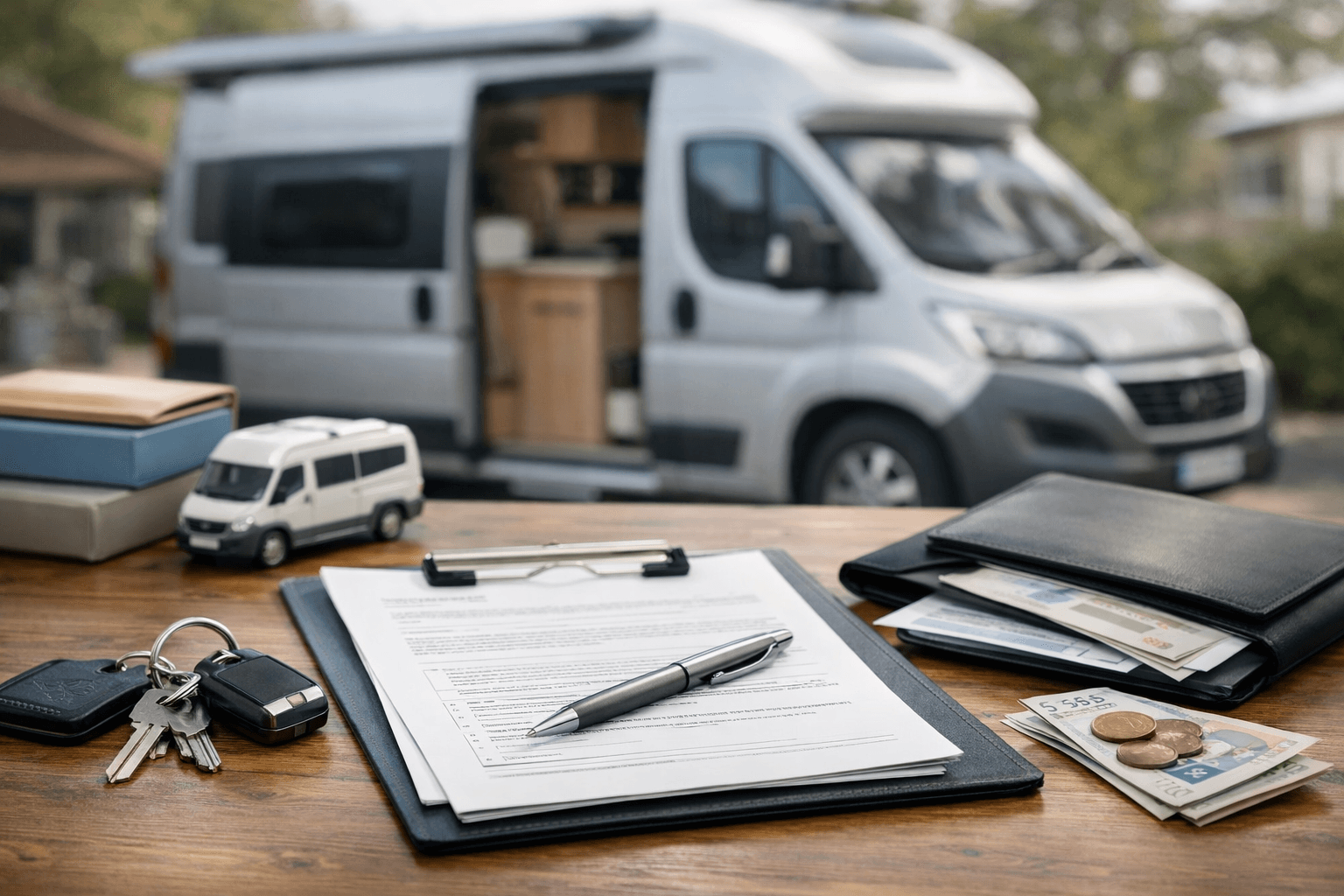
To sell a camper van in the UK, you need at minimum: the V5C logbook, a valid or recently expired MOT certificate, proof of identity, and — if the vehicle is a conversion — a Gas Safety Certificate and electrical installation sign-off. Miss any of these and you will either lose the sale, lose money on the price, or expose yourself to legal liability after the keys change hands.
Most sellers know about the V5C. Far fewer know about the conversion-specific paperwork that separates a legally sound camper van sale from a liability waiting to happen. This article covers every document you need, in the order you need to think about it.
- The V5C logbook is non-negotiable — without it, no serious buyer or dealer will complete a purchase
- Converted camper vans require additional documents that factory-built motor caravans do not: Gas Safety Certificate, electrical installation certificate, and potentially DVLA reclassification paperwork
- Outstanding finance on the vehicle must be settled before or at the point of sale — selling with undisclosed finance is a criminal matter
- A written bill of sale protects you legally after the handover; without one, disputes become your word against theirs
- Notifying the DVLA immediately after sale protects you from road tax liability and parking fines incurred by the new owner
Why Having the Right Documents Matters When Selling a Camper Van
Missing paperwork does not just slow a sale down. It kills it. A buyer who arrives with cash and leaves empty-handed because the V5C does not match the VIN is not coming back. Neither is the dealer who runs an HPI check and finds outstanding finance you forgot to mention.
The legal obligations differ depending on whether you are selling privately or as a trade seller. Private sellers must not misrepresent the vehicle, but they sell without the consumer protections that trade sellers must provide under the Consumer Rights Act 2015. Trade sellers — anyone who buys and sells vehicles as a business — carry significantly more legal responsibility around fitness for purpose and accurate description.
Incomplete documentation can also expose you to liability after the sale. If you sell a converted camper van without a Gas Safety Certificate and the new owner suffers a carbon monoxide incident, the absence of that certificate puts you in a very uncomfortable position. The paperwork is not bureaucracy. It is your protection.
This article covers every document you need: from the V5C and MOT through to conversion-specific certificates that most sellers — and most articles on this subject — completely overlook.
The V5C Logbook: Your Most Important Document
The V5C — the vehicle registration certificate — is the single document that proves the vehicle exists as a legal entity on UK roads and that you are entitled to sell it. Without it, no informed buyer will hand over money, and no dealer will make an offer.
Before you do anything else, check that the V5C matches the vehicle in front of you. The VIN (Vehicle Identification Number), stamped into the chassis and displayed on the dashboard, must match the V5C exactly. So must the engine number. So must the registered keeper details. A single digit discrepancy is enough to derail a sale or, worse, suggest to a buyer that the vehicle has been cloned.
If the registered keeper on the V5C is not you — perhaps because you bought the van privately and the previous owner never updated the DVLA — resolve this before you try to sell. A buyer has every right to walk away if the paperwork does not stack up.
If your V5C is lost or damaged, apply for a replacement immediately using DVLA form V62. There is a small fee. Allow several weeks for the replacement to arrive, so do not leave this until the week before you want to sell.
At the point of sale, complete the V5C correctly. The buyer fills in their details in the relevant section, you retain the yellow ‘sell, transfer or part-exchange your vehicle’ slip to notify the DVLA, and the buyer keeps the green ‘new keeper’ supplement until their new V5C arrives. Do not hand over the entire logbook without completing this process — it creates confusion and delays.
One issue specific to camper van sales: if your vehicle was converted from a panel van or light commercial, the V5C body type may still read ‘goods vehicle’ rather than ‘motor caravan’. This matters. A buyer financing the purchase, insuring it as a camper van, or applying for a leisure vehicle discount will face problems if the V5C says otherwise. Update the body type with the DVLA before selling. The process requires evidence of the conversion — more on this in Section 7.
MOT Certificate
You are not legally required to have a valid MOT to sell a camper van. But selling without one — or with a recently failed one — will cost you. Buyers use MOT status as a proxy for vehicle condition and seller honesty. A clean, current MOT is worth real money at negotiation time.
Every buyer worth dealing with will check the MOT history online using the DVSA’s free tool before they visit. They will see every test result, every advisory note, every failure going back years. Do not try to hide a chequered history. Instead, address the advisories you can, and be straightforward about those you cannot.
If you are selling with a recently failed MOT, you must disclose the failure reasons. Concealing a known defect is misrepresentation. It can unwind the sale and, in serious cases, result in legal action. Price the vehicle accordingly and let the buyer factor in the repair cost themselves.
Advisory notes — items that were flagged but did not cause a failure — will affect your negotiating position even if the MOT itself is valid. A buyer who spots corroded brake pipes on the advisory list will want money off. Know your advisories before they do.
Camper van-specific MOT considerations are worth understanding. Vehicles over 3,500kg gross vehicle weight fall into a different test category and require a Class V or Class VII test rather than the standard Class IV. The habitation area — the living space — is not formally inspected during an MOT, but gas installations and electrical systems attached to the vehicle’s chassis can be flagged if they present an obvious safety hazard. This is another reason why the conversion certificates in Section 7 matter.
Service History and Maintenance Records
A full service history (FSH) — a complete record of every scheduled service the vehicle has received — can add hundreds, sometimes thousands of pounds to a camper van’s sale price. Buyers pay for certainty. A stamped service book or a verifiable digital record gives them certainty.
Acceptable service history takes several forms. Main dealer stamps carry the most weight with buyers. Independent garage receipts are perfectly valid, provided they are dated, itemised and show the mileage at time of service. Digital records — email confirmations from garages, online service portals — are increasingly accepted, particularly for newer vehicles.
For a camper van, service history splits into two distinct areas: the base vehicle and the conversion. Do not conflate them. Gather the base vehicle service book first. Then separately compile records for all conversion-specific work: solar panel installation, leisure battery upgrades, water system servicing, gas appliance maintenance. A buyer considering a camper van v5c sale and all the associated paperwork will be impressed by a seller who has both files ready and clearly labelled.
Even if your base vehicle service history is patchy, a comprehensive file of conversion maintenance records demonstrates that you have cared for the vehicle. Present what you have honestly. Gaps in a service history are common; what matters is that you do not pretend they do not exist.
The difference between the two sets of records matters legally as well. The base vehicle history speaks to mechanical reliability. The conversion records speak to safety. A buyer who later discovers a gas system was never serviced has grounds to claim misrepresentation if you implied otherwise.
Proof of Ownership and Identity Documents
Before handing over a significant sum of money, any sensible buyer needs to verify that you are who you say you are and that you have the right to sell the vehicle. This is not an insult. It is basic due diligence.
Acceptable proof of identity in a UK vehicle sale is a passport or a photocard driving licence. Bring both if you have them. A buyer who is uncertain about your identity may walk away from an otherwise clean deal.
Proof of address — a recent utility bill or bank statement — is not always requested in private sales, but dealers will ask for it as a matter of routine. Have something dated within the last three months ready.
Selling a camper van registered in a company name requires additional steps. You will need to demonstrate authority to sell on behalf of the company — a letter of authorisation on company letterhead, signed by a director, is standard. The buyer may also want to verify the company’s registration at Companies House.
If you are selling a camper van that was recently inherited or gifted, you will need the probate documentation or the deed of gift to establish your legal right to sell. This is not optional. A buyer who later discovers the vehicle was sold without proper authority can have the sale voided.
Finance Settlement Documents
Before you list the vehicle, run an HPI check — a search of the vehicle’s history that reveals whether any finance is outstanding against it. HPI stands for Hire Purchase Information, and the check draws on data from finance lenders, insurance write-offs and stolen vehicle registers. It costs a small fee and takes minutes. Do it.
If you sell a camper van with outstanding finance and do not disclose it, the finance company retains a legal interest in the vehicle. They can repossess it from the buyer. The buyer can then pursue you for the money. This is not a grey area — it is fraud.
If you have outstanding finance, contact your lender before marketing the vehicle. Request a settlement figure — the exact amount required to clear the debt. This figure is valid for a set period, typically 30 days. Factor it into your asking price.
At the point of sale, you have two clean options. Either settle the finance before the sale completes and provide the buyer with written confirmation from the lender that the vehicle is now unencumbered. Or arrange for the buyer’s payment to clear the finance directly, with any surplus going to you, using a solicitor or escrow service to manage the transaction.
For high-value camper van sales where finance is involved, using a solicitor or escrow service is not excessive caution — it is common sense. It protects both parties and removes any ambiguity about who paid what and when.
Provide the buyer with written confirmation of finance clearance. A letter from the lender, on headed paper, stating that no outstanding finance exists against the vehicle’s VIN is the gold standard. Keep a copy for yourself.
Conversion and Build Documents for DIY or Custom Camper Vans
This is the section that most sellers miss entirely. And it is the section that matters most if your camper van is a conversion.
A factory-built motor caravan — a vehicle that left the manufacturer as a camper van — comes with type approval as standard. A converted van does not. The conversion creates a set of documentation requirements that are entirely separate from the standard V5C and MOT paperwork, and failing to address them will either collapse the sale or expose you to serious liability.
If you want to sell your camper van quickly and at the best possible price, having the full conversion document pack ready before you approach any buyer or dealer is not optional — it is the difference between a smooth sale and a painful one.
Gas Safety Certificate. Any gas installation in a camper van — hob, oven, space heater, water heater — must be certified by a Gas Safe registered engineer. The certificate confirms that the installation is safe, correctly ventilated and compliant with current regulations. Buyers should insist on it. Sellers who do not have one should get one before selling. The cost is modest. The liability for not having it is not.
Electrical installation certificate. Both 12V leisure systems and 240V hook-up systems should be signed off by a qualified electrician. The certificate — issued to the relevant standard, typically BS 7671 for 240V systems — confirms that the wiring, fusing and earthing are safe. DIY electrical work is common in camper conversions. That does not make it safe, and it does not exempt you from providing evidence that it is.
Habitation check certificate. A habitation check is an inspection of the living area of a camper van, covering gas systems, electrical systems, water systems, ventilation and damp. It is carried out by a specialist technician — typically an approved workshop or caravan engineer. It is not a legal requirement to sell, but it is increasingly expected by informed buyers and provides strong evidence that the vehicle has been properly maintained.
DVLA reclassification paperwork. If the vehicle was originally registered as a goods vehicle and you have converted it to a motor caravan, you should formally reclassify it with the DVLA. To do this, you submit evidence of the conversion — photographs, a description of the habitation features, and the V5C — and the DVLA updates the body type to ‘motor caravan’. This affects insurance, road tax categorisation and resale value. Do it before you sell, not after.
Receipts and warranties for major components. Keep every receipt for inverters, solar panels, heating systems, water pumps, and roof conversions. These are not just evidence of what was spent — they are proof of what is installed, and they allow the buyer to register warranties or claim support from manufacturers if something fails.
If a professional converter built your camper van, ask them for a copy of their build specification and any type approval documentation they hold. Some converters issue their own habitation certificates. Others register conversions under the DVLA’s Individual Vehicle Approval (IVA) scheme. If yours did, that paperwork is valuable and should be passed to the buyer.
Insurance Documents and What to Do Before Handing Over the Keys
Contact your insurer before the sale completes. Tell them the vehicle is being sold and confirm the date of transfer. You will need written confirmation — an email is sufficient — that your policy has been cancelled or transferred from that date. Keep this for your records.
The buyer must have their own insurance in place before they drive the vehicle away. This is their responsibility, not yours. But if you hand over the keys knowing the buyer has no cover, and they cause an accident on the way home, you may face questions about your conduct. Ask to see their insurance confirmation before the keys change hands.
A short-term or temporary insurance policy takes minutes to arrange online and costs the buyer relatively little. If they are serious about the purchase, they will have sorted this before they arrive. If they have not, give them five minutes to do it before you complete the handover.
Keep a copy of your own insurance schedule — the document that shows the period of cover and the vehicle details — in your post-sale file. If a claim arises relating to an incident before the sale date, you will need it.
Warranties, Recalls and Manufacturer Documents
Check for outstanding safety recalls before you sell. The DVSA operates a free recall checker at its website — enter the vehicle’s registration number and it will tell you whether any safety recalls are outstanding. An unresolved recall is a problem. It tells the buyer that a known safety defect has not been fixed. Resolve it first, or disclose it and price accordingly.
If the base vehicle carries a transferable manufacturer warranty, gather the relevant documentation and confirm with the manufacturer or dealer that the warranty transfers to a new private owner. Many do. Some do not. Know which applies to your vehicle.
Conversion warranties from professional converters are less consistently transferable. Contact the converter directly and ask. If the warranty transfers, get written confirmation and include it in your document pack.
Appliance manuals and warranties — for hobs, fridges, diesel heaters, solar charge controllers — should be gathered and presented to the buyer at handover. These are not just nice to have. They allow the buyer to operate the equipment correctly, register products for warranty, and claim manufacturer support if something fails. A complete set of manuals signals a seller who has looked after the vehicle properly.
Writing a Receipt and Bill of Sale
In a private sale, a written receipt is your legal protection. Without one, every detail of the transaction — the price, the condition agreed, what was and was not disclosed — becomes a matter of disputed memory. Write the receipt. Sign it. Keep a copy.
A proper bill of sale for a camper van should include: the date of sale, the full purchase price, the full names and addresses of both buyer and seller, the vehicle’s VIN and registration number, the mileage at time of sale, and a description of the vehicle’s condition as agreed between both parties.
If you are selling privately and the buyer accepts the vehicle in its current condition, you may include a ‘sold as seen’ clause. This limits your exposure to post-sale complaints about pre-existing issues — but it does not override your obligation not to actively misrepresent the vehicle. You cannot describe a vehicle as mechanically sound, include ‘sold as seen’, and then claim immunity when the engine fails a week later.
Trade sellers — those selling as a business — cannot rely on ‘sold as seen’ to the same extent. The Consumer Rights Act 2015 requires that goods sold by traders are of satisfactory quality, fit for purpose and as described. This applies regardless of what the bill of sale says.
Both parties should sign the receipt. Both should keep a copy. This takes five minutes and can save months of dispute.
Include a line confirming that the seller has disclosed all known defects and that no outstanding finance exists on the vehicle at the time of sale. It costs nothing to write and adds significant legal clarity.
Notifying the DVLA After the Sale
Tell the DVLA the moment the sale is complete. Not the next day. Not when you get around to it. The moment the keys change hands.
You can notify the DVLA online at the GOV.UK website, or by posting the yellow ‘sell, transfer or part-exchange your vehicle’ slip from the V5C. The online route is faster and gives you immediate confirmation. Use it.
If you do not notify the DVLA and the buyer incurs a parking fine, a congestion charge, or a speeding penalty in the vehicle, those charges will come to you. The DVLA’s records will show you as the registered keeper until you tell them otherwise. This is not a technicality — it is a real and avoidable problem.
Once you have notified the DVLA, you are entitled to a refund of any remaining full months of road tax. This is automatic — the DVLA will issue it to the address on record. Do not forget to claim it; on a vehicle taxed for a full year, it can be worth a meaningful sum.
Give the buyer the green ‘new keeper’ supplement from the V5C. This is their proof of ownership until the DVLA issues them a new V5C in their name. The DVLA typically processes the change of keeper within two to four weeks, though this can extend during busy periods.
Selling to a Dealer or Part-Exchanging: Document Differences
Selling to a dealer is faster than a private sale, but it is not paperwork-free. The dealer will handle the DVLA notification themselves — that is standard practice — but they will still need the V5C from you before they will complete the purchase.
Dealers will ask for things that private buyers typically do not. Proof of address — a utility bill or bank statement dated within three months — is standard. Bank details for the payment transfer are required. Some dealers will ask for proof of identity even if you have been dealing with them for years.
Every reputable dealer will run an HPI check on the vehicle before making a final offer. They will see any outstanding finance, any insurance write-offs, any mileage discrepancies and any stolen vehicle markers. If your paperwork is clean and your camper van service history sale documentation is in order, this check will confirm your position and speed up the offer. If it reveals problems, the dealer’s offer will reflect them — or disappear entirely.
Prepare your full document pack before approaching dealers. V5C, MOT, service history, conversion certificates, finance clearance letter if applicable. A seller who arrives with everything in order gets a faster decision and, usually, a better offer. Dealers price uncertainty into their bids. Remove the uncertainty.
Checklist: All Documents Needed to Sell a Camper Van in the UK
Use this before you list the vehicle. Not after.
Essential documents — every camper van sale
- V5C logbook (matching VIN, engine number and registered keeper)
- MOT certificate (current or recently expired — note any advisories)
- Proof of identity (passport or photocard driving licence)
- Proof of address (utility bill or bank statement, within three months)
- HPI clearance confirmation (or finance settlement letter from lender)
- Written bill of sale / receipt
- Insurance cancellation or transfer confirmation
Strongly recommended — all camper vans
- Full service history (stamped book or garage receipts)
- DVSA recall check confirmation (printed or screenshot)
- Transferable warranty documentation (if applicable)
- Appliance manuals for habitation equipment
Essential for converted or DIY camper vans only
- Gas Safety Certificate (issued by a Gas Safe registered engineer)
- Electrical installation certificate (12V and/or 240V systems, to BS 7671)
- Habitation check certificate (from an approved specialist)
- DVLA reclassification paperwork (if body type changed from goods vehicle to motor caravan)
- Conversion receipts and component warranties (solar, heating, water systems)
- Professional converter’s build specification or type approval documentation (if applicable)
If the vehicle was converted under the DVLA’s Individual Vehicle Approval (IVA) scheme, include the IVA certificate. This is a significant asset and should be prominently presented to any buyer.
Frequently Asked Questions
These questions cover the most common concerns sellers raise about the documents needed to sell a camper van in the UK — from the basics of the V5C to the conversion-specific certificates that catch many sellers off guard.
Can I sell a camper van without a V5C logbook?
You can attempt to sell without a V5C, but you should not expect to achieve a fair price. Most buyers — and all dealers — will refuse to complete a purchase without it, because without the V5C there is no reliable way to verify ownership or legal title. Apply for a replacement using DVLA form V62 before you sell. The fee is small; the benefit to your sale price is significant.
Does a camper van need a valid MOT to be sold legally in the UK?
No — a valid MOT is not a legal requirement to sell a camper van. However, selling without one, or with a recent failure, will reduce buyer confidence and your asking price. Every buyer will check the MOT history online via the DVSA tool, so a clean record adds real value.
Do I need a Gas Safe certificate to sell a camper van privately?
There is no law that requires a Gas Safe certificate for a private camper van sale, but the absence of one is a serious red flag for any informed buyer — and a serious liability for you. If the gas system causes harm after the sale and you had no certificate, you are in a very difficult legal position. Get the certificate. It costs far less than the alternative.
What is a habitation check and do I need one to sell?
A habitation check is an inspection of a camper van’s living area — gas systems, electrical systems, water systems, ventilation and damp — carried out by a specialist technician. It is not a legal requirement to sell, but it is increasingly expected by buyers of converted and used camper vans, and it provides strong evidence of responsible ownership. Think of it as an MOT for the living space.
What are the documents needed to sell a camper van that I converted myself?
A self-converted camper van requires more paperwork than a factory-built motor caravan. You need a Gas Safety Certificate from a Gas Safe registered engineer for any gas installation, an electrical installation certificate for 12V and 240V systems, a habitation check certificate, and — if the vehicle was registered as a goods vehicle — DVLA reclassification paperwork to update the body type to ‘motor caravan’. Receipts for major components and any conversion warranties should also be gathered and presented to the buyer.
How do I change the vehicle classification from van to motor caravan on the V5C before selling?
Contact the DVLA with evidence of the conversion: photographs showing the habitation features (fixed bed, cooking facilities, storage), a written description of the conversion, and the existing V5C. The DVLA will assess the submission and, if the vehicle meets the criteria for a motor caravan, update the body type on the V5C. This affects insurance classification, road tax and resale value — do it before you sell, not after.
Can I sell a camper van that still has finance outstanding on it?
You can, but only if you handle it correctly. Selling a vehicle with undisclosed outstanding finance is fraud — the finance company retains legal title and can repossess the vehicle from the buyer. Obtain a settlement figure from your lender, clear the finance before or at the point of sale, and provide the buyer with written confirmation from the lender that the vehicle is unencumbered. For high-value sales, use a solicitor or escrow service to manage the transaction.
What should I include in a bill of sale for a camper van, and what documents needed to sell a camper van uk should I reference in it?
A bill of sale for a camper van should include: the date of sale, the full purchase price, the full names and addresses of both buyer and seller, the vehicle’s VIN and registration number, the recorded mileage at the time of sale, a brief description of the vehicle’s condition, and confirmation that all known defects have been disclosed and that no outstanding finance exists. Both parties should sign it and keep a copy. If you are a private seller, you may include a ‘sold as seen’ clause — but this does not remove your obligation to describe the vehicle accurately.
Still have questions about the documents needed to sell a camper van in the UK? The checklist in Section 13 covers every document in one place — essential, recommended, and conversion-specific. Work through it before you list the vehicle, and you will be in a stronger legal and commercial position than the vast majority of sellers.