
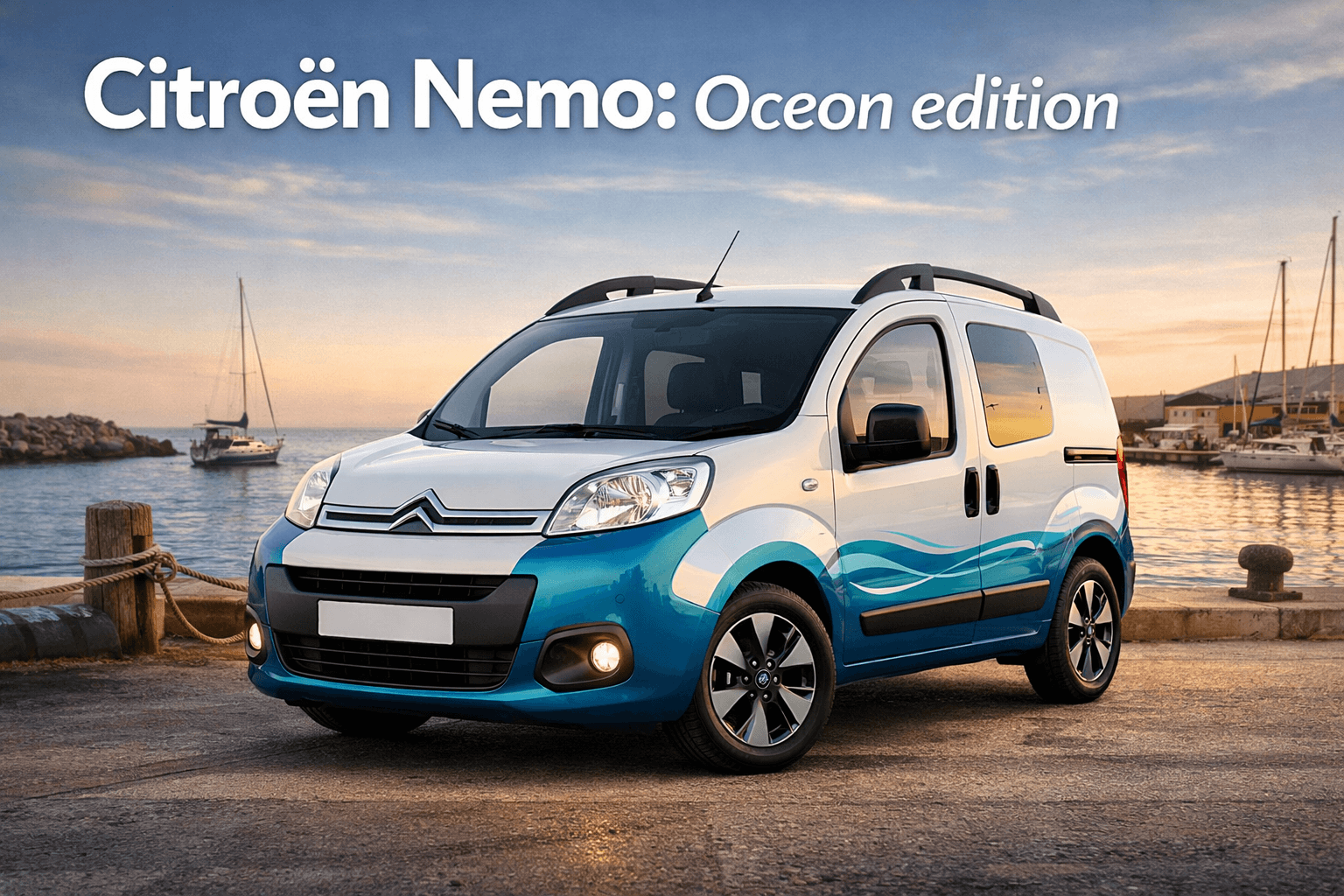
You’ve spotted something most van reviews completely miss. The Citroën Nemo Ocean edition isn’t just a Nemo with a sticker pack — it’s a calculated move by Citroën to keep an ageing platform feeling fresh and desirable. If you’re shopping for a used Nemo Ocean, or you’re simply trying to understand what the Ocean badge actually means, you’re in the right place.
- The Ocean edition is a special-trim variant of the Citroën Nemo, introduced to add lifestyle appeal and stimulate demand for the platform in its later years
- It shares its engines and mechanicals entirely with the standard Nemo, so reliability and running costs are identical
- Load capacity, fuel economy, and day-to-day usability are the Nemo’s genuine strengths — the Ocean trim adds cosmetic and minor comfort upgrades on top
- Used examples are widely available at accessible prices, but require specific checks around timing belts, bodywork corrosion, and Ocean-badge authenticity
- The Ocean edition offers good value on the used market, particularly for urban tradespeople and small business owners who want a premium-feeling compact van without a premium price tag
What Is the Citroën Nemo Ocean Edition?
The Citroën Nemo is a compact panel van and passenger car that Citroën produced from 2008, built on a shared platform with the Peugeot Bipper and Fiat Fiorino. It was aimed squarely at urban operators who needed a small, fuel-efficient load carrier that could squeeze into tight city streets and park where larger vans simply couldn’t.
The Ocean edition is a special-trim variant — not a new model, but a dressed-up version of the standard Nemo designed to broaden its appeal beyond pure utility buyers. Citroën introduced special-edition trims like Ocean as a deliberate marketing strategy: when a platform matures and the headline specs stop changing, lifestyle-branded variants create a renewed reason to buy. It’s the same playbook used across the small-van segment, and it works particularly well on the used market, where a named edition can sustain residual values better than a plain base-spec equivalent.
The Ocean edition targets three types of buyer: small business owners who want a practical van that doesn’t look purely functional, urban delivery drivers prioritising running costs and manoeuvrability, and lifestyle buyers — tradespeople or hobbyists who want something a little more characterful than a white panel van.
Exterior Design and Ocean Edition Styling
The Ocean edition is visually distinguished from the standard Nemo through a combination of colour choices, graphics, and trim details. Ocean-specific exterior colours typically lean toward cooler, cleaner tones — think blues and silvers — complemented by subtle body graphics that reference the Ocean name without being garish.
Alloy wheels are a key differentiator. Where base-spec Nemos roll on steel wheels with plastic trims, the Ocean edition is fitted with alloy wheels, typically in a 15-inch specification, which meaningfully lift the van’s kerb appeal.
Front-end detailing includes Ocean-specific badging and, depending on the market and year, minor grille and bumper trim differences that separate it visually from standard variants. Roof rails are fitted on some Ocean examples, adding genuine practical value for those who need to carry ladders or roof-mounted equipment.
At just over 3.8 metres long and under 1.7 metres wide, the Nemo’s compact dimensions are its urban superpower. It fits comfortably in a standard UK parking space, navigates narrow city streets without drama, and can access loading bays that defeat larger competitors.
Interior Features and Ocean Edition Upgrades
Step inside an Ocean edition and the cabin feels a notch above the standard Nemo’s fairly spartan interior. Ocean-specific upholstery — typically featuring contrasting stitching or Ocean-branded seat fabric — gives the driver’s environment a more considered feel. It’s not luxury, but it’s noticeably more pleasant than the plain cloth you’d find in a base-spec van.
Infotainment provision on the Nemo is modest by modern standards, reflecting its production era. Expect a CD radio as standard, with Bluetooth connectivity on better-equipped examples. USB provisions vary by year — earlier models may require an aftermarket solution.
The instrument cluster is clear and functional, with a driver-focused layout that keeps the key readouts — speed, fuel, engine temperature — easy to read at a glance. Ergonomics are straightforward rather than sophisticated, which suits the van’s working-vehicle brief.
The Nemo was sold in two body styles relevant to the Ocean trim:
- Panel van: a two-seat commercial vehicle with a load bay behind the driver and passenger
- Multispace: a five-seat passenger car variant, effectively a small MPV, with rear seating in place of the load bay
Storage in the cabin is thoughtfully arranged for a van of this size. A large central dashboard cubby, generous door pockets, and under-seat storage in the Multispace version mean there’s always somewhere to put a phone, a flask, or a delivery manifest.
Engine and Transmission Options
The Ocean edition uses the same engine lineup as the rest of the Nemo range — there’s no performance variant here. Your choices are:
- 1.4i petrol: a naturally aspirated 75 PS unit, smooth and simple to maintain, but the least economical option
- 1.3 HDi diesel (75 PS): the most popular choice, offering strong real-world fuel economy and adequate urban performance
- 1.4 HDi diesel (70 PS): available on some variants, with similar characteristics to the 1.3 HDi
All Ocean edition variants are paired with a 5-speed manual gearbox — there is no automatic option. The gearbox is robust and well-suited to urban stop-start driving, though the shift action is functional rather than slick.
Stop-start technology is available on certain diesel variants, reducing fuel consumption and emissions during urban driving — particularly relevant for delivery drivers spending significant time in traffic.
Performance figures reflect the Nemo’s urban focus rather than any motorway ambition. The 1.3 HDi manages 0–62 mph in approximately 14–15 seconds, with a top speed in the region of 95 mph. Real-world driveability in town is perfectly adequate; sustained motorway cruising above 65 mph is where the engine feels stretched.
Fuel Economy and Running Costs
Running costs are one of the Nemo Ocean’s strongest arguments, and the diesel variants make a compelling case.
Official NEDC combined fuel consumption figures for the 1.3 HDi sit around 60–65 mpg, though real-world owner reports typically land in the 45–55 mpg range depending on load, driving style, and urban versus mixed use. The petrol 1.4i is noticeably thirstier, with real-world figures closer to 35–42 mpg.
CO2 emissions for the 1.3 HDi are low enough to place it in a favourable VED (road tax) band — a meaningful saving for business users managing fleet costs. The petrol variant sits in a higher band.
Insurance group ratings for the Nemo Ocean are modest, typically falling in groups 5–8 depending on the variant and insurer, which keeps premiums accessible for younger or newer drivers.
Service intervals are typically every 12 months or 12,500 miles. Parts availability is good — the Nemo shares components with the Peugeot Bipper and Fiat Fiorino, meaning the parts network is broader than the Citroën badge alone might suggest.
When budgeting for a used Nemo, factor in timing belt replacement if the service history doesn’t confirm it’s been done. On the HDi diesel, this is a critical maintenance item.
Load Space and Practicality
The Nemo panel van offers approximately 2.5 cubic metres of cargo volume — compact but genuinely useful for urban deliveries, tradespeople carrying tools, or small businesses managing regular collections.
Maximum payload capacity is around 500 kg depending on the variant and specification, which covers the majority of light commercial use cases. The Nemo is not rated for towing in most configurations — it’s designed as a load carrier rather than a tow vehicle.
Load bay dimensions are practical for the van’s size:
- Length: approximately 1.5 metres behind the bulkhead
- Width between wheel arches: approximately 1.1 metres
- Height: approximately 1.2 metres
Rear door configurations vary. Barn doors (the split opening pair) are the most common on panel van versions, allowing full-width access to the load bay. A tailgate option is available on some variants.
How does it compare to key rivals?
| Van | Cargo Volume | Payload |
|---|---|---|
| Citroën Nemo | ~2.5 m³ | ~500 kg |
| Fiat Fiorino | ~2.5 m³ | ~520 kg |
| Vauxhall Combo (Mk3) | ~3.4 m³ | ~650 kg |
The Nemo and Fiorino are closely matched — unsurprisingly, given their shared platform. The Vauxhall Combo offers more space but is a larger, less manoeuvrable vehicle.
Safety and Driver Assistance Features
The Nemo platform received a two-star Euro NCAP rating when tested, which reflects the safety standards of its era rather than a fundamental flaw in the design. Context matters here: it was assessed under testing criteria that have since become significantly more demanding.
Standard safety equipment on the Ocean edition includes:
- ABS (Anti-lock Braking System) — standard across the range
- EBD (Electronic Brakeforce Distribution) — standard
- Dual front airbags — standard on Ocean trim
- ESP (Electronic Stability Programme) — available on Ocean edition, though fitment varies by market and year; confirm on any specific example
Parking sensors are not standard on the Ocean edition but may be fitted as a dealer option on some examples. The Nemo’s compact dimensions mean rear visibility, while not exceptional, is manageable without sensors for most drivers.
ISOFIX child seat mounting points are available in the Multispace passenger version, making it a practical family or mixed-use vehicle.
Citroën Nemo Ocean vs. Standard Nemo: Is the Upgrade Worth It?
The honest answer: the Ocean edition is worth it on the used market if the price premium is small, because the mechanical package is identical to the standard Nemo.
Here’s a side-by-side comparison of what the Ocean edition typically adds over base and mid-range trims:
| Feature | Base Nemo | Mid-Range Nemo | Ocean Edition |
|---|---|---|---|
| Alloy wheels | ✗ | Sometimes | ✓ |
| Ocean-specific upholstery | ✗ | ✗ | ✓ |
| Body graphics/badging | ✗ | ✗ | ✓ |
| Roof rails | ✗ | ✗ | Some examples |
| Bluetooth | ✗ | Sometimes | Sometimes |
| ESP | Optional | Optional | More common |
At launch, the Ocean edition commanded a modest premium over mid-range Nemo trim. On the current used market, that premium has largely evaporated — meaning you can often pick up an Ocean edition for the same money as an equivalent standard Nemo, simply because buyers don’t always recognise the distinction.
Buyers who gain most from the Ocean edition: those who care about the van’s appearance alongside its utility — small business owners who meet clients, lifestyle users, or anyone who’ll spend significant time in the cab and appreciates the slightly more refined interior.
Resale value for special-edition small vans is generally modest — the used market for compact vans is price-sensitive — but the Ocean badge can help a listing stand out, which aids a quicker sale.
Buying a Used Citroën Nemo Ocean Edition
Used Nemo Ocean examples are most commonly found in the 2010–2014 registration range, with mileages typically between 60,000 and 130,000 miles. The diesel variants dominate the used market.
What to check mechanically
- Timing belt: the HDi diesel engines are interference engines — a snapped belt causes serious engine damage. Confirm replacement history and budget for it if unconfirmed (typically every 5 years or 80,000 miles, but verify with the service record)
- Turbocharger: listen for excessive whine or lag on the HDi units; turbos on high-mileage examples can show wear
- Gearbox: check for smooth, precise shifts through all five gears; baulky changes or difficulty finding reverse can indicate wear
- Clutch: urban use means clutches work hard; test for slip under load
Bodywork and corrosion checks
The Nemo platform can suffer corrosion around the wheel arches, sill edges, and lower door panels — particularly on examples that have spent their lives in urban environments with heavy road salt exposure. Check the floor of the load bay carefully on panel van versions, as commercial use can lead to rust where protective coating has been damaged.
Service history and MOT records
A full service history is the gold standard, but given the Nemo’s commercial-vehicle use, a partial history with receipts for key items (timing belt, brakes, tyres) is a reasonable minimum. Review the last three MOT certificates for recurring advisories — repeated notes about corrosion or brake issues tell a story.
Verifying Ocean edition authenticity
The Ocean edition is identified by its badging, alloy wheels, and interior trim. Cross-reference the VIN against Citroën’s records if you want certainty. Be cautious of standard Nemos that have had Ocean badges added — the interior upholstery and build quality of the cabin are the most reliable indicators.
Average asking prices
Prices vary by year, mileage, and condition, but as a general guide:
- 2010–2011, 80,000–100,000 miles: typically £2,500–£4,000
- 2012–2013, 60,000–80,000 miles: typically £3,500–£5,500
- 2014, under 60,000 miles: typically £5,000–£7,000
Be sceptical of any Nemo Ocean priced significantly below these ranges without a clear explanation — inspect carefully for hidden corrosion or mechanical issues.
Owner Reviews and Real-World Verdict
Owners are consistently positive about the Nemo Ocean’s core proposition: it does exactly what a compact urban van should do, reliably and economically.
What owners praise most:
- Compact dimensions that make city driving and parking genuinely stress-free
- Diesel running costs — many owners report real-world figures of 48–52 mpg in mixed urban use
- Ease of loading for the van’s size
- The Ocean edition’s slightly more refined interior versus base-spec vans
What owners criticise:
- Ride quality is firm, particularly on poorer road surfaces — the suspension is tuned for load carrying, not comfort
- Interior noise at motorway speeds is noticeable; the HDi can feel vocal above 65 mph
- Power output is adequate in town but limiting on A-roads and motorways, particularly when loaded
- Infotainment feels dated by current standards
Long-term owners — tradespeople who’ve run Nemo Oceans for 5+ years — report that the van rewards careful maintenance. Keep up with servicing, address corrosion early, and the drivetrain is fundamentally reliable. The Ocean edition’s interior trim holds up reasonably well, though seat fabric can show wear on high-mileage examples.
The Ocean badge, years after purchase, still does what Citroën intended: it makes the van feel like a considered choice rather than a default one. For a compact van that’s been on the road for a decade, that’s a minor triumph of positioning.
Frequently Asked Questions
What makes the Citroën Nemo Ocean edition different from the standard Nemo?
The Ocean edition adds cosmetic and minor comfort upgrades over the standard Nemo — alloy wheels, Ocean-specific upholstery and badging, and in some cases roof rails. The mechanical package, including engines, gearbox, and load capacity, is identical to the standard range. It was introduced as a lifestyle-branded trim to refresh interest in the platform and broaden its appeal beyond pure utility buyers.
What engines are available in the Citroën Nemo Ocean edition?
The Ocean edition is available with a 1.4i petrol engine (75 PS) or 1.3 HDi diesel (75 PS) in most markets. The diesel is by far the more popular choice for its fuel economy and real-world running costs. All variants use a 5-speed manual gearbox — no automatic option exists.
How much load can a Citroën Nemo carry?
The Nemo panel van offers approximately 2.5 cubic metres of cargo volume and a maximum payload of around 500 kg. Load bay length behind the bulkhead is approximately 1.5 metres, with a width of approximately 1.1 metres between the wheel arches. The Nemo is not rated for towing in most configurations.
Is the Citroën Nemo Ocean edition reliable?
Yes, broadly — provided it has been maintained correctly. The key vulnerability on diesel variants is the timing belt, which must be replaced on schedule (typically every 5 years or 80,000 miles). Turbos and clutches can show wear on high-mileage urban examples. With a verified service history and no significant corrosion, a well-maintained Nemo Ocean is a dependable daily workhorse.
What is the fuel consumption of the Citroën Nemo Ocean edition?
The 1.3 HDi diesel returns official NEDC combined figures of around 60–65 mpg. Real-world owner reports typically land between 45–55 mpg depending on load and driving conditions. The 1.4i petrol is noticeably less economical, with real-world figures closer to 35–42 mpg.
How does the Citroën Nemo Ocean compare to the Fiat Fiorino and Peugeot Bipper?
All three vans share the same underlying platform, so their mechanical specifications, load capacities, and running costs are closely matched. The differences come down to trim, badge, and dealer network. The Peugeot Bipper is the most direct equivalent to the Nemo Ocean. The Fiat Fiorino shares the same cargo volume (approximately 2.5 m³) and payload. Choosing between them on the used market often comes down to service history quality and asking price rather than any meaningful mechanical advantage.
What should I check when buying a used Citroën Nemo Ocean edition?
Prioritise: timing belt replacement history on diesel variants, turbocharger condition, gearbox shift quality, and corrosion around wheel arches, sills, and the load bay floor. Review the last three MOT certificates for recurring advisories. Verify Ocean edition authenticity through the interior upholstery and alloy wheels — not just the badges.
Are Citroën Nemo spare parts easy to find?
Parts availability is good. The Nemo shares components with the Peugeot Bipper and Fiat Fiorino, which broadens the supply network considerably. Independent specialists and online parts suppliers stock the most commonly needed items — filters, belts, brakes, and clutch components — at accessible prices.
What is the towing capacity of the Citroën Nemo?
The Citroën Nemo is not rated for towing in most configurations. It is designed as a load carrier rather than a tow vehicle, and owners should not assume towing capability without confirming the specific vehicle’s type approval documentation.
Does the Citroën Nemo Ocean edition have a passenger (Multispace) version?
Yes. The Nemo was sold in both a panel van configuration (two seats, full load bay) and a Multispace version (five seats, passenger car layout). The Ocean trim was applied to both body styles in some markets, though the panel van version is more commonly found on the used market in the UK.
If you’re considering a used Citroën Nemo Ocean, the most useful next step is straightforward: find a well-documented example with a confirmed timing belt history, run a full HPI check, and take it for a drive in the kind of conditions you’ll actually use it in — city streets, not a smooth test route. The Ocean edition is a reliable, economical, and genuinely practical compact van. It just needs to be the right example.