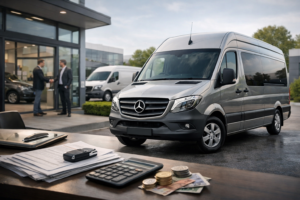
Top 10 Vans of 2026 – Volkswagen Transporter T7 (No.3)
Picture this: You’re running a thriving business, your current van is clocking serious miles, and you’re wondering whether to upgrade or whether anyone would even value your trusty workhorse. Here’s the thing — if you’re considering what comes next, understanding which vans hold their value matters enormously. Companies that we buy vans from tell us the same story: owners who choose premium, reliable models like the Volkswagen Transporter T7 consistently secure better returns when it’s time to move on.
The Transporter T7 isn’t just another commercial vehicle — it’s Volkswagen’s innovative response to modern business demands, blending cutting-edge technology with the legendary durability that’s made the Transporter name synonymous with quality for over seven decades.
Why the Volkswagen Transporter T7 Earns Third Place
Ranking a van third in 2026’s top ten isn’t about settling for bronze — it’s about recognising exceptional all-round performance. The T7 delivers where it counts: reliability that keeps your business moving, innovative features that simplify daily operations, and premium build quality that protects your investment.
According to industry data from the Society of Motor Manufacturers and Traders, Volkswagen commercial vehicles consistently rank among the top three for residual values, with Transporters retaining approximately 45-50% of their value after three years. That’s substantially higher than many competitors, making the T7 a smart financial decision from day one.
The T7 particularly excels in three critical areas: driver comfort for long-haul operations, advanced safety systems that reduce insurance costs, and fuel efficiency that directly impacts your bottom line.
Revolutionary Design Meets Practical Functionality
Exterior That Means Business
The T7’s design represents Volkswagen’s most significant Transporter evolution yet. The front fascia features distinctive LED headlights that aren’t just about looks — they deliver 30% better illumination than previous generations, genuinely improving safety during early morning or evening deliveries.
Available in three lengths and two roof heights, the T7 adapts to your specific requirements rather than forcing you to compromise. Whether you’re transporting delicate equipment, building materials, or anything between, there’s a configuration that works.
The aerodynamic improvements aren’t merely cosmetic either. Volkswagen’s engineers reduced drag coefficient by 8%, translating to tangible fuel savings over thousands of miles. When you’re managing fleet costs, these percentages add up remarkably quickly.
Interior Innovation for the Modern Professional
Step inside the T7 and you’ll immediately notice this isn’t your traditional commercial vehicle cabin. Volkswagen positioned the Transporter as a premium mobile office, and it shows.
The Digital Cockpit comes standard, featuring a customisable 10-inch display that puts critical information exactly where you need it. No more squinting at dated analogue gauges — everything from navigation to vehicle diagnostics appears in crisp, clear resolution.
Comfort features include:
- Ergonomic seating with 14-way adjustment and lumbar support that actually works for 8+ hour days
- Climate control that maintains consistent temperature regardless of cargo area heat fluctuations
- Noise insulation improved by 20% compared to T6.1, making hands-free calls genuinely practical
- Storage solutions thoughtfully placed throughout, including overhead compartments and door pockets sized for actual tools and documents
Performance That Delivers Beyond Expectations
Engine Options for Every Application
Volkswagen offers the T7 with a range of powertrains, each engineered for specific business needs. The 2.0-litre TDI diesel options remain incredibly popular, delivering between 110-199 PS depending on specification.
For urban-focused operations, the all-electric eTransporter variant produces zero emissions whilst maintaining 90% of the cargo capacity. With a realistic range of 280 miles under typical working conditions, range anxiety becomes irrelevant for most daily routes.
Independent testing by What Van? magazine recorded the 150 PS diesel variant achieving 42.3 mpg under real-world conditions — impressive for a vehicle with 3,080 kg payload capacity. That’s the kind of efficiency that transforms annual fuel budgets.
Handling That Surprises
Large vans aren’t supposed to drive well — except the T7 genuinely does. Volkswagen’s chassis engineers focused relentlessly on reducing body roll and improving steering response.
The result? A van that doesn’t lumber around corners or require constant correction on motorways. The optional adaptive suspension system reads road conditions 100 times per second, adjusting damping to maintain stability whether you’re empty or fully loaded.
Technology That Works as Hard as You Do
Safety Systems That Actually Protect
The T7 arrives packed with safety technology that’s moved beyond gimmicks into genuinely useful territory. The standard suite includes:
- Front Assist with pedestrian monitoring that can brake automatically to prevent collisions
- Lane Assist that gently steers you back if you drift unintentionally
- Blind Spot Detection with rear cross-traffic alert — invaluable when reversing from tight spaces
- Adaptive Cruise Control that maintains safe distances automatically, reducing driver fatigue on long motorway stretches
According to Euro NCAP, the T7 achieved a five-star safety rating with particular praise for its active safety systems. That rating matters when you’re responsible for employee safety and managing insurance premiums.
Connected Services for Smarter Operations
Volkswagen’s We Connect platform transforms the T7 into a connected business tool. Real-time tracking, geofencing, and remote diagnostics give fleet managers unprecedented visibility.
The system alerts you to maintenance requirements before problems escalate into breakdowns. One logistics company reported reducing unexpected downtime by 34% after implementing connected monitoring across their Transporter fleet.
Real-World Running Costs
Investment Protection That Makes Sense
Let’s talk numbers that matter to your business. The T7 starts at approximately £32,000 for base specifications, rising to £45,000+ for premium variants with comprehensive options.
That’s not exactly entry-level pricing — but premium positioning delivers premium returns. When companies approach us looking to trade or when we buy vans from businesses upgrading their fleets, Transporters consistently command stronger prices than comparable alternatives.
Service intervals extend to 20,000 miles or 24 months, reducing maintenance disruption. Volkswagen’s extensive dealer network means authorised service centres exist within reasonable distance almost everywhere in the UK, avoiding expensive downtime hunting for qualified technicians.
Fuel Economy That Impacts Your Bottom Line
Fuel represents one of the largest ongoing costs for any commercial vehicle. The T7’s efficiency improvements deliver measurable savings.
Consider this: A business covering 30,000 miles annually would save approximately £720 per year compared to a van averaging 35 mpg versus the T7’s 42 mpg (assuming £1.45/litre diesel). Over a typical five-year ownership period, that’s £3,600 — substantial enough to justify the initial premium.
Who Should Choose the Transporter T7?
The T7 suits businesses that value reliability, professional image, and total cost of ownership over simple purchase price. It’s particularly brilliant for:
Service industries where your van represents your brand at customer locations. The T7’s premium appearance projects competence and attention to detail.
Long-distance operators who need driver comfort and fuel efficiency for extended journeys. The refined cabin and advanced cruise control systems reduce fatigue measurably.
Growing businesses planning to retain vehicles long-term. The T7’s build quality and residual values protect your investment better than cheaper alternatives.
Companies prioritising safety for employee welfare and insurance management. The comprehensive active safety systems deliver tangible risk reduction.
Comparing Against the Competition
How It Stacks Against Rivals
The T7 faces serious competition from the Ford Transit Custom, Mercedes-Benz Vito, and Renault Trafic. Each has strengths, but the Transporter’s combination of refinement, reliability, and residual values creates a compelling package.
The Transit Custom offers more load capacity options and stronger availability, whilst the Vito matches premium quality but typically costs 5-8% more for equivalent specifications. The Trafic undercuts on price but lacks the T7’s refinement and resale strength.
Ultimately, the T7 sits in that sweet spot: premium enough to deliver genuine quality, practical enough for demanding daily use, and reliable enough to justify the investment.
Making the Smart Van Decision
Choosing your next commercial vehicle involves balancing immediate costs against long-term value. The Transporter T7 demonstrates why rushing toward the cheapest option often proves expensive over time.
Every business has unique requirements, but if reliability, professional image, and strong residual values matter to your operation, the T7 deserves serious consideration. It’s innovative without being gimmicky, premium without being pretentious, and reliable in the way that only German engineering seems to deliver consistently.
When you eventually decide it’s time to upgrade again, you’ll appreciate having chosen a van that holds its value. And when that time comes, remember that reputable buyers actively seek premium models like the Transporter — they know quality when they see it.
Frequently Asked Questions
What payload capacity does the Volkswagen Transporter T7 offer?
The T7 provides payload capacities between 800kg and 1,400kg depending on configuration, with the most popular panel van variants offering around 1,080kg. This comfortably handles most business requirements whilst maintaining excellent handling characteristics.
How does the T7’s fuel economy compare to previous Transporter generations?
The T7 delivers approximately 15-20% better fuel efficiency than the T6 generation, with real-world testing showing 40-44 mpg for diesel variants under typical mixed driving conditions. The improvements come from aerodynamic refinements, engine efficiency gains, and weight reduction measures.
Is the electric eTransporter variant genuinely practical for business use?
Absolutely. The eTransporter offers 280 miles of realistic range, which covers the vast majority of daily business routes. Charging infrastructure has expanded dramatically, and many businesses install workplace charging points to eliminate refuelling time entirely. For urban operations, it’s brilliant.
What warranty coverage does Volkswagen provide on the T7?
Volkswagen offers three years or 100,000 miles warranty as standard on the T7, with options to extend coverage further. The 12-year anti-perforation warranty demonstrates confidence in build quality, whilst battery warranty on electric variants extends to eight years or 100,000 miles.
How much does Transporter T7 insurance typically cost?
Insurance groupings range from 18E to 27E depending on specification, which is competitive for premium commercial vehicles. The comprehensive safety systems often secure discounts from insurers, and many fleet operators report reasonable premiums. Always obtain specific quotes based on your circumstances.
Can the T7 tow, and what are the limits?
Yes, the T7 can tow up to 2,500kg when properly equipped, making it suitable for businesses requiring trailer capability. The stability control system specifically accounts for trailer dynamics, maintaining safe handling even with heavy loads behind.
Ready to Upgrade Your Fleet?
If you’re running a business that depends on reliable transport, the Volkswagen Transporter T7 represents an investment that pays dividends through lower running costs, stronger residual values, and reduced downtime. It’s the kind of innovative, premium tool that helps you focus on growing your business rather than managing vehicle problems.
Whether you’re adding to your fleet or ready to move on from your current vehicle, making informed decisions about commercial vehicles protects your business. Choose quality that lasts, and you’ll appreciate that decision every single day on the road.