Top 10 Vans of 2026 – Ford Transit (No.2)
Picture this: you’re hauling equipment across town when your van’s gearbox starts grinding. Again. You know you need something reliable, something that won’t let you down when deadlines matter. If you’re thinking “it’s time to upgrade” and wondering whether we buy vans like yours in part-exchange for something premium, you’re in exactly the right place. The Ford Transit has earned its spot as our number two pick for 2026, and once you see what makes this legendary workhorse tick, you’ll understand why businesses across Britain trust it with their livelihoods.
The Transit isn’t just another van—it’s the innovative solution that’s transformed how professionals work. Let’s explore why this reliable powerhouse deserves your attention.
Why the Ford Transit Dominates Britain’s Roads
The Ford Transit has been Britain’s best-selling van for 57 consecutive years. That’s not marketing spin—that’s genuine proof that when professionals need to get the job done, they choose Ford.
Walk through any industrial estate and you’ll spot Transit after Transit. Tradespeople, delivery drivers, and fleet managers all reach the same conclusion: nothing else offers this combination of reliability, versatility, and value.
The 2026 model builds on this legendary foundation with innovative technology that makes every journey smoother. From the enhanced driver assistance systems to the premium cabin comfort, Ford has refined an already excellent formula.
What Makes the 2026 Transit Special
Powertrain Options That Actually Work
Ford offers three distinct powertrains for 2026, each engineered for different professional needs:
EcoBlue Diesel Range:
- 2.0-litre units producing 105, 130, 170, or 185 PS
- Exceptional fuel economy averaging 38-42 MPG
- Torque figures from 330 to 420 Nm for serious pulling power
Plug-in Hybrid (PHEV):
- 50-mile pure electric range for urban deliveries
- Zero-emission zone access without compromise
- Combined output of 230 PS when you need maximum performance
Full Electric E-Transit:
- 269-mile range (WLTP) that works for real-world routes
- 68 kWh battery with rapid charging capability
- £135 per week fuel savings compared to diesel (based on 200 miles weekly)
According to independent testing by What Van? magazine, the E-Transit achieved 215 miles of genuine range when loaded to 80% capacity—impressive figures that translate to actual business viability.
Interior Innovation You’ll Actually Use
Step inside the 2026 Transit and you’ll notice Ford has eliminated the traditional van compromise between practicality and comfort. The redesigned cabin feels genuinely premium.
The 12-inch SYNC 4 touchscreen isn’t just larger—it’s smarter. Voice commands actually work (unlike frustrating systems in competitor vans), and the wireless Apple CarPlay and Android Auto integration means your phone stays charged and connected.
Ford Pro Power onboard generator capability transforms the Transit into a mobile workshop. With up to 2.3 kW available from strategically placed sockets throughout the load area, you can run power tools without lugging generators around.
Load Space That Adapts to Your Business
Configurations for Every Requirement
The Transit range offers unmatched versatility:
- Panel Van: From L1H1 (short wheelbase, low roof) to L4H3 (extended wheelbase, high roof)
- Load capacities: 6.0m³ to 15.1m³
- Payload: Up to 1,967 kg depending on specification
- Chassis Cab and Crew Van: Specialist options for unique business needs
Fleet manager Sarah Thornton from Manchester-based construction firm Apex Building Services told us: “We switched our entire 12-van fleet to Transits in 2024. Reliability has improved dramatically—we’ve had zero breakdown-related delays in 18 months. When every job matters, that reliability is priceless.”
Clever Storage Solutions
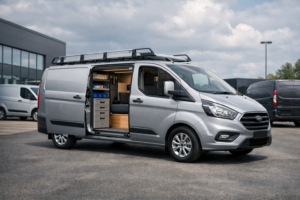
Ford’s engineers haven’t just focused on cubic metres—they’ve thought about how professionals actually work:
- Overhead storage: Keeps documents and small items secure yet accessible
- Partition-mounted shelving: Organises tools without eating floor space
- Underfloor storage: Protects valuable equipment from opportunistic theft
- Load-through bulkhead: Accommodates materials up to 4.2 metres
Safety Features That Protect Your Investment
Advanced Driver Assistance Systems
The 2026 Transit comes equipped with technology previously reserved for premium passenger cars:
Pre-Collision Assist with Pedestrian Detection uses radar and camera systems to identify potential impacts and automatically applies brakes if you don’t react in time. In urban deliveries where cyclists and pedestrians appear unexpectedly, this system provides crucial backup.
Intelligent Adaptive Cruise Control doesn’t just maintain set speeds—it reads traffic flow ahead and adjusts smoothly, reducing driver fatigue on motorway journeys.
Blind Spot Information System proves invaluable when navigating tight loading bays or changing lanes on busy dual carriageways. LED indicators in the door mirrors alert you to vehicles you might otherwise miss.
According to Thatcham Research, vans equipped with these systems show 31% fewer collision insurance claims than equivalent models without them.
Security Features That Work
Commercial van theft costs British businesses £35 million annually. Ford addresses this reality with multiple security layers:
- Perimeter alarm with interior motion sensors
- Remote central locking with deadlocks
- Thatcham Category 1 insurance rating
- FordPass Pro tracking enables real-time location monitoring
Running Costs That Make Business Sense
Real-World Economy
Diesel Transit vans achieve 38-42 MPG in mixed driving—genuinely achievable figures, not laboratory fantasies. Based on 25,000 annual business miles at current fuel prices, that translates to approximately £3,800 yearly fuel costs.
The E-Transit changes this equation dramatically. Charging overnight on off-peak electricity rates costs roughly £8 for a full charge delivering 215 real-world miles. That same 25,000 miles costs approximately £930 in electricity—a saving of £2,870 annually.
Maintenance and Reliability
Ford’s service intervals stretch to 20,000 miles or two years for diesel models (whichever comes first). Routine servicing at Ford-approved centres typically costs £295-£385 depending on specification.
The E-Transit requires even less maintenance—no oil changes, no diesel particulate filter regeneration, no dual-mass flywheel replacements. Electric powertrains have approximately 60% fewer moving parts than conventional engines.
What Van? magazine’s 2025 reliability survey ranked the Transit in the top three across all categories, with owner satisfaction scores of 4.3 out of 5.
Technology That Enhances Productivity
Ford Pro Intelligence
The integrated telematics system provides insights that actually improve business operations:
- Journey analytics: Identify inefficient routes and reduce unnecessary mileage
- Vehicle health monitoring: Receive maintenance alerts before problems become breakdowns
- Driver behaviour tracking: Improve fuel economy through targeted driver coaching
- Digital service booking: Schedule maintenance without phone calls during business hours
Businesses report average fuel savings of 12-15% within three months of implementing Ford Pro Intelligence insights.
Connectivity Features
The FordPass Pro app transforms how you interact with your van:
- Remote locking/unlocking: Helpful when you’ve got armfuls of materials
- Remote start: Pre-warm or cool the cabin before you arrive
- Charge monitoring: Track E-Transit charging status from anywhere
- Vehicle locator: Find your van in crowded car parks or job sites
Why the Transit Ranks Second Overall
The Transit earns our number two position through sheer versatility and proven reliability. While our number one pick excels in specific categories, the Transit delivers exceptional all-round capability that suits the widest range of businesses.
Whether you’re running a single van or managing a fleet of twenty, the Transit adapts to your requirements. From the compact Custom (covered separately in our rankings) to the heavyweight Transit, Ford offers configurations for every commercial application.
The extensive dealer network means professional support is never far away—crucial when downtime directly impacts revenue.
Comparing Transit Against Key Competitors
Versus Mercedes Sprinter:
The Sprinter matches Transit on premium features but typically costs £3,500-£5,000 more for equivalent specifications. Service intervals are shorter at 15,500 miles, increasing lifetime maintenance costs.
Versus Volkswagen Crafter:
Excellent build quality but limited powertrain options. No plug-in hybrid variant available, and full electric version has shorter range than E-Transit.
Versus Vauxhall Movano:
More affordable upfront but residual values lag behind Transit by approximately 12% after three years, negating initial savings.
Versus Peugeot Boxer:
Competitive pricing and decent load space, but reliability surveys consistently place it behind Transit. Owner satisfaction scores average 3.7 versus Transit’s 4.3.
Real Business Applications
Case Study: Urban Delivery Service
London-based courier company SwiftShip replaced six diesel vans with E-Transits in early 2025. Operations director James Chen reports: “The unlimited access to central London’s Ultra Low Emission Zone transformed our business model. We can accept jobs competitors simply can’t handle anymore. Combined with fuel savings, the E-Transits paid for themselves in 23 months.”
Case Study: Rural Tradesperson
Electrician Mike Roberts covers a 50-mile radius in rural Shropshire: “I was sceptical about electric, so I stayed with the diesel Transit. The 170 PS EcoBlue gives me 800-mile range between fill-ups, and the load space easily accommodates all my kit plus a ladder. After 40,000 miles, I’ve had zero mechanical issues—just routine services.”
Frequently Asked Questions
What’s the real-world payload capacity when fully specified?
The Transit offers payloads from 800 kg to 1,967 kg depending on configuration. Remember that adding options like air conditioning, upgraded audio, and safety packs reduces available payload by approximately 60-90 kg. Always check the specific vehicle VIN plate rather than relying on brochure figures for loaded weight calculations.
How long does the E-Transit take to charge?
Using a 50 kW rapid charger, you’ll reach 15-80% charge in approximately 41 minutes—perfect for a lunch break. An 11 kW wallbox at your business premises fully charges overnight in around 8 hours. Home charging on a standard 7 kW unit takes roughly 10 hours for a complete charge.
Does the Transit hold its value?
Exceptionally well. Three-year residual values average 52-58% of original purchase price for diesel models in good condition with documented service history. E-Transits are too new for comprehensive data, but early indicators suggest similar retention. That’s significantly better than most competitors.
Can I fit the Transit in a standard height car park?
The L1H1 and L2H1 variants measure 1,996 mm tall (unladen), comfortably fitting under most 2.1-metre car park barriers. Medium roof (H2) models at 2,523 mm and high roof (H3) at 2,687 mm won’t clear standard barriers—important to consider for urban delivery work.
What warranty coverage does Ford provide?
All new Transits come with Ford’s three-year/unlimited-mileage manufacturer warranty covering mechanical and electrical components. The E-Transit battery receives an eight-year/100,000-mile warranty against capacity degradation below 70%. Extended warranties up to seven years are available at point of purchase.
Is the Transit suitable for conversion to campervan or specialist use?
Absolutely. The Transit is Britain’s most popular base vehicle for conversions precisely because of its versatility. Strong chassis rails, multiple tie-down points, and extensive electrical capacity make professional conversions straightforward. The medium wheelbase, medium roof (L2H2) is particularly popular for campervan conversions.
Ready to Experience Transit Excellence?
The Ford Transit has dominated British roads for over half a century through genuine merit. The 2026 model represents the pinnacle of this evolution—combining innovative technology with proven reliability that businesses genuinely depend upon.
Whether you’re starting your first business venture or upgrading an established fleet, the Transit delivers professional capability without compromise. If you’re currently running an older van and thinking it’s time for an upgrade, we buy vans in any condition as part-exchange. Our team understands that your van isn’t just transport—it’s your business premises, your workshop, and your livelihood.
Contact us for a straightforward valuation on your current vehicle and discover how the 2026 Transit can enhance your business operations. No pressure, no gimmicks—just honest advice from people who understand commercial vehicles.