
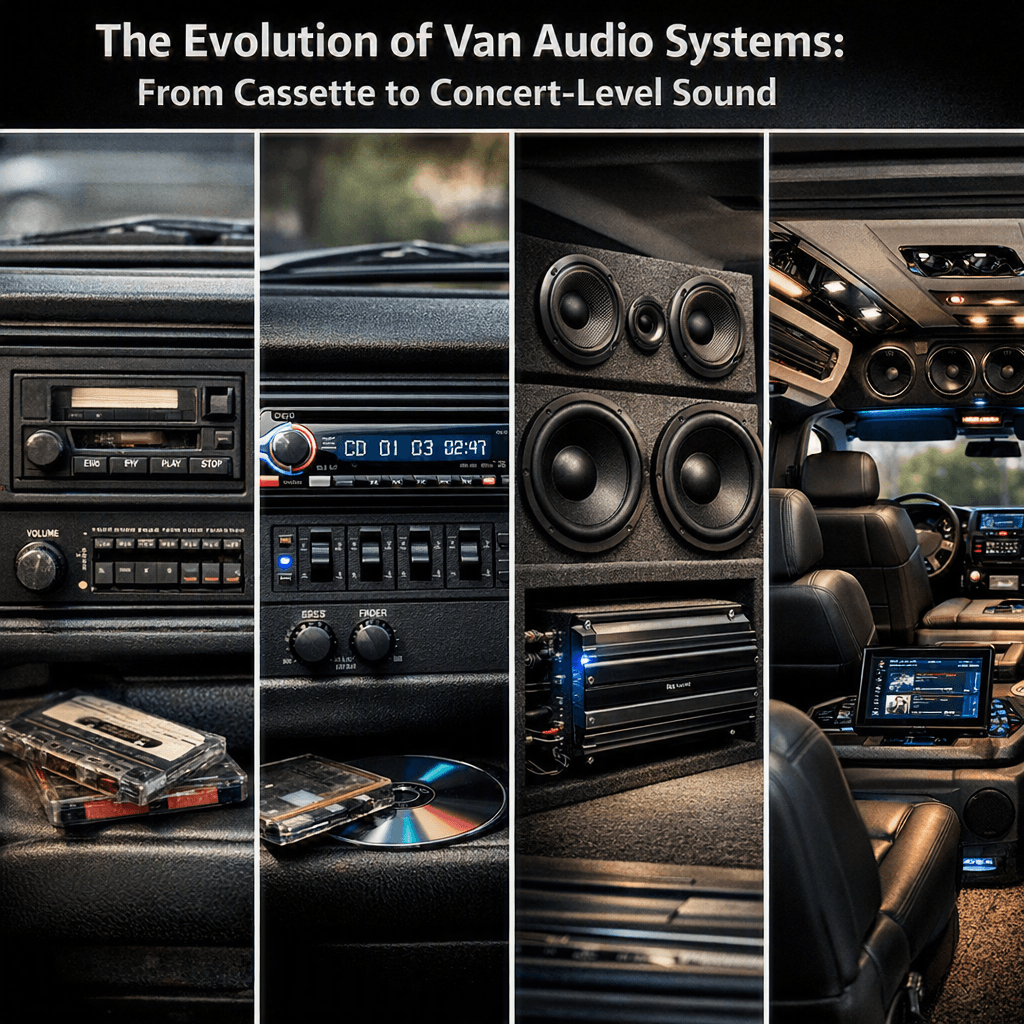
Van audio culture has come a long way. What started as basic factory radios and tinny speakers has evolved into full concert‑level systems capable of shaking the ground at meets. Over the last few decades, Britain’s van‑mod scene has pushed audio upgrades further than almost any other part of customisation. Today, a van can be a mobile studio, a rolling nightclub, or a sound system that rivals professional setups. The journey from cassette decks to high‑end audio rigs is a story of passion, experimentation, and relentless pursuit of better sound.
In the early days, van audio was simple. Most vans came with basic head units, weak speakers, and little thought for acoustics. Builders upgraded out of necessity. Cassette decks were swapped for CD players. Factory speakers were replaced with aftermarket coaxials. Subwoofers began appearing in the back, often in homemade boxes built from leftover timber. It wasn’t refined, but it was the start of something bigger.
As technology improved, so did ambition. The arrival of MP3 head units and early digital audio opened the door to more complex setups. Builders began experimenting with component speakers, separating tweeters and mids to create clearer sound. Amplifiers became standard, giving systems the power they needed to fill a van’s large interior. Subwoofers grew in size and number. A single 10‑inch sub became two 12s, then a pair of 15s. Vans became rolling bass machines.
The real turning point came when builders started treating vans like acoustic spaces rather than vehicles. They added sound‑deadening materials to reduce vibration and improve clarity. They built custom enclosures tuned to specific frequencies. They positioned speakers strategically to create balanced sound rather than just volume. Audio became an art form. A well‑built van system wasn’t just loud—it was clean, controlled, and immersive.
By the 2010s, audio culture exploded. Digital processors allowed builders to fine‑tune every aspect of their setup. Bluetooth streaming became standard. Touch‑screen head units brought navigation, apps, and full media control. Builders integrated lighting with audio, creating interiors that pulsed with the music. Some vans featured full entertainment walls—multiple screens, LED strips, and speaker arrays that looked like something from a club.
Then came the show vans. These builds pushed audio to extremes. Entire rear sections were converted into speaker bays. Subwoofers filled the cargo area. Amplifiers were mounted behind glass panels with LED backlighting. Some vans featured more speakers than small venues. The goal wasn’t subtlety—it was spectacle. These vans became centrepieces at meets, drawing crowds with their sheer presence and power.
But not all audio builds were about volume. Many modders focused on quality. High‑end brands, precision tuning, and carefully balanced systems created vans that sounded better than home setups. Builders used premium components—silk‑dome tweeters, carbon‑fibre cones, class‑D amplifiers, and digital signal processors—to achieve studio‑level clarity. These vans weren’t loud; they were beautiful to listen to.
The evolution also brought new styles. Some builders created cinema vans, complete with surround sound, projectors, and reclining seats. Others built gaming vans, with immersive audio designed for competitive play. A few even created mobile DJ vans, with decks, mixers, and external speakers for events. Audio became a way to define a van’s identity.
What makes van audio culture special is the dedication behind it. Building a great system takes time, knowledge, and patience. It requires understanding acoustics, wiring, tuning, and fabrication. It’s not just plugging in speakers—it’s crafting an experience. And the community reflects that. Builders share tips, compare setups, and celebrate each other’s creativity. It’s a culture built on passion for sound.
Today, van audio systems are more advanced than ever. From subtle upgrades to full concert‑level rigs, they show how far the mod scene has come. A van is no longer just a vehicle—it’s a space. And sound is one of the most powerful ways to transform that space into something unforgettable.