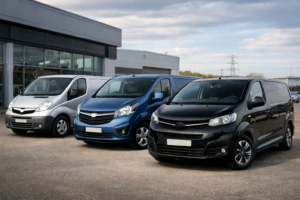
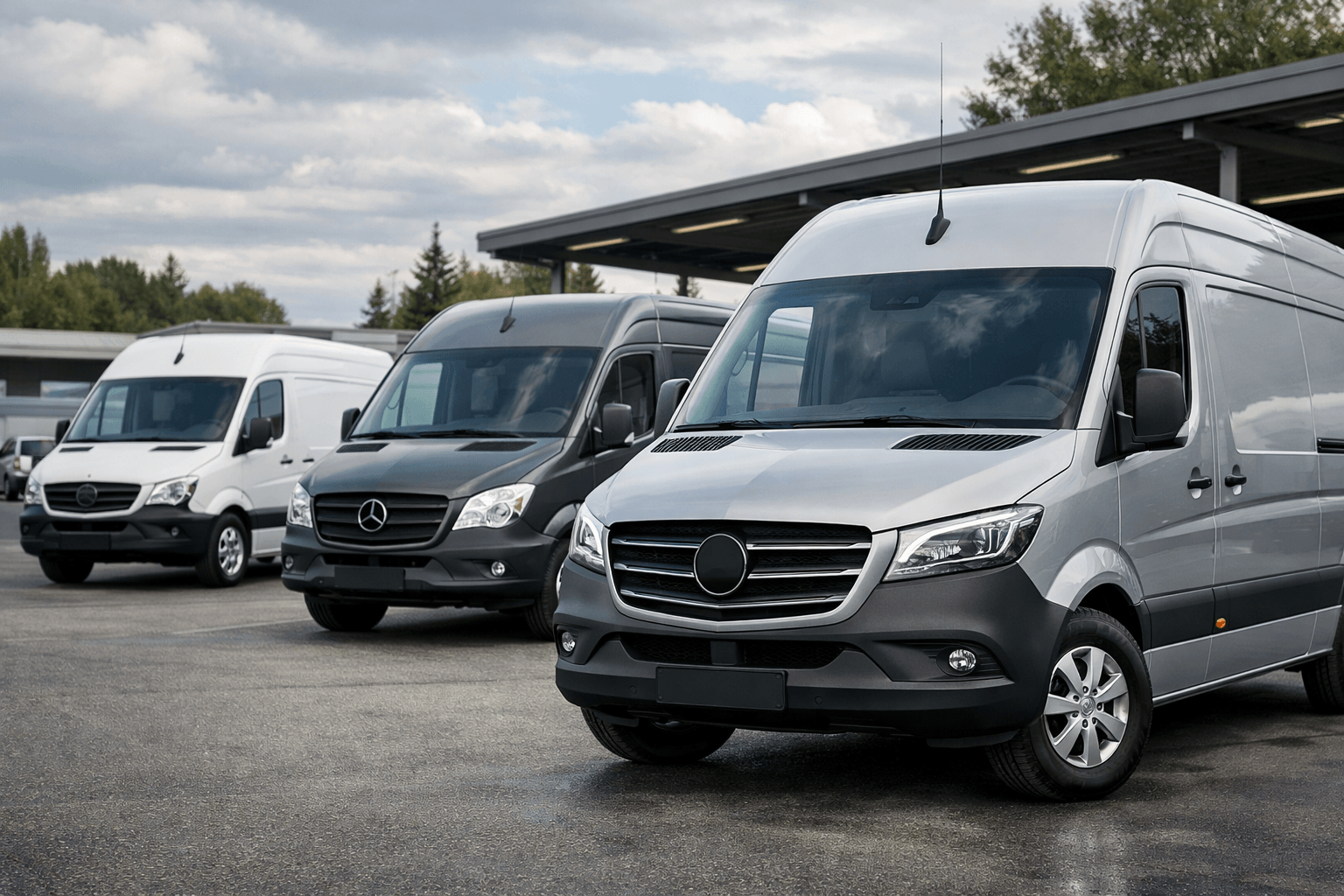
There are three generations of Mercedes Sprinter. Each one is a different machine with different strengths, different weaknesses, and — critically — a different resale value trajectory. Buy the wrong year and you pay twice: once at purchase, once when you try to sell.
What Does “Mercedes Sprinter Generations by Year” Actually Mean?
The Mercedes Sprinter has been built in three distinct generations since 1995. Think of it like a house that has been completely rebuilt twice on the same plot. The address is the same. The name above the door is the same. But the foundations, the wiring, and the plumbing are entirely different.
Each generation brought new engines, new electronics, new body structures, and new problems. Knowing which generation you are looking at — and which year within that generation — is the difference between a reliable workhorse and an expensive mistake.
Technical Definition — The Three Generations Explained
The Sprinter W901–W905 (first generation) ran from 1995 to 2006. The W906 (second generation) ran from 2006 to 2018. The W907 (third generation) launched in 2018 and is the current model.
Within each generation, Mercedes made significant mid-cycle updates — often called “facelifts” — that changed engines, emissions compliance, and technology. So the year of manufacture matters almost as much as the generation. A 2013 W906 and a 2017 W906 are the same generation, but they are meaningfully different vehicles.
How Each Generation Works — What Changed and Why It Matters
First Generation: Sprinter W901–W905 (1995–2006)
This is where the Sprinter story begins. The W901 through W905 codes refer to different body variants — panel van, chassis cab, minibus — within the same mechanical family. All ran on pre-common-rail and early common-rail diesel engines, the most notable being the 2.2-litre CDI introduced in 2000.
These vans are mechanically simple by modern standards. That is both their strength and their limitation. They are easier and cheaper to repair than later models. But they lack the payload capacity, the fuel efficiency, and the safety features that buyers now expect. Resale values on W901–W905 Sprinters have largely bottomed out. They sell on price alone, not on merit.
If you are buying a W901–W905 for a specific trade use — classic vehicle support, for example — it can make sense. For general commercial use, the economics rarely stack up.
Second Generation: Sprinter W906 (2006–2018)
The W906 is where the Sprinter became the van that dominates the used market. Twelve years of production means there are hundreds of thousands of them in circulation. The engines — primarily the 2.1-litre CDI in 95bhp, 129bhp, and 163bhp variants — are well understood by mechanics across the UK.
The sweet spot within this generation is the post-2013 facelift. Mercedes updated the engine management, improved the interior, and refined the suspension geometry. Vans from 2014 to 2018 carry better residuals than their pre-facelift counterparts because they are newer, cleaner for emissions purposes, and better equipped.
If you are thinking about what to do with a Sprinter W906 you already own, the Mercedes Sprinter van valuation and buying service is worth checking before you make any decisions — knowing what your van is worth changes the calculation entirely.
The 2014–2018 W906 with the 314 CDI engine (140bhp) hits the best balance of power, economy, and future saleability. It is the generation’s strongest performer at auction.
Third Generation: Sprinter W907 (2018–Present)
The W907 is a different animal. It introduced a nine-speed automatic gearbox, a full touchscreen infotainment system, and significantly more driver assistance technology. It also introduced more complexity — and more potential failure points.
Early W907 models (2018–2020) had well-documented issues with the nine-speed automatic gearbox and some teething problems with the MBUX infotainment system. By 2021, most of those issues had been addressed through software updates and revised components. If you are buying a W907, the 2021 model year onwards is the safer entry point.
Real-World Examples — How Generation Choice Plays Out
Example 1: The courier operator. A courier business buying five vans for a three-year fleet cycle should look at 2019–2021 W907 models. High-mileage durability is proven, the automatic gearbox suits urban stop-start driving, and the residual values at three years old remain strong because demand for late-plate Sprinters outstrips supply.
Example 2: The sole trader buying used. A plumber buying a single van on a tight budget often lands on a 2014–2016 W906. Parts are cheap, every local mechanic knows the engine, and a well-maintained example will run reliably for another 100,000 miles. This is the Sprinter model history UK buyers return to most consistently.
Example 3: The resale-focused buyer. Someone buying a Sprinter specifically to use for two years and sell should prioritise the 2021+ W907. Depreciation on new vans is front-loaded. A two-year-old W907 in good condition sells quickly and commands a premium because the market knows the early gearbox issues are behind it.
Common Misconceptions — What People Get Wrong About Sprinter Generations
“Older means cheaper to run”
Not always. A W901–W905 Sprinter might cost £3,000 to buy. But if it fails an emissions test, needs an injector, or requires a gearbox rebuild, the repair bill can exceed the van’s value. Cheap to buy is not the same as cheap to own.
“The best year Mercedes Sprinter is the newest one”
Newer is not automatically better. The 2018–2020 W907 proved that. Early adopters of the third generation paid new-van prices for vehicles that had unresolved mechanical issues. The best year in any generation is usually 18 to 24 months after launch, once the factory has resolved production problems and the market has validated reliability.
“All W906s are the same”
The W906 ran for twelve years. A 2007 example and a 2017 example share a nameplate and a basic engine family. But they have different emissions classifications, different technology, and different parts availability. Treating them as interchangeable is like assuming a 2007 iPhone and a 2017 iPhone are the same product because they both say “iPhone” on the back.
Why This Matters — Especially When You Come to Sell
Most buyers focus entirely on purchase price. That is the wrong frame. The question is not “what does this van cost today?” It is “what will this van cost me over the time I own it, and what will someone pay me for it when I am done?”
The W906 post-2013 holds its value better than pre-2013 examples because it meets Euro 5 and Euro 6 emissions standards. As clean air zones expand across UK cities, Euro 4 and below vans face access restrictions and falling demand. A van you cannot drive into Birmingham or London without a charge is a van with a shrinking pool of buyers.
The W907 depreciates fastest in years one and two, then stabilises. If you buy at the three-year point, you capture the remaining useful life at a fraction of the new price — and sell into a market that still values late-plate stock.
Understanding Mercedes Sprinter generations by year is not a technical exercise. It is a financial one.
Frequently Asked Questions
Which generation of Mercedes Sprinter is most reliable?
The W906 post-2013 facelift has the strongest long-term reliability record, largely because it has been in service long enough for all its weaknesses to be known and addressed. The W907 is catching up, but the 2018–2020 early models still carry more uncertainty.
What is the best year Mercedes Sprinter to buy used?
For the best balance of reliability, running costs, and resale value, a 2015–2017 W906 or a 2021+ W907 are the two strongest choices. The 2015–2017 window gives you a post-facelift second-generation van with a proven track record. The 2021+ W907 gives you third-generation technology with the early problems resolved.
Does the Sprinter generation affect insurance and parts costs?
Yes, directly. W906 parts are widely available and competitively priced because volume is high. W907 parts are newer, less commoditised, and more expensive. W901–W905 parts can be hard to source and are increasingly being discontinued. Insurance groups also shift between generations — the W907’s higher trim levels push it into higher groups.
How do I identify which Sprinter generation I am looking at?
The easiest method is the registration plate year combined with the body styling. W906 models have a more angular front end with separate headlight and indicator units. W907 models have a single-piece LED headlight cluster and a noticeably more modern dashboard. The VIN plate will also carry the model code if you need certainty.
Will clean air zones affect older Sprinter generations?
Yes. W901–W905 vans are typically Euro 3 or below, and many W906 pre-2011 models are Euro 4. These face daily charges in Clean Air Zones in cities including Birmingham, Bristol, and Bath. This directly reduces the pool of buyers for those vans and suppresses resale values. Euro 6 compliance — generally W906 post-2016 and all W907 models — avoids these charges.
Summary
- The Sprinter has three generations: W901–W905 (1995–2006), W906 (2006–2018), and W907 (2018–present).
- Within each generation, the post-facelift years consistently outperform early production models on reliability and resale value.
- The 2014–2018 W906 and the 2021+ W907 represent the two strongest used-market choices for most buyers.
- Emissions compliance is not a technicality — it directly determines which buyers can afford your van when you sell it.
- The best year to buy is not the newest or the cheapest; it is the one where known problems are resolved and depreciation has already done its worst.