
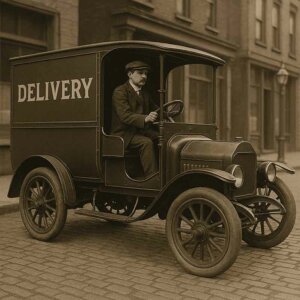
Engines Invade: From Brass Era Dreams to the Model TT
At the turn of the 20th century, inventors looked at horses, then at engines, and concluded oats were no way to run an empire. Early motorized delivery wagons were brave, wobbly contraptions—Daimler, De Dion-Bouton, Renault and others producing little boxes with big ideas. Some had tillers instead of steering wheels, chain drive, and solid rubber tires tough enough to survive a fistfight with a pothole.
Electric delivery vehicles had a promising early chapter. In dense cities, short routes and depot charging made sense. Baker and Walker Electric trucks tootled around American streets with quiet dignity, while in Europe, assorted electric vans experimented with the same formula: torque from zero, no gears, and the ability to start each morning without spooking a horse. The trouble was chemistry. Lead-acid batteries weighed about as much as regret, and range collapsed the moment a hill got cheeky.
Internal combustion arrived like an extrovert at a library. Noisy, smelly, but annoyingly effective. Refueling was simpler, range improved, and engines got just reliable enough that businesses could do sums without factoring in tow ropes. The Ford Model T exploded into the market, and coachbuilders promptly strapped boxes to its back. Then came the Model TT in 1917—a beefed-up chassis designed for proper loads, the spiritual ancestor of every light commercial we now take for granted.
Across the pond, Renault, Fiat, and Peugeot pushed their own commercial derivatives. In Germany, Benz and Daimler evolved workhorses parallel to their glamorous touring cars. The recipe refined itself: put the driver up front, keep the cargo compartment enclosed, and design for easy service because downtime is an accountant’s nightmare. Brakes improved. Lighting advanced from “candle with ambitions” to actual headlamps. Springing got less medieval.
By the 1910s and ’20s, the motor van was no longer a curiosity. It was infrastructure with spark plugs. Department stores extended their reach; dairies and bakeries hit wider rounds; newspapers could promise delivery before coffee cooled. Shops could be smaller because stocks could arrive more often. Commerce stretched its limbs.
Even then, the van’s identity was wonderfully unromantic. Car magazines swooned over roadsters; companies drooled over vehicles that moved goods without drama. Practicality hardened into choreography: routes, schedules, maintenance cycles. The motor van took the ancient task of hauling and added a new dimension—predictability. And in trade, predictability is worth more than poise.
The stage was set for a postwar explosion in smart packaging, forward control, and corrugations that would make aeronautical engineers blush. But first the world had a war to fight, and industry had lessons to learn about mass production, lightweighting, and building machines that could be repaired with a hammer and a prayer at the roadside.
do you have a van to sell? we buy vans