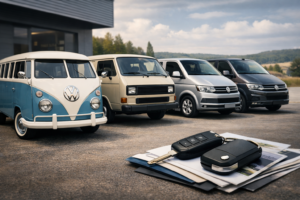
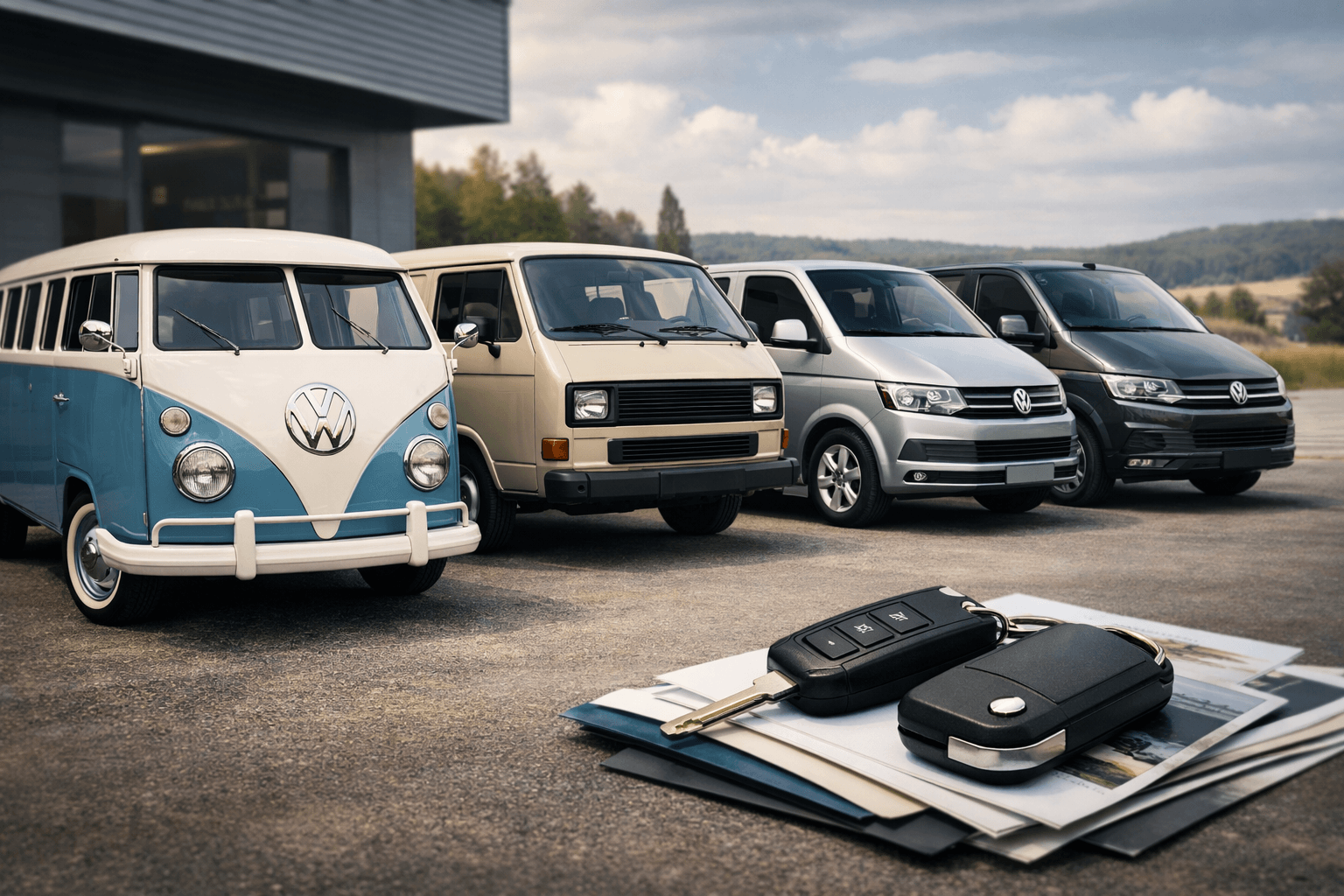
The Volkswagen Transporter has been built in seven distinct generations since 1950. If you want the short answer on which year to buy: a T5.2 facelift (2009–2015) hits the sweet spot for most used buyers — refined enough to live with daily, old enough to be genuinely affordable, and proven enough that its failure points are well-documented. Everything below tells you exactly why, and what to buy if your needs differ.
A Brief History of the Volkswagen Transporter
It started with a sketch on a notepad.
In 1947, Dutch importer Ben Pon visited the Volkswagen factory in Wolfsburg and noticed workers ferrying parts around on a makeshift flatbed. He sketched a simple box van on a Beetle platform. Three years later, that sketch became the T1 — and one of the most enduring commercial vehicles in history was born.
The Transporter wasn’t designed to be iconic. It was designed to haul things. But over seven decades, it evolved from a post-war utility hauler into a vehicle that tradespeople, campervan converters, families, and collectors all want for entirely different reasons. That breadth of appeal is exactly why understanding volkswagen transporter generations by year matters before you spend a penny.
No other light commercial van has sustained this level of desirability across so many buyer types, for so long. The Transporter outsells most rivals not because of clever marketing, but because each generation genuinely improved on the last — in refinement, safety, and versatility.
T1 (1950–1967): The Original Split-Screen
The T1 is the one your grandparents remember. Split windscreen. Barn doors. An air-cooled flat-four engine mounted in the rear, producing between 25 and 42 horsepower depending on the year.
It came as a Panel Van, Kombi (with side windows and removable rear seats), Microbus, and Pickup. Engine options ran from 1.1L up to 1.5L — modest by any standard, but adequate for the era.
Today, a T1 is a collector’s piece, not a working van. Expect to pay anywhere from £15,000 for a rough project to well over £60,000 for a restored example. Parts are available through specialist suppliers, but fitting them requires expertise. This is a vehicle for enthusiasts with patience and budget — not for anyone who needs reliable daily transport.
Rust is endemic on T1s. Structural corrosion in the floor, sills, and chassis rails is the norm, not the exception. Never buy without a full inspection from a specialist.
T2 (1967–1979): The Bay Window Era
The T2 replaced the split screen with a single curved windscreen — the “Bay Window” — and a noticeably larger body. Visibility improved. Load space increased. The 1.6L and 2.0L air-cooled flat-four engines gave it more usable performance than the T1.
The T2 split into two sub-variants: the T2a (1967–1971) with a slightly different nose, and the T2b (1971–1979) with minor refinements. Volkswagen continued producing the T2 in Brazil until 2013, which is genuinely good news for parts availability — Brazilian-market components are still accessible.
The Bay Window is beloved by the campervan community above all other generations. Its proportions suit conversion work, and the aesthetic is universally recognised. If you want a show vehicle or a weekend camper, this is the generation to target. If you want a van to work from, look elsewhere.
T3 (1979–1992): The Last Air-Cooled Generation
The T3 looked more modern than its predecessors — boxier, with better aerodynamics and a wider body. But it kept the rear-engine layout that defined the first two generations.
Here’s where the engineering story gets interesting. From 1982, Volkswagen introduced water-cooled engines alongside the air-cooled units — a sign of where the brand was heading. More significantly, the T3 introduced the first diesel option in Transporter history, a landmark for commercial buyers who understood that fuel economy was money.
The Syncro 4WD variant deserves special mention. Developed with Steyr-Daimler-Puch, it gave the T3 genuine off-road capability. Syncros are rare, increasingly collectible, and command strong premiums. A good one is worth finding.
Westfalia camper conversions of the T3 remain highly sought after. Reliability is reasonable for the era, but watch for rust on the rear corners, wheel arches, and chassis — the T3 suffers badly if not maintained.
T4 (1990–2003): The Front-Engine Revolution
The T4 changed everything. Front-mounted, water-cooled engine. Conventional front-wheel drive layout. It looked nothing like the vans that came before it, and it drove nothing like them either.
Engine options were broad: 1.8 petrol, 2.0 petrol, a 2.5 TDI diesel, and the VR6 six-cylinder for those who wanted something genuinely quick. The 2.5 TDI is the one to have — it’s torquey, relatively durable, and cheap to fuel. The 1.8 and 2.0 petrols are underpowered for van use and thirsty.
A facelift in 1996 updated the nose, refreshed the interior, and brought new engine options. Post-facelift T4s are the better buy.
The T4 spawned the Caravelle (passenger version), the Multivan (flexible people-carrier), and the California (factory camper). All remain usable today.
Common problems to know: rear axle rust is almost universal on unrestored examples. TDI models leak oil from the injector seals. Coolant systems need careful attention. Budget for these before you buy.
For under £5,000, a solid T4 2.5 TDI post-facelift is genuinely viable transport. But inspect it hard.
T5 (2003–2015): The Modern Classic
The T5 is where the Transporter became the van most buyers recognise today. New platform. Significantly better refinement, safety, and payload. It felt like a proper modern vehicle in a way the T4 never quite did.
The engine lineup covered most needs: the 1.9 TDI is frugal and proven; the 2.0 TDI in its BiTDI twin-turbo form produces up to 180 PS and is excellent for high-mileage operators; the older 2.5 TDI carried over briefly before being phased out.
The T5 split into two distinct phases. The T5.1 (2003–2009) is the original — good, but with known issues around the 1.9 TDI’s injectors and DPF systems. The T5.2 facelift (2009–2015) brought a revised front end, better interior quality, and the improved 2.0 TDI engine family. The T5.2 is the one most buyers should target.
DSG automatic gearbox was available — smooth, but the mechatronic unit is an expensive repair if neglected. 4Motion all-wheel drive was offered across several variants and is worth having if you work on difficult terrain.
Variants included the Panel Van, Kombi, Caravelle, Multivan, and the California camper. If you’re considering selling a Volkswagen Transporter or buying one on the used market, the T5 is the generation with the deepest pool of stock and the most competitive pricing — which cuts both ways.
Most common problems: DPF blockages on low-mileage diesel examples, timing chain stretch on the 2.0 TDI (service history is critical), and EGR valve failures. None are catastrophic if caught early. All are expensive if ignored.
The T5 is the most popular used Transporter on the market today, and for good reason.
T6 (2015–2019) and T6.1 (2019–2024): The Refined Workhorse
Think of the T6 as the T5 with everything turned up. Same platform. But meaningfully better interior, more tech, and a revised 2.0 TDI engine in multiple power outputs from 84 PS to 204 PS.
The T6.1 (from 2019) went further: a digital cockpit, a restyled front end influenced by the ID. Buzz’s design language, mild-hybrid technology on select models, and Apple CarPlay/Android Auto as standard on higher trims. It’s a significantly more sophisticated vehicle to live with.
Payload and towing capacity improved over the T5 — useful for anyone carrying heavy loads or towing regularly.
Common issues on both: AdBlue system faults (the T6 uses SCR emissions technology), DSG mechatronic unit failures on high-mileage examples, and particulate filter problems if used predominantly on short runs.
Is the T6.1 worth the premium over the T6? For used buyers, yes — if the budget stretches. The digital cockpit and mild-hybrid system make a real-world difference. But a well-maintained T6 at the right price is no compromise.
California Ocean and Beach editions command strong premiums in both generations — expect to pay £10,000–£20,000 more than an equivalent Panel Van.
T7 (2024–Present): The New Generation
The T7 is the most significant engineering departure since the T4. It moves to the MQB platform — the same architecture used across VW Group’s larger passenger cars. The result is a van that drives more like a car than any Transporter before it.
The headline powertrain is the plug-in hybrid eHybrid, which pairs a 1.5 TSI petrol engine with an electric motor for a combined output around 218 PS and a claimed electric-only range sufficient for urban deliveries. Diesel variants remain available for operators who need range without charging infrastructure.
Dimensions have changed slightly — the T7 is fractionally longer than the T6.1, with a revised load area. Early owner feedback suggests the MQB platform delivers a noticeably more refined ride, though some operators report the higher load floor as a practical trade-off.
Safety technology is comprehensive as standard: lane assist, autonomous emergency braking, adaptive cruise control, and a reversing camera.
The honest assessment: the T7 is the right choice for fleets with sustainability targets, eco-conscious operators, and high-mileage urban drivers who can charge regularly. For traditional tradespeople, the T6.1 diesel may remain more practical until charging infrastructure matures.
Volkswagen Transporter Generations Compared: Side-by-Side Specs
The table below maps each generation against the specifications that matter most to buyers.
| Generation | Years | Engine Types | Approx. Payload | Load Volume | Towing Capacity |
|---|---|---|---|---|---|
| T1 | 1950–1967 | Air-cooled petrol (1.1–1.5L) | ~750 kg | ~4.0 m³ | Not rated |
| T2 | 1967–1979 | Air-cooled petrol (1.6–2.0L) | ~850 kg | ~4.5 m³ | Not rated |
| T3 | 1979–1992 | Air/water-cooled petrol, diesel | ~1,000 kg | ~5.0 m³ | ~1,000 kg |
| T4 | 1990–2003 | Petrol, TDI diesel, VR6 | ~1,100 kg | ~5.8 m³ | ~2,000 kg |
| T5 | 2003–2015 | 1.9 TDI, 2.0 TDI, 2.5 TDI | ~1,200 kg | ~5.8–9.3 m³ | ~2,500 kg |
| T6/T6.1 | 2015–2024 | 2.0 TDI (84–204 PS) | ~1,250 kg | ~5.8–9.3 m³ | ~3,000 kg |
| T7 | 2024– | 2.0 TDI, eHybrid PHEV | ~1,200 kg | ~5.8–9.3 m³ | ~2,500 kg |
Load volumes vary significantly by body style (Panel Van vs Kombi vs Caravelle). Figures above represent Panel Van variants. Always verify against the specific vehicle’s V5C and manufacturer data.
Fuel economy tells a clear story across the generations. The T1 and T2 returned around 20–25 mpg. The T3 diesel improved that to 30 mpg territory. The T4 TDI pushed past 35 mpg. The T5 2.0 TDI manages 40+ mpg in real-world use. The T6.1 TDI exceeds that further. The T7 eHybrid, on short runs with regular charging, can dramatically reduce fuel costs — though long-distance diesel economy is comparable to the T6.1.
Safety ratings reflect the era. The T1 through T3 predate formal crash testing. The T4 received basic Euro NCAP assessment. The T5 scored three stars. The T6 achieved four stars. The T7 is rated to current five-star standards with full driver assistance suites.
Used market pricing today (approximate, UK, 2024):
- T1: £15,000–£80,000+ (collector market)
- T2: £12,000–£50,000+ (collector market)
- T3: £5,000–£25,000
- T4: £1,500–£8,000
- T5: £5,000–£25,000
- T6: £15,000–£35,000
- T6.1: £22,000–£45,000+
- T7: £40,000–£55,000+ (new)
Which Volkswagen Transporter Year Should You Buy?
The right generation depends on your budget and your use case. Here is a direct decision framework — no vague advice, no hedging.
Budget under £5,000: Target a post-facelift T4 (1996–2003) with the 2.5 TDI engine. Avoid the 1.8 and 2.0 petrol units — they’re underpowered and thirsty. Budget £500–£1,000 for remedial work on rust and seals. An early T5.1 is possible at this price but will need careful inspection for DPF and timing chain condition.
Budget £5,000–£15,000: The T5.2 facelift (2009–2015) is the clear choice. The 2.0 TDI 102 PS is the sweet spot — reliable, economical, and with the widest choice of stock. Avoid DSG examples unless you can verify full gearbox service history. The 140 PS variant is worth the small premium if you carry heavy loads.
Budget £15,000–£30,000: T6 or T6.1. If you need the latest infotainment and digital cockpit, hold out for a T6.1. If the budget is at the lower end of this range, a high-specification T6 with full service history is a better buy than a basic T6.1 with gaps in its paperwork. Prioritise AdBlue system condition and DSG service records.
Budget £30,000+: A nearly-new T6.1 or a new T7. The T7 eHybrid makes most sense if you cover urban miles, have home charging, and need to meet low-emission zone requirements. For long-distance or rural operators, the T6.1 diesel remains the more practical choice until charging infrastructure catches up.
Campervan conversion buyers: The T5.2 and T6 are the best base vehicles. They offer the right internal dimensions, modern enough mechanicals to be reliable, and a wide enough supply of stock to negotiate on price. The T2 and T3 are options for those who want the aesthetic — but budget at least double for the conversion and mechanical work.
High-mileage tradespeople: Engine choice matters more than generation here. The 2.0 TDI 140 PS in a T5.2 or T6 will cover 200,000 miles with proper maintenance. Avoid BiTDI twin-turbo variants unless you’re confident in the service history — the second turbo is an expensive failure point.
Collectors and classic enthusiasts: T1 and T2 for investment-grade vehicles. The T3 Syncro for something rarer and more usable. All three require specialist knowledge to buy and maintain. Join the relevant owners’ clubs before purchasing — the community knowledge is invaluable.
Electric and hybrid buyers: The T7 eHybrid is the only current factory option. A full battery-electric Transporter is expected, but no confirmed UK launch date has been announced at time of writing. If you need zero-emission capability now, the T7 PHEV or a third-party electric conversion of an older generation are the only routes.
Key Things to Check When Buying Any Used Transporter
Every generation has its Achilles heel. Know them before you view.
Rust hotspots by generation: T1–T3: floors, chassis rails, rear corners — structural corrosion is common and expensive. T4: rear axle beam and sill edges. T5 and T6: rear wheel arches, sliding door sills, and the chassis crossmember under the load floor. Probe everything with a magnet and a torch.
Service history: A full, stamped service history is not a bonus on a Transporter — it’s a requirement. Gaps indicate either neglect or a clocked vehicle. On DSG-equipped vans, confirm the gearbox oil has been changed every 40,000 miles. On TDI models, confirm timing chain or belt replacement at the correct interval.
DPF and EGR condition: Diesel Particulate Filters (DPFs — devices that trap soot from exhaust gases) block on vans used predominantly for short, urban runs. Ask for a DPF pressure test before buying. EGR (Exhaust Gas Recirculation) valves fail on high-mileage T5 and T6 examples — a diagnostic scan will show stored fault codes.
Timing chain vs timing belt: The 1.9 TDI (T4, T5.1) uses a timing belt — replace every 60,000–80,000 miles or 5 years. The 2.0 TDI (T5.2, T6) uses a timing chain — these can stretch, particularly on earlier examples. A rattling cold start is a warning sign. Never buy without knowing the replacement history.
Camper conversion checks: Previous conversions can hide damp, structural modifications, and wiring work of variable quality. Check the roof, floor edges, and any penetrations through the bodywork for moisture. Smell the interior — damp is often detectable before it’s visible.
HPI and mileage verification: T5 and T6 vans are among the most commonly clocked vehicles in the UK used market. Run an HPI check on every example. Cross-reference the mileage against service stamps, MOT history (available free via the DVLA), and wear patterns on the driver’s seat, steering wheel, and pedal rubbers.
Pre-purchase inspection: For any van over £5,000, a professional pre-purchase inspection from an independent VW specialist costs £100–£200 and is the best money you’ll spend. It’s not optional — it’s insurance.
- Seven generations of Transporter exist, from the T1 (1950) to the T7 (2024–present), each with distinct engineering and buyer appeal
- The T5.2 facelift (2009–2015) offers the best reliability-to-cost ratio for most used buyers; the T6.1 is the premium choice for those with more budget
- Engine choice matters as much as generation — the 2.0 TDI 102–140 PS is the most balanced option across T5 and T6
- Rust, DPF condition, and service history are the three non-negotiables to check on any used Transporter
- The T7 eHybrid suits urban fleets and eco-conscious operators; for traditional commercial use, the T6.1 diesel remains more practical today
Frequently Asked Questions
How many generations of the Volkswagen Transporter are there?
There are seven generations: T1 (1950–1967), T2 (1967–1979), T3 (1979–1992), T4 (1990–2003), T5 (2003–2015), T6/T6.1 (2015–2024), and T7 (2024–present). The T4 and T5 generations overlapped briefly during production transitions.
What is the difference between the T5, T5.1, and T5.2?
“T5” covers the entire fifth generation (2003–2015). “T5.1” is informal shorthand for the original pre-facelift models (2003–2009). “T5.2” refers to the facelifted version (2009–2015), which brought a revised front end, improved interior quality, and the updated 2.0 TDI engine family. VW never officially used these sub-designations — they come from the owner community, but they’re universally understood in the used market.
What year did the VW Transporter switch to a front-mounted engine?
The T4, launched in 1990, was the first Transporter to use a front-mounted, water-cooled engine. Every generation since — T5, T6, T6.1, and T7 — has continued with front-engine layouts. The T1, T2, and T3 all used rear-mounted engines.
Is the T6 or T6.1 Transporter more reliable?
Both are reliable when properly maintained. The T6.1’s mild-hybrid system introduces additional complexity that the T6 doesn’t have, but there is no evidence of systemic reliability problems unique to the T6.1. The T6 has a longer track record simply because it’s been in service longer. For used buyers, service history and AdBlue system condition matter more than which sub-generation you choose.
What is the most reliable Volkswagen Transporter engine?
The 2.0 TDI 102 PS in T5.2 and T6 variants has the strongest reliability reputation among diesel buyers. It’s less stressed than the higher-output versions, well-understood by independent mechanics, and capable of very high mileages with regular oil changes. The 1.9 TDI in T4 and early T5 models is also proven — but it’s older technology with a timing belt that must be serviced on schedule.
What does the T7 Transporter offer that the T6.1 doesn't?
The T7 brings a new MQB platform (shared with VW Group passenger cars), a plug-in hybrid eHybrid powertrain, a more car-like driving experience, and a full suite of modern driver assistance technology as standard. It also meets the latest emissions standards without the AdBlue complexity of the T6.1’s SCR system. The trade-off is higher purchase price and, for some operators, a higher load floor than the T6.1.
Which Volkswagen Transporter generation is best for a campervan conversion?
The T5.2 and T6 Panel Van are the most practical bases for a modern campervan conversion. They offer the right internal dimensions, a wide choice of used stock, and modern enough mechanicals to be reliable on long trips. The T2 and T3 are popular for aesthetic reasons, but require significantly more investment in mechanical preparation and specialist conversion work.
How long do Volkswagen Transporters typically last in miles?
A well-maintained T5 or T6 with a 2.0 TDI engine will routinely reach 200,000 miles. Examples with full service history and no major mechanical neglect have been documented beyond 300,000 miles. Engine longevity depends almost entirely on oil change frequency and timing chain/belt maintenance. Bodywork longevity depends on rust prevention — underseal and regular arch cleaning are not optional in UK conditions.
What is the difference between a Transporter, Caravelle, and Multivan?
All three share the same Transporter platform and bodyshell. The Transporter is the commercial variant — Panel Van, Kombi, or chassis cab, focused on load carrying. The Caravelle is a full passenger vehicle with fixed seating for up to nine people. The Multivan sits between the two — a flexible people-carrier with configurable seating that can be removed to create load space. The Multivan commands the highest prices on the used market.
Is the Volkswagen Transporter being discontinued in favour of the ID. Buzz?
No. The T7 Transporter launched in 2024 as a direct continuation of the commercial Transporter line. The ID. Buzz is a separate, battery-electric vehicle positioned above the Transporter in the VW commercial range. The two vehicles serve different markets and will coexist. VW has not announced plans to discontinue the Transporter nameplate.