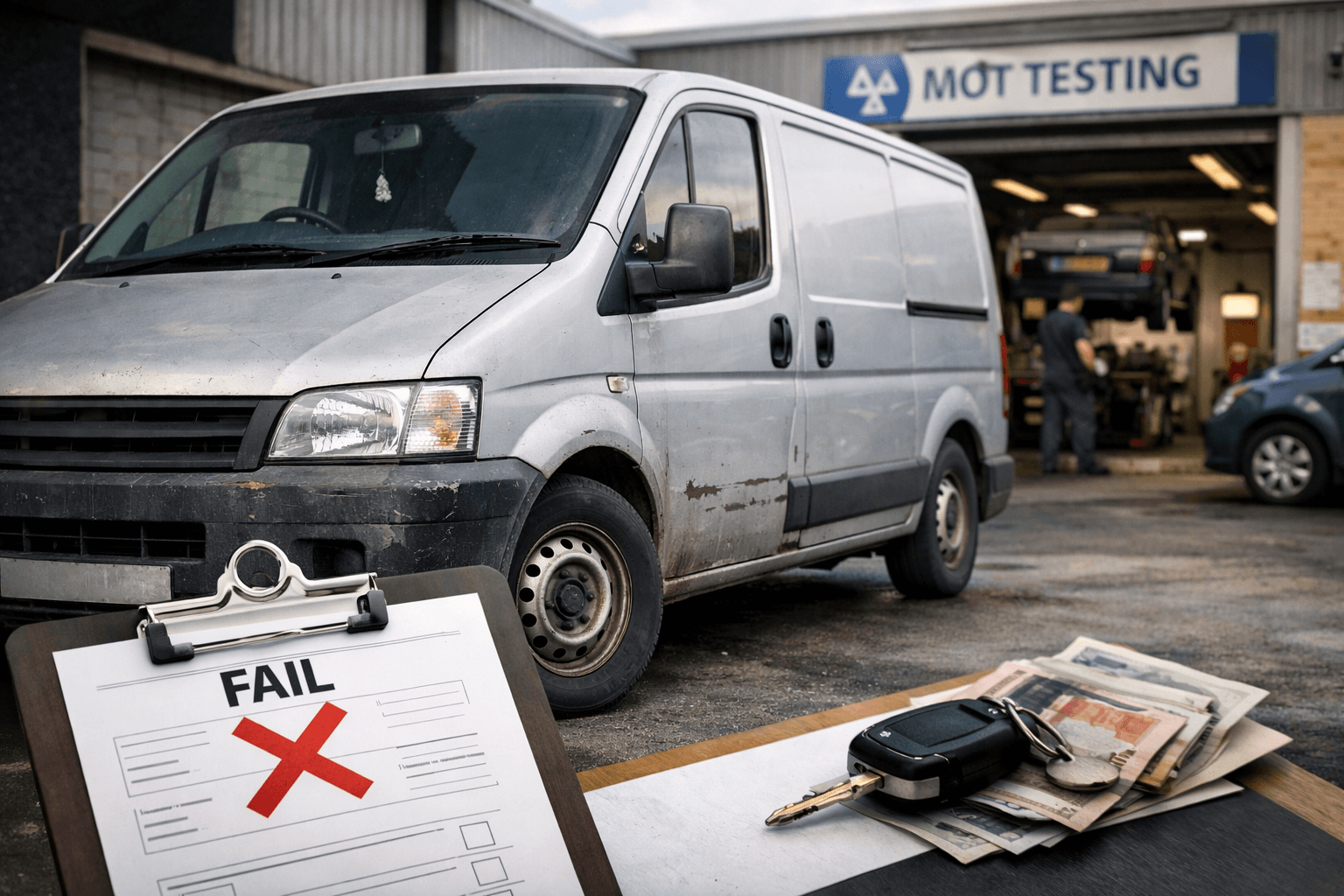
Your MOT just failed. The van is sitting on the forecourt, the tester has handed you a list of advisories that reads like a shopping receipt, and you’re wondering what on earth you do next. If you want to sell a van with a failed MOT in the UK, you have more options than you might think — and most of them are faster and less painful than fixing everything first.
- Selling a van with a failed MOT is legal in the UK, provided you are transparent about its condition and do not drive it on public roads without a valid MOT
- A specialist van buying service will typically offer the quickest, most straightforward route when private buyers are hard to find
- A failed MOT has a real price impact, but knowing the numbers helps you negotiate fairly rather than accept the first lowball offer
- Repair-then-sell only makes financial sense when the repair costs are modest relative to the uplift in value
- Transparency is not just good ethics — it is a legal requirement when selling any vehicle in the UK
Is it legal to sell a van with a failed MOT?
Yes — selling a van with a failed MOT is entirely legal in the UK. The law does not require a vehicle to hold a valid MOT certificate at the point of sale. What the law does require is that you disclose the vehicle’s condition honestly to any buyer. Misrepresenting a van as roadworthy when you know it is not could expose you to a claim under the Consumer Protection from Unfair Trading Regulations 2008.
The key distinction is between selling and driving. You cannot legally drive an unroadworthy van on a public road to show it to a buyer or drop it off — unless you have a specific statutory exemption, such as driving directly to a pre-booked MOT test. If you need to move the van, consider a trailer or a recovery truck.
Driving a vehicle with a failed MOT on a public road (outside the narrow exemptions) can result in a fine of up to £1,000 and potential invalidation of your insurance policy. Do not risk it.
How much does a failed MOT reduce a van’s value?
A failed MOT will reduce what a private buyer is willing to pay — typically by more than the actual cost of the repairs. Buyers factor in their own time, the hassle of arranging work, and the risk that further problems emerge once the van is on a ramp. As a rough guide, expect a private buyer to discount the van by at least the repair cost plus 20–30% on top for their inconvenience.
A specialist van buying service will also price in the failure, but their discount is usually more predictable and based on real trade data rather than a buyer’s anxiety. The gap between a private sale price and a buying-service offer tends to narrow significantly when the van has a failed MOT, because the pool of private buyers willing to take on a project is small.
The severity of the failure matters enormously. MOT failures in the UK are categorised as:
- Dangerous — the vehicle poses an immediate road risk and must not be driven
- Major — the vehicle has failed and must not be driven on a public road
- Minor — recorded as an advisory; the vehicle can still be used but the issue should be addressed
A van with a single “major” failure for a worn tyre is a very different proposition from one with “dangerous” failures across brakes, steering and emissions. Know your category before you start any conversation with a buyer.
Should you repair the van before selling it?
Repair first only if the numbers stack up. Work through this simple check:
- Get a written quote for all the work needed to bring the van to a pass
- Find out the realistic market value of the van with a valid MOT (use trade guides and recent sold listings)
- Subtract the repair quote from that figure
- Compare the result with what a buying service would offer for the van as-is
If step 3 leaves you with a meaningfully higher number than step 4, repair and sell. If the gap is small — or if the repair quote is uncertain because the van is old and other issues could surface — selling as-is is almost certainly the smarter move.
Older vans with high mileage rarely repay expensive repairs at point of sale. The uplift in value simply does not keep pace with the labour and parts costs on a vehicle that has already depreciated heavily.
What are your realistic options for selling a van with a failed MOT?
Option 1: Sell to a specialist van buying service
This is the most straightforward route for most people trying to sell an unroadworthy van. A reputable van buying service will assess the vehicle based on its make, model, mileage, age and condition — including the failed MOT — and make you a firm offer, usually within a few hours. There is no need to advertise, field calls from time-wasters, or arrange viewings.
If you want a quick comparison of what a professional service involves, getting an instant online valuation for your van takes a few minutes and gives you a concrete number to work from. Many buying services will also collect the van, removing the problem of how to move an unroadworthy vehicle.
Option 2: Sell privately
Selling privately with a failed MOT is possible, but harder. You must be completely upfront in your listing — describe the failure category, list the specific faults, and price accordingly. Experienced private buyers and small independent traders do look for project vans, but they will negotiate hard and the process takes longer.
Always get the transaction in writing, state the failed MOT status clearly in any receipt or bill of sale, and keep a copy. This protects you if a buyer later claims they were not told about the condition.
Option 3: Sell for salvage or parts
If the failure is severe — a structural issue, a written-off chassis, or damage that makes repair uneconomical — a salvage buyer or parts dealer may be the most realistic route. You will receive less than trade value, but the transaction is quick and the van is taken away. Search for DVLA-registered vehicle dismantlers to ensure you are dealing with a legitimate operation.
Option 4: Repair and then sell
As covered above, this only makes sense when the repair cost is modest and the resulting uplift in value is clear. Always get two or three quotes before committing, and ask each garage to confirm in writing what the quote covers — unexpected extras on an old van can quickly turn a sensible repair into a money pit.
What do you need to tell a buyer?
Honesty is both the ethical and the legal standard here. When selling a van without a valid MOT, you should:
- State clearly in any advert that the van has a failed MOT
- Specify the category of failure (Dangerous, Major, or Minor/advisory)
- List the specific faults identified by the tester
- Confirm that the vehicle cannot be driven on a public road in its current state (if applicable)
- Provide the buyer with the original MOT failure certificate
Doing all of this upfront protects you from any post-sale dispute and builds the kind of trust that actually makes transactions happen faster.
Frequently Asked Questions
Can I drive my van to a buyer after it has failed its MOT?
No — not on a public road. Once a van has received a Major or Dangerous failure, it must not be driven on a public road. The only legal exception is driving directly to a pre-booked MOT test appointment. To get the van to a buyer, you would need to transport it on a trailer or arrange for a recovery vehicle to collect it.
Does a failed MOT affect my van insurance?
Yes, potentially. Most UK motor insurance policies require the insured vehicle to be roadworthy. Driving a van with a known Major or Dangerous MOT failure could invalidate your policy entirely, leaving you uninsured as well as unroadworthy. Check your policy wording and speak to your insurer before moving the vehicle.
How long does a failed MOT stay on the vehicle's record?
MOT results — including failures — are recorded permanently on the DVLA’s vehicle enquiry database and on the MOT history service at gov.uk. Any buyer can check this history for free using the van’s registration number. There is no way to remove a failure from the record, which is another reason why transparency with buyers is the only sensible approach.
Will a van buying service collect a van that has failed its MOT?
Most reputable van buying services will arrange collection, since they understand that an unroadworthy vehicle cannot legally be driven to them. Confirm this at the point of enquiry and make sure the collection is free — some services charge a transport fee that erodes your offer. Get the full net figure in writing before agreeing to anything.
Is a van with a failed MOT worth anything?
Yes — even a van with a severe MOT failure has value, whether as a running project, a parts donor, or scrap metal. The value depends on the make, model, age, mileage and the nature of the failure. A high-spec van with a minor failure is worth considerably more than an old, high-mileage van with structural damage. Getting two or three offers gives you a realistic picture of where your van sits.
What is the difference between an MOT failure and an advisory?
An MOT failure means the vehicle did not meet the minimum legal standard for road use and cannot be driven on a public road (with very limited exceptions). An advisory is a note that a part is approaching the end of its useful life but has not yet failed the legal standard — the van can still be driven, but the issue should be monitored and addressed. Advisories do not cause an MOT failure on their own, but they do affect buyer confidence and resale value.
A failed MOT feels like a dead end, but it genuinely is not. Whether you decide to repair, sell privately, or use a specialist buying service, you have real choices — and the right one depends on the specific faults, the van’s age and value, and how quickly you need to move it on. Get a couple of valuations, do the repair maths honestly, and you will have a clear picture within a day or two.