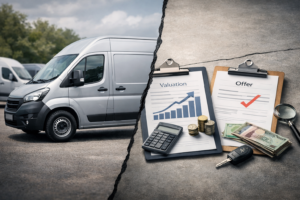

Van condition is the single biggest variable in how van condition affects sale price UK — bigger than mileage, age, or even make and model. A van in excellent condition can fetch thousands more than an identical model in poor shape. This guide breaks down exactly what buyers look at, category by category, so you know where you stand before you sell.
Why Van Condition Matters More Than You Think
Buyers — whether private individuals, dealers, or instant-offer platforms — are not just buying a vehicle. They are pricing risk. Every dent, warning light, and worn tyre represents a potential repair bill, a day off the road, and lost revenue. Commercial vans are working assets, not weekend runarounds, so that risk calculation is sharper and less forgiving than it is for a family car.
The gap between a van in poor condition and one in excellent condition on the same model and year can easily run to £3,000–£6,000 or more. And here is the part most sellers miss: first impressions set the negotiating tone before a buyer even opens the door. A scruffy exterior signals “what else has been neglected?” — and that question costs you money.
How Buyers and Traders Actually Assess Van Condition
Trade buyers and instant-offer platforms assess condition very differently from private buyers. A private buyer might fall in love with a colour or a spec sheet and overlook a few scuffs. A trade buyer runs through a mental checklist in under ten minutes, assigning a rough cost to every fault they find and subtracting it from their offer.
The trade uses standardised grading systems — CAP and Glass’s are the two dominant data providers in the UK — alongside auction-house condition grades (typically 1–5, where 1 is showroom and 5 is salvage). These grades are not just labels; they directly determine what a vehicle is worth at auction and what an online platform’s algorithm will offer you.
Mileage alone is a poor proxy for condition. A 120,000-mile motorway van that has been regularly serviced can be mechanically sounder than a 60,000-mile city van that has spent its life in stop-start traffic with a neglected DPF (diesel particulate filter — a component that traps soot and clogs if not regularly cleared on longer runs).
Before a physical inspection, buyers scrutinise your photos and description. Blurry images, missing angles, or suspiciously cropped shots raise red flags. Traders assume the worst when they cannot see clearly — and they price that uncertainty into their offer.
Bodywork and Exterior: The First Price Killer
Dents, scratches, and scuffs are not assessed emotionally by trade buyers — they are costed per panel. A minor scuff on a bumper might be £80–£150 to repair using SMART (Small to Medium Area Repair Technology) techniques. A creased door panel that needs a body shop respray could be £400–£700. Multiply that across several panels and you can see how quickly the deductions stack up.
Rust is a different conversation entirely. Surface rust — light oxidisation on a sill or wheel arch — is cosmetic and priced accordingly. Structural rust, which affects the chassis, floor, or load area frame, is a potential deal-breaker. Many traders will walk away, or offer only salvage value, because structural rust creates MOT failure risk and liability.
Accident damage is worth declaring honestly, even if it has been repaired. A professional repair to a high standard will still show on a vehicle history check (such as HPI), and buyers who discover undisclosed accident damage on inspection will reduce their offer sharply — or withdraw it altogether.
Roof damage, ladder rack gouges, and poor-quality fleet livery removal are frequently overlooked by sellers but spotted immediately by buyers. A van roof with deep scratches from unsecured loads can cost £500+ to address properly.
Tyre and wheel condition matters more than most sellers expect. Kerbing damage on alloys (if fitted) is priced per wheel. Tread depth below the legal minimum of 1.6mm is an automatic deduction — buyers cannot resell a van with illegal tyres without replacing them first.
Mechanical Condition and Its Impact on Offers
Engine health is the single most important mechanical factor. Warning lights — especially the engine management light — trigger immediate concern. An oil leak visible on the underside, or blue/white smoke on startup, signals expensive work ahead. Traders will either walk away or make a heavily discounted offer to cover worst-case repair costs.
Gearbox and clutch wear is particularly relevant for high-mileage urban vans. A slipping clutch on a Ford Transit Custom or Vauxhall Vivaro can cost £600–£900 to replace. Buyers know this and price it in. A notchy or reluctant gearbox raises similar alarm.
DPF condition deserves its own mention. On diesel vans registered after 2009, a blocked or removed DPF is a serious concern — it causes MOT failure and can cost £1,000–£2,500 to replace on common models. If your van has a DPF warning light on the dashboard, expect a significant reduction in any offer.
A valid, recent MOT shifts negotiating power in your favour. An MOT that expires within weeks, or a van that is clearly approaching failure, hands that power to the buyer. Brakes, suspension, and steering play are all checked during an MOT — and buyers know exactly what borderline components cost to fix.
Interior Condition: Often Underestimated by Sellers
The load area is a van’s workplace, and it shows. Ply lining that is split, saturated with oil, or torn away from fixings is deducted from offers — not because it is expensive to replace, but because it signals the van has been worked hard and possibly neglected. Tie-down rail integrity and floor condition (rust, holes, or chemical staining) are inspected carefully.
The cab interior tells a story about how a van has been treated. Seat bolster wear, cracked dashboards, and missing trim pieces are all noted. Individually they are minor; collectively they build a picture of a vehicle that has not been cared for.
Smell is underestimated by almost every seller. Cigarette smoke, damp, or chemical odours are extremely difficult and expensive to fully eliminate. Buyers know this and factor it in — sometimes by several hundred pounds. A van that smells clean and neutral genuinely does recover value.
Electrical faults — central locking that misbehaves, a window that drops slowly, or heating controls that stick — are cheap to ignore but expensive to a buyer who has to fix them. Address these before sale if the repair cost is modest.
Service History and Paperwork: The Hidden Value Multiplier
Full service history — every stamp in sequence, ideally at manufacturer or recognised independent garages — can add meaningful value in the UK van market. The difference between full history and no history on a common model like a Transit Custom or Sprinter can be £500–£1,500 depending on age and mileage.
Stamped service books still outperform digital records for many buyers, particularly private buyers and smaller traders who are sceptical of screenshots or dealer portal printouts. Physical stamps feel verifiable in a way that a PDF does not.
The paperwork you must have ready includes: the V5C (logbook), current and previous MOT certificates, and — if there is outstanding finance — a settlement letter from the finance company. Missing any of these creates doubt, and doubt is always priced into an offer.
Manufacturer warranties or extended warranties that are transferable to a new owner add genuine value. Check whether yours qualifies — it is worth mentioning prominently in any listing or conversation with a buyer.
Mileage vs. Condition: Which Wins?
Condition wins more often than sellers expect. A well-maintained van with 150,000 miles and full service history will frequently sell for more than a neglected van with 80,000 miles and no paperwork, no MOT, and a cab that smells of damp.
Buyers interpret mileage relative to age and use type. Motorway miles are kinder to an engine than city miles — a van that has covered long distances at steady speeds will typically have less clutch, brake, and DPF wear than one that has spent years in urban stop-start. A 2018 van with 100,000 motorway miles is a different proposition from a 2018 van with 100,000 city miles.
That said, mileage does become a ceiling. Beyond a certain point — which varies by model but is often around 150,000–180,000 miles for common diesels — condition improvements have diminishing returns. No amount of polish recovers the value that very high mileage removes from a buyer’s confidence.
Modifications and Conversions: Do They Add or Subtract Value?
Racking, shelving, and ply lining are a mixed picture. A trade buyer — a plumber buying a van to put their own tools in — may actively want a clean, empty load area. A buyer in the same trade as the previous owner may value the existing fit-out. You cannot predict which you will encounter, so present conversions clearly and price them neutrally.
Refrigeration units and specialist conversions (welfare units, tippers, Luton box vans) narrow your buyer pool significantly. Specialist buyers will pay well for the right conversion; general traders will discount it. If you have a specialist conversion, target specialist buyers — it is worth the extra effort.
Tow bars, roof bars, and accessories add marginal value at best. Buyers rarely pay a premium for them, but their absence is rarely a deal-breaker either.
Aftermarket modifications that may have voided the manufacturer warranty — non-standard engine remaps, suspension lifts, or unapproved electrical additions — can concern buyers and should be disclosed. A buyer who discovers an undisclosed remap after purchase has grounds for a dispute.
How to Accurately Self-Assess Your Van’s Condition
Walk around your van as if you are seeing it for the first time and have never driven it. Start at the front nearside corner and work clockwise, panel by panel. Note every dent larger than a 50p coin, every scratch that has broken the paint, and every area of rust, however minor.
Open every door — including the rear and any side loading door — and inspect the seals, the hinges, and the load area floor. Sit in the cab and test every switch, every window, the heating, the central locking, and the infotainment (if fitted). Start the engine and look for warning lights. Let it warm up and check for smoke or unusual noises.
Use free valuation tools — AutoTrader, What Car, or the CAP consumer-facing tool — to benchmark your van at different condition grades. Be honest about which grade you actually fall into. Overestimating your condition does not get you more money; it gets you a revised (lower) offer on collection day and a wasted afternoon.
Photograph your van the way a buyer would — not the way an estate agent would. That means shooting into corners, capturing any damage clearly, and including the dashboard with the engine running so buyers can see no warning lights are present.
What Repairs and Improvements Are Worth Doing Before Selling
Apply a simple ROI test to every potential repair: will this fix return more than it costs? If a professional valet costs £150 and adds £300–£500 to perceived value, that is an easy yes. If a full respray costs £2,500 and adds £1,500, that is a clear no.
Low-cost, high-impact actions before selling:
- Professional valet (interior and exterior)
- Replace any blown bulbs
- Inflate tyres to the correct pressure
- Clear any warning lights you can address cheaply (e.g., a loose fuel cap triggering an engine light)
- Tidy the load area and remove all personal items
Repairs that rarely pay back include full panel resprays, major mechanical overhauls (engine rebuilds, gearbox replacements), and full interior refits. The cost almost always exceeds the value recovered.
Timing a service or MOT renewal before listing genuinely does help — not because it adds mechanical value, but because it removes a buyer’s biggest negotiating lever. A fresh MOT and recent service stamp signals a van that is ready to work, not one that needs attention before it can earn its keep.
How Condition Affects Different Selling Routes
Private sale gives you the best chance of a top price, but condition matters most here because private buyers are risk-averse and emotional. A single undisclosed fault discovered during a test drive can collapse the deal entirely.
Part-exchange at a dealer is the most convenient route but the least financially rewarding. Dealers discount condition heavily to protect their own margin when they resell. Expect 10–20% less than a realistic private sale price, regardless of condition.
If you are considering selling through an instant-offer platform, it is worth understanding exactly how the process works before you commit. Services that buy vans directly from private sellers and businesses will give you an initial online quote based on the information you provide — but that quote is conditional. The physical inspection on collection day is where condition is re-graded, and this is the moment most sellers are unprepared for.
Here is the ‘inspection day reality check’ that most guides skip entirely. When a driver or assessor arrives to collect your van, they are not there to confirm your quote — they are there to verify it. They will check every panel, start the engine, check for warning lights, inspect the tyres, and test the electrics. Any fault you did not disclose, or any condition you overstated, becomes a deduction from the original offer. Common triggers for a revised offer on collection day include: undisclosed dents or scratches, warning lights that were not mentioned, tyres below legal tread depth, and interior damage or odour. The best way to protect your original quote is to be scrupulously honest in your initial description — and to have addressed the cheap, easy fixes beforehand.
Auction is transparent but unpredictable. Condition grades directly determine the reserve price and influence hammer price. A van graded 3 out of 5 at auction will attract different bidders — and different bids — than the same van graded 2.
Specialist van buyers are often the best route for unusual condition scenarios: high-mileage vans with full history, specialist conversions, or vans with known mechanical issues. They understand the market better than a general trader and will price accordingly.
Realistic Expectations: What Condition Grades Mean in Pounds
To illustrate how van condition grading UK translates into real money, consider a 2019 Ford Transit Custom 280 L1 with 80,000 miles. Condition grades in the trade typically run from 1 (excellent) to 5 (poor/salvage). In practical terms for a private or trade sale:
- Excellent (Grade 1–2): Clean bodywork, full service history, fresh MOT, no warning lights, clean interior. Likely to achieve top retail or near-retail value.
- Good (Grade 2–3): Minor cosmetic marks, reasonable history, valid MOT. Achieves a solid mid-market price — perhaps £1,500–£2,500 below excellent condition.
- Fair (Grade 3–4): Several bodywork issues, partial history, some electrical faults. Offers drop meaningfully — potentially £3,000–£4,000 below excellent.
- Poor (Grade 4–5): Significant damage, no history, warning lights, worn mechanicals. Attracts trade-only interest at a heavily discounted price.
The same damaged van valuation logic applies across all common models — Vauxhall Vivaro, Mercedes Sprinter, VW Transporter. The model changes; the principle does not.
These are illustrative ranges based on typical UK market dynamics, not guaranteed figures. Actual values depend on spec, colour, regional demand, and market conditions at the time of sale.
The first offer you receive is not always the worst. Traders build in negotiating room, but they also have real costs. Understanding van wear and value — and being able to articulate your van’s condition clearly and honestly — puts you in a position to negotiate from knowledge rather than guesswork.
- Condition affects sale price more than mileage — a well-maintained high-mileage van will often outsell a neglected low-mileage one.
- Trade buyers and instant-offer platforms re-grade vans on physical inspection; undisclosed faults trigger price reductions on collection day.
- Bodywork, mechanical health, interior condition, and paperwork each independently shift the final offer up or down.
- Low-cost pre-sale actions (valet, bulb replacement, tyre inflation) offer the best return on investment; major repairs rarely pay back.
- Honest self-assessment and transparent disclosure protect your initial quote and build buyer trust.
Frequently Asked Questions
How much does van condition affect the sale price in the UK?
Van condition can shift the sale price by thousands of pounds on common models. On a typical mid-size van like a Ford Transit Custom, the difference between excellent and poor condition can be £3,000–£6,000 or more, depending on the severity of faults and the selling route. Van inspection criteria used by trade buyers are systematic and thorough — every fault has a cost attached to it.
Will a van with a full service history sell for more?
Yes, reliably. Full service history can add £500–£1,500 to the value of a van in the UK market, depending on age and mileage. Buyers — particularly private buyers — treat full history as evidence that the van has been maintained properly, which reduces their perceived risk. Stamped service books are still preferred over digital records by many buyers.
Does a recent MOT increase what I can sell my van for?
A fresh MOT does not add value directly, but it removes a powerful negotiating lever from the buyer’s hands. A van with twelve months of MOT remaining is ready to work immediately; a van with one month left invites the buyer to ask what it might fail on — and to deduct accordingly. Timing your sale after a fresh MOT is a straightforward way to protect your asking price.
Is it worth repairing bodywork before selling a van?
Only if the repair costs less than the value it recovers. SMART repairs on minor dents and scuffs (typically £80–£200 per panel) can return more than they cost in improved offers. Full panel resprays rarely pay back. The best approach is to get a repair quote, compare it to the likely improvement in offer price, and make the decision on that basis rather than on instinct.
How do online van buying platforms assess condition?
Online platforms give an initial quote based on the information you provide — mileage, age, spec, and a self-reported condition grade. That quote is conditional. On collection day, a physical inspection re-grades the van against van inspection criteria. Any discrepancy between what you described and what the inspector finds — undisclosed dents, warning lights, tyre wear, interior damage — results in a revised, lower offer. The way to protect your original quote is to be accurate and honest in your initial submission.
Does a high-mileage van in good condition sell for more than a low-mileage van in poor condition?
Usually, yes. Buyers are pricing the cost of future repairs, and a well-maintained high-mileage van with full service history represents a more predictable risk than a low-mileage van with unknown history and visible neglect. Mileage is one data point; condition, history, and paperwork together tell a more complete story — and buyers respond to the complete story.
How does DPF condition affect a van's value?
Significantly. A blocked, damaged, or removed DPF (diesel particulate filter) on a post-2009 diesel van causes MOT failure and can cost £1,000–£2,500 to replace on common models. A DPF warning light on the dashboard will trigger an immediate deduction from any trade offer. If your DPF warning is illuminated, address it before selling or declare it clearly and price your van accordingly.
What paperwork do I need to get the best price for my van?
At minimum: the V5C logbook, current and previous MOT certificates, and a finance settlement letter if there is outstanding finance on the vehicle. A full service history — ideally in a stamped book — adds meaningful value. Any transferable manufacturer or extended warranty documentation should also be ready. Missing paperwork creates doubt, and doubt costs you money.
Do racking and shelving add value to a van?
It depends on the buyer. A trade buyer in the same industry as the previous owner may value existing racking; a buyer who wants a clean load area will see it as something to remove. Racking and shelving rarely add significant value and sometimes narrow your buyer pool. Present them clearly, offer to remove them if asked, and price your van on its underlying condition rather than its fit-out.
How do I know if my van is in good, fair, or poor condition?
Walk around the van panel by panel and note every dent, scratch, and rust spot. Check the tyres for tread depth and kerbing damage. Start the engine and look for warning lights. Test every switch, window, and lock in the cab. Inspect the load area floor and lining. Then use a free valuation tool — AutoTrader or CAP’s consumer tool — to compare your honest assessment against the condition grades they describe. If you are unsure, a pre-sale inspection from an independent mechanic (typically £50–£100) will give you a clear, objective picture.