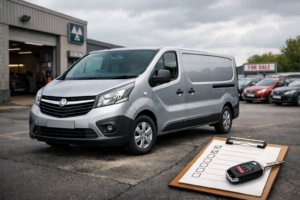

On the day your camper van is collected, a buyer or their driver comes to your location, inspects the vehicle, confirms the agreed price, and takes it away. The whole process typically takes under an hour. No tow trucks. No drama. But knowing exactly what to expect — and what to do beforehand — makes the difference between a smooth handover and a stressful one.
What Is a Camper Van Collection Service?
A camper van collection service is exactly what it sounds like: instead of you driving the van to a buyer or auction yard, the buyer sends someone to collect it from your door. You agree a price, confirm a date, and the van leaves without you lifting a finger beyond handing over the keys.
Think of it like a courier collecting a parcel from your home. You do not take the parcel to a depot. The depot comes to you. The difference is that the “parcel” is a converted van worth thousands of pounds — so the collection day involves a few more steps than signing a delivery note.
For sellers who no longer drive the van regularly, or whose camper has developed a fault, this model removes the single biggest practical obstacle: getting the vehicle to the buyer in the first place.
Technical Definition — What the Process Actually Involves
A camper van collection service in the UK is a logistical arrangement in which a purchasing company or private buyer dispatches a qualified driver to the seller’s nominated address to complete the transaction on-site. The driver conducts a physical inspection, verifies the vehicle against its description, confirms or finalises the offer, and then drives — or, in specific circumstances, transports — the vehicle away.
The key distinction from a standard vehicle sale is the on-site completion. Title transfer, payment, and physical handover all happen at your location. Nothing is deferred to a later date or a different place.
Payment method varies by buyer. Reputable companies transfer funds electronically on the day, before or immediately after the driver departs. Always confirm the payment timeline in writing before collection day arrives.
How the Camper Van Collection Process Works in the UK
Get your valuation and accept an offer
You submit details about your camper — make, model, year, mileage, conversion type, condition — and receive an offer. Reputable buyers base this on real market data, not guesswork. Once you accept, you agree a collection date and address.
Prepare the van and its paperwork
This is the step most sellers underestimate. The driver will want to see the V5C logbook, any service history, MOT certificates, and any documentation specific to the conversion — such as a gas safety certificate or habitation check records. Gather these before the day.
More importantly for a camper van: clear out the living space. Remove personal belongings, bedding, cooking equipment, food, and anything you plan to keep. Buyers purchase the van and its fixed fittings — not your cafetière and your favourite sleeping bag. Treat it like vacating a holiday rental. Leave what was there when you bought it; take everything that is yours.
The driver arrives and inspects the vehicle
The driver checks the van’s condition against what was described at valuation. They will look at the cab — bodywork, tyres, windscreen, electrics — and the living area: the habitation electrics, water system, gas installation, and any fitted furniture. This is not a forensic strip-down. It is a visual check that takes fifteen to thirty minutes.
Be present for the inspection. You can answer questions about the van’s quirks — the solar panel switch that needs a firm press, the water pump that takes a moment to prime — and this builds trust. It also prevents any misunderstanding about condition.
The offer is confirmed or adjusted
If the van matches its description, the offer stands. If the driver finds something significant that was not declared — a hidden damp patch, a non-functioning motor mover, a cracked leisure battery — they may revise the figure. Honest descriptions at the valuation stage almost always mean the price is confirmed without adjustment.
Paperwork is signed and payment is made
You sign over the V5C, hand over the keys, and receive payment. The driver notifies the DVLA of the change of ownership. Your responsibility for the vehicle ends the moment the paperwork is complete.
The van is driven away
In the vast majority of cases, the driver simply drives the van away. If the van will not start or has a mechanical issue that makes driving it unsafe, a reputable collection service will arrange a transporter — at no cost to you. This is worth confirming when you book: ask explicitly what happens if the van is non-runner on the day.
Real-World Examples
Example 1 — The retired couple with a high-spec motorhome conversion
A couple in Yorkshire had a professionally converted Volkswagen Crafter they no longer used. It was in excellent condition but they had no interest in private viewings. They accepted an online offer, cleared out three years of accumulated camping kit, and had the van collected from their driveway on a Tuesday morning. The driver arrived, spent twenty minutes inspecting, confirmed the price, and was gone by 10:30am. Payment cleared the same afternoon.
Example 2 — The non-starter with a failed leisure battery
A seller in Bristol had a camper that had sat unused for eight months. The starter battery was flat and the leisure electrics were intermittent. He declared this upfront. The offer reflected the condition. On collection day, the driver arrived with jump leads, got the van started, completed the inspection, and drove it away. No transporter needed. No renegotiation.
Example 3 — The seller who was not present
A woman in Edinburgh was selling her late father’s camper van. She could not be there on the day but arranged for a neighbour to be present with the keys and paperwork. The collection went ahead without issue. Most buyers will accept a nominated representative — confirm this in advance.
Common Misconceptions About Camper Van Collection
Misconception 1: “I need to be there in person.”
You do not, in most cases. A trusted representative with the keys and paperwork is usually sufficient. That said, being present is always preferable. You know the van. Your neighbour does not.
Misconception 2: “If the van does not start, the collection will be cancelled.”
This is rarely true with a professional camper van collection service. Reputable buyers factor in non-runners. They either bring the means to start the vehicle or arrange a transporter. Declare the issue upfront — do not leave it as a surprise on the day.
Misconception 3: “The driver will haggle aggressively at the door.”
A professional collection driver is not a market trader. They are there to complete a transaction that has already been agreed. If there is a price adjustment, it is based on a specific, identifiable discrepancy — not a pressure tactic. If a buyer routinely uses collection day to slash prices without justification, that is a sign to walk away before you ever book.
Why the Collection Day Experience Matters More Than Sellers Realise
Most guides to selling a camper van stop at “accept the offer.” They skip what actually happens next. That gap is where anxiety lives.
Sellers worry about logistics in ways that car sellers simply do not. Who drives the van away — is it qualified? What if it does not start? Do I need to drain the water system first? What about the gas? These are not irrational questions. A camper van is part vehicle, part home. Handing it over feels different.
The answers are straightforward. A qualified driver handles the vehicle. You do not need to drain the water system unless the van will be transported in freezing conditions — ask the buyer. The gas should be turned off at the cylinder, which is standard practice. The living space should be emptied of personal items, just as you would clear a flat before handing back the keys.
Understanding the van collection process in the UK removes the uncertainty. And certainty is what turns a stressful sale into a simple one.
Frequently Asked Questions
Do I need to clean the camper van before collection?
A reasonable clean is courteous and creates a good first impression, but it will not change your offer. The inspection focuses on mechanical and structural condition, not cleanliness. Do remove all personal belongings — that is not optional.
What documents do I need on collection day?
The V5C logbook is essential. Bring any MOT certificates, service records, and conversion-specific documents such as a gas safety certificate or habitation check. The more history you can provide, the smoother the handover.
What if the driver finds something I did not mention?
Declare everything upfront. If something is found on the day that was not disclosed, the buyer may adjust the offer. If the adjustment seems disproportionate or unjustified, you are not obligated to accept it — the sale is not complete until you sign.
How long does the collection take?
Allow thirty to sixty minutes. A straightforward collection on a van in described condition takes around thirty minutes. More complex vehicles — larger conversions, vans with unusual layouts or non-standard electrics — may take slightly longer.
Is free camper van collection in the UK standard?
Among reputable buyers, yes. Collection at no charge to the seller is the norm. Confirm this before you agree to anything — any buyer charging a collection fee should be treated with scepticism.
Summary
- A camper van collection service sends a qualified driver to your door to inspect, confirm the price, and take the van away — typically within an hour.
- Prepare your paperwork (V5C, MOT, service history, gas certificates) and clear the living space of all personal belongings before the driver arrives.
- Non-starters are not a deal-breaker. Declare the issue upfront and a reputable buyer will arrange a solution.
- You do not need to be present in person, but being there makes the handover faster and avoids misunderstandings.
- Honest descriptions at valuation stage almost always mean the agreed price holds on collection day — surprises are what cause renegotiation.