You already know something is off the moment a buyer’s offer comes in lower than expected. Nine times out of ten, van condition and valuation are the reason — and not in the vague, hand-wavy way most sellers assume.
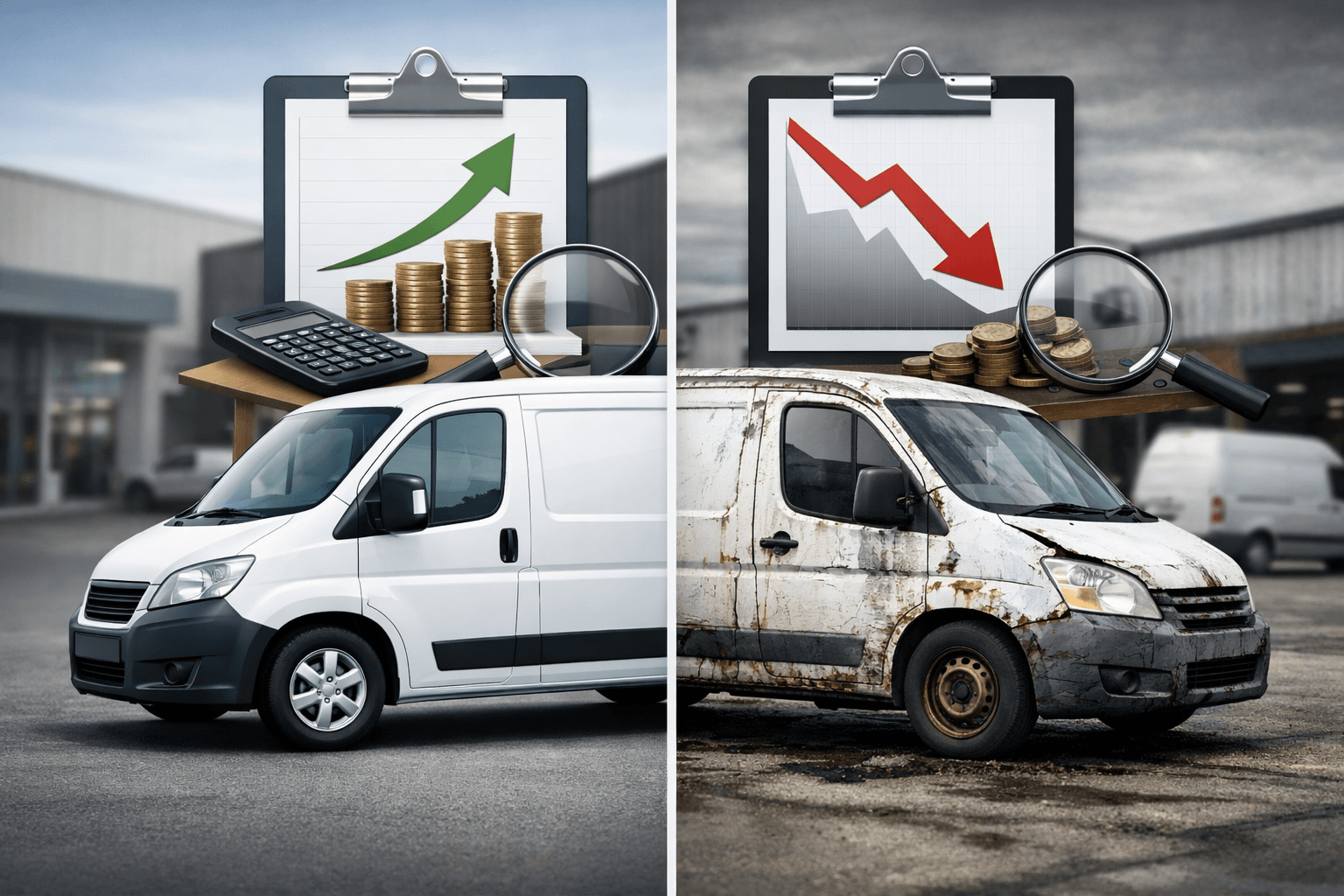
Condition isn’t just one factor among many. It is the multiplier that sits between a guide price and the actual money that lands in your account. Get it right and you protect your offer. Get it wrong — or misrepresent it — and you’ll face a revised (read: lower) number at handover, which is a rubbish way to end a sale.
This article covers every condition category that moves the needle on van value: bodywork, mechanical health, interior, paperwork, tyres, accident history, and the psychology of how trade buyers actually price risk. That last one is where most sellers leave serious money on the table.
- Condition is a multiplier on your van’s baseline guide price — not a minor footnote
- Trade buyers deduct more than the actual repair cost because they are pricing in uncertainty, not just the repair itself
- A full service history can outweigh a high mileage figure when it comes to final offer value
- Small, cheap fixes (a valet, replacing blown bulbs, clearing warning lights) often return disproportionate value
- Honest, documented self-assessment protects you from revised offers at handover
Why Van Condition Is a Core Valuation Factor
Every van starts with a baseline guide price — a figure derived from make, model, age and mileage. Condition is what adjusts that baseline up or down, and the adjustment can be substantial. Trade buyers and online platforms treat condition as a multiplier, not an afterthought.
The distinction between retail and trade valuation matters here. A retail buyer (a private individual buying from a forecourt) pays a premium for a van that is ready to use immediately. A trade buyer — an auction house, a fleet buyer, or an instant-offer platform — is pricing in reconditioning costs, margin, and the time it takes to resell. So the same dent that a private buyer might overlook entirely can trigger a meaningful deduction in a trade offer.
Online instant valuation tools use condition grades as multipliers within their pricing models. Selecting “Good” instead of “Average” on a valuation form can shift the output by hundreds of pounds — sometimes more than £500 on a commercial vehicle. Choosing the wrong grade doesn’t just give you an inaccurate number; it sets up a painful conversation at handover when the physical inspection reveals the discrepancy.
How Valuation Tools Grade Van Condition
Most valuation platforms use four condition grades: Excellent, Good, Average/Fair, and Poor. In practice, these translate differently for vans than they do for cars.
Excellent means the van presents as near-showroom: no visible damage, full service history, low wear throughout. Realistically, this applies to a small minority of commercial vehicles — vans work for a living.
Good means minor cosmetic marks consistent with age, mechanically sound, with most of the service history present. This is where most well-kept vans genuinely sit.
Average/Fair means visible dents or scratches, some service history gaps, tyres or brakes approaching replacement, and interior wear that reflects commercial use.
Poor means significant bodywork damage, mechanical issues, warning lights present, patchy or absent history, or a combination of the above.
Commercial vehicles are graded more harshly than cars because heavy wear is assumed. A scratch that would be “Good” on a family hatchback might push a van into “Average.” Over-grading is the single most common seller mistake — and it results in a revised offer at handover that is always lower than the original.
Bodywork and Exterior Condition: Scratches, Dents and Rust
Minor surface scratches on a van typically reduce an offer by £50–£150, depending on location and severity. A panel dent requiring filler and a respray is a different matter — expect deductions in the £200–£500 range per panel, because the buyer is pricing in bodyshop time, paint matching and the risk that the repair shows on close inspection.
Rust is treated as a red flag, and for good reason. Surface rust on a wheel arch is one thing; rust on a sill, chassis rail or floor pan signals potential structural compromise. Trade buyers apply a risk premium here — they don’t just price in the visible repair, they price in what they might find underneath. That’s why a patch of structural rust can trigger a deduction far beyond its apparent size.
Livery removal and signwriting residue are often underestimated value reducers. Ghost lettering — the outline left by removed vinyl — makes a van look tired and limits its appeal to buyers who want a clean, rebrandable vehicle. Professional livery removal costs around £150–£300 but can recover more than that in offer value, particularly on newer vans.
Colour matters too. White vans (the commercial staple) show scratches less obviously than darker colours, which is one reason white remains the dominant choice for fleet operators. A dark-coloured van with visible swirl marks or faded lacquer will attract more scrutiny than the same damage on white.
Mileage vs. Condition: Which Matters More?
Mileage does not automatically trump condition — this is one of the most persistent myths in van selling. A 100,000-mile van with a full stamped service history, good bodywork and a clean interior will frequently command a stronger offer than a 60,000-mile van with no service records, dashboard warning lights and a battered load area.
Here’s why. Mileage tells a buyer how far the van has travelled. Condition — and particularly service history — tells them how it was treated along the way. Professional valuers use a concept sometimes called mileage-adjusted condition: they assess whether the van’s physical state is consistent with its mileage. A 60,000-mile van that looks like it’s done 150,000 raises immediate questions. A 120,000-mile van that has been meticulously maintained raises far fewer.
The practical example is stark. Van A: 100,000 miles, full main dealer service history, clean MOT, no warning lights, presentable interior. Van B: 60,000 miles, no service history, two dashboard warning lights, worn tyres, interior damage. In most trade valuations, Van A wins. The history is documented proof of care; the warning lights on Van B represent unknown liability.
Mechanical Condition and Its Hidden Impact on Value
Mechanical issues reduce van value in two ways: the direct cost of repair, and the risk premium a buyer applies on top. That risk premium is the part most sellers don’t account for — and it’s where the real money is lost.
Engine health, gearbox condition, clutch wear and braking system integrity are the primary mechanical value drivers. A clutch replacement on a Transit-sized van costs roughly £400–£600 at an independent garage. But a buyer who suspects clutch wear won’t deduct £500 — they’ll deduct £700–£900, because they’re also pricing in the inconvenience of booking the work, the time the van is off the road, and the risk that the inspection missed something else.
Dashboard warning lights deserve special attention. Even a minor light — a tyre pressure sensor, a service reminder — can cause a trade buyer to walk away or apply a blanket “mechanical unknown” deduction that bears no relation to the actual fault. A diagnostic read at a garage costs £40–£80 and can tell you exactly what the light means. If it’s something cheap to fix, fix it. If it’s not, at least you can disclose it accurately.
A pre-sale mechanical inspection report from an independent garage costs around £100–£150 and can pay for itself several times over. Buyers respond to documented evidence of condition — it removes uncertainty, and removing uncertainty removes the risk premium from their calculation.
Interior Condition: Cab, Load Area and Upfitting
Cab and load area are assessed separately because they signal different things to a buyer. The cab tells them about the driver’s relationship with the vehicle — a wrecked dashboard or shredded seat suggests general neglect. The load area tells them about the van’s working life — cuts in the ply lining, broken racking mounts and stained floors are expected, but excessive damage raises questions about structural integrity.
Racking and shelving is a nuanced area. Quality, manufacturer-fitted racking from brands like Sortimo or Bott can add genuine value, particularly if the buyer operates in a trade where it’s immediately useful. Generic or poorly fitted racking can actually reduce value — the buyer has to pay to remove it, and removal isn’t always clean. If you’re unsure, ask the buyer before the sale whether they want it included or removed.
Odour is a significant but frequently overlooked value reducer. Smoke smell, chemical residue and damp are difficult and expensive to remediate fully, and buyers know it. A van that smells of cigarettes will attract a lower offer even if everything else is immaculate, because the buyer knows some buyers will walk away from it on the forecourt.
A professional valet — typically £80–£150 for a commercial vehicle — is one of the highest-return pre-sale investments you can make. It doesn’t fix damage, but it removes the perception of neglect, and perception matters enormously in the first thirty seconds of a physical inspection.
Service History, MOT and Paperwork: The Paper Trail of Condition
A full service history is documented proof of mechanical condition, and it commands a clear premium. In trade valuations, the difference between a full history and no history can be £300–£800 on a mid-range commercial vehicle — sometimes more on newer or higher-value vans.
Main dealer history and independent garage history are not treated equally by all buyers. Main dealer stamps carry more weight because the records are verifiable and the servicing standards are assumed to be consistent. That said, a complete independent garage history — with invoices, not just stamps — is far better than patchy or absent records. Keep every receipt.
MOT status matters in a direct, calculable way. A van with ten months of MOT remaining is a different proposition from one with six weeks left. Buyers factor in the cost and risk of an upcoming test, particularly if recent advisory items are visible on the DVLA MOT history (which any buyer can check in seconds). An MOT advisory for corroded brake pipes is a much bigger conversation than one for a worn wiper blade.
V5C (the registration document), finance settlement letters if the van is on finance, and any remaining manufacturer warranty documentation all support your asking price. Missing V5C is a genuine red flag — it slows the sale and raises questions about ownership history.
Tyres, Brakes and Consumables: Small Details, Real Money
Tyre condition is one of the first things a trade buyer physically checks, and for good reason — it’s the fastest proxy for maintenance culture. A van with tyres worn to 2mm or below signals that the owner ran things to the limit rather than maintaining them proactively. That inference extends to everything else on the vehicle.
Worn tyres don’t just reduce value by the cost of replacement. A set of four commercial tyres costs £300–£500 fitted, but a buyer who spots worn rubber may deduct £500–£700 because they’re now questioning what else has been run to the limit. The deduction exceeds the replacement cost — that’s the risk premium in action again.
The same logic applies to brake pads and discs. A buyer who finds pads at 2mm and scored discs doesn’t just price in the £200–£300 repair; they apply a broader “what else?” discount. If your brakes are genuinely close to the end of their life, replacing them before sale is often worth it — not because of the brake cost itself, but because of the signal it sends about the rest of the van.
Before deciding whether to replace consumables, get a pre-sale offer first using a tool like the van valuation calculator on We Buy Vans. You’ll have a real baseline to work from, which makes the cost-benefit calculation on any pre-sale repairs much cleaner.
How Accident History Affects Van Valuation
Accident history reduces van value — but by how much depends heavily on what happened, how it was repaired, and whether it was disclosed. A declared, professionally repaired accident on a well-maintained van is a very different proposition from an undisclosed write-off with a backstreet repair.
HPI checks and vehicle history reports are standard practice for trade buyers. These checks reveal previous insurance write-offs, outstanding finance, and plate changes. If your van has a Category S (structural damage, repaired) or Category N (non-structural damage, repaired) marker on its history, buyers will find it — so disclosing it yourself, with evidence of quality repair, is always the better strategy.
Category S write-offs carry a permanent and significant value reduction, typically 20–40% below equivalent clean-history vehicles, because structural integrity can never be fully guaranteed post-repair. Category N write-offs are less severe — non-structural damage doesn’t compromise the chassis — but they still reduce value, usually by 10–20%, because of the stigma and the fact that some buyers will simply walk away regardless of repair quality.
Non-disclosure of accident history is not just a financial risk — it’s a legal one. Selling a vehicle with known undisclosed material history can expose you to claims under the Consumer Rights Act or Misrepresentation Act, depending on who you’re selling to. Transparency is always the right call, practically and legally.
The Difference Between Private Sale and Trade Valuation for Condition
Private buyers will often pay more for a van in excellent condition — they’re buying something they plan to use immediately, and they value the peace of mind of a clean, well-presented vehicle. But they’re also more risk-averse about defects. A private buyer who spots a warning light or significant rust may simply walk away, whereas a trade buyer will price it in and make an offer.
Trade buyers — dealers, auction houses, online buying platforms — apply a reconditioning margin on top of their repair cost estimates. They need to make the van saleable and then make a profit on resale. That means their offers will always be lower than private sale prices for the same van, but the process is faster, more certain, and doesn’t require you to manage viewings, test drives and time-wasters.
Online instant-offer platforms handle condition through self-declared grades, which are then verified at physical inspection. Auction houses assess condition in person and adjust the reserve accordingly. The key difference: an instant-offer platform gives you a number upfront (subject to inspection), while an auction result is determined by who turns up on the day.
If your van is in poor condition, private sale becomes significantly harder. Buyers without mechanical knowledge are wary of anything that isn’t clean and straightforward. A trade buyer or specialist buying platform is often the more realistic route for a van in poor condition selling in the UK market.
Should You Repair Your Van Before Selling? A Cost-Benefit Guide
The framework is simple: calculate the repair cost, estimate the likely value uplift, and only proceed if the margin is clearly positive. The challenge is that most sellers overestimate the uplift and underestimate the cost.
Repairs that almost always pay off:
- Professional valet (£80–£150): removes the perception of neglect, often recovers £200–£400 in buyer confidence
- Minor paint touch-ups on small chips (£50–£100 DIY or mobile service): prevents rust and signals care
- Replacing blown bulbs and fixing minor warning lights (£40–£80 diagnostic + parts): removes a buyer’s “unknown mechanical” discount
- Clearing a service reminder light after completing overdue service: straightforward and high-return
Repairs that rarely pay off:
- Full respray on an older van: costs £1,500–£3,000 and rarely adds equivalent value in trade
- Major mechanical overhaul (engine rebuild, new gearbox) on a high-mileage van: the maths almost never work
- Bespoke interior modifications or custom racking: buyers who don’t want it will deduct removal cost; buyers who do are rare
Get a pre-sale quote from a trade buyer before committing to any significant repair. You’ll know exactly what the van is worth in its current state, which gives you a real number to test any repair investment against — rather than guessing.
How to Present Your Van’s Condition Honestly to Maximise Value
Honest self-assessment is not just the ethical approach — it’s the commercially smart one. A seller who accurately describes their van’s condition avoids the revised offer at handover, which is the most demoralising way to lose money in a van sale.
Photograph all visible damage before listing. Every dent, every scratch, every rust spot. This does two things: it prevents “surprise” deductions at handover, and it demonstrates to the buyer that you know your vehicle and have nothing to hide. Sellers who document damage proactively are treated with more trust than those who don’t mention it and hope it goes unnoticed.
Gather every piece of paperwork you have: service invoices, MOT certificates, V5C, tyre receipts, any repair documentation. Present it as a package. A folder of organised paperwork signals a conscientious owner, and conscientious owners get better offers — not because buyers are being generous, but because the paperwork reduces their risk and therefore reduces the premium they charge for uncertainty.
Transparency about known issues, paired with evidence of good maintenance, consistently outperforms vague claims of “good condition.” Buyers have seen every version of “good condition” — what they actually respond to is specificity and evidence.
Frequently Asked Questions
Does a van with high mileage but full service history get a better valuation than a low-mileage van with no history?
Yes, frequently. A full service history is documented proof of how the van was maintained, not just how far it travelled. A 100,000-mile van with a complete stamped history and clean MOT will often command a stronger trade offer than a 60,000-mile van with no records and visible neglect, because the history removes the “unknown liability” discount that buyers apply when they can’t verify maintenance.
How much does a dent or scratch actually reduce a van's value?
Minor surface scratches typically reduce an offer by £50–£150. A panel dent requiring filler and a respray can trigger a deduction of £200–£500 per panel, because the buyer is pricing in bodyshop time, paint matching and the risk of a visible repair. Structural rust deductions are typically larger still, because buyers are pricing in what they might find beneath the surface — not just the visible damage.
Will dashboard warning lights affect my van's valuation?
Yes, significantly — even minor ones. A trade buyer who sees an active warning light applies a “mechanical unknown” discount that often exceeds the actual cost of the fault, because they’re pricing in diagnostic time, the risk of a larger underlying issue, and the inconvenience of managing the repair. A pre-sale diagnostic read costs £40–£80 and can save you several hundred pounds by identifying and resolving the fault before sale.
Does accident history always reduce a van's value, even if it was properly repaired?
Yes, but the degree varies. A Category N write-off (non-structural damage, repaired) typically reduces value by 10–20% compared to a clean-history equivalent. A Category S write-off (structural damage, repaired) carries a larger reduction — often 20–40% — because structural integrity cannot be fully guaranteed post-repair. A declared, well-documented repair with quality evidence reduces the discount compared to undisclosed history, which buyers will find via HPI check regardless.
Is it worth getting my van professionally valeted before selling?
Almost always, yes. A professional commercial vehicle valet costs £80–£150 and can recover £200–£400 in buyer confidence by removing the perception of neglect. It doesn’t fix damage, but a clean van signals a cared-for van — and buyers respond to that signal in their offers. It is one of the highest-return pre-sale investments available to a van seller.
How do online van valuation tools account for condition?
Online valuation tools use condition grades — typically Excellent, Good, Average/Fair and Poor — as multipliers applied to a baseline price derived from make, model, age and mileage. Selecting the wrong grade can shift the output by hundreds of pounds. The grade you select at the online stage is then verified at physical inspection, so over-grading leads to a revised (lower) offer at handover. Accurate self-grading protects both your offer and the sale process.
Does racking or shelving in a van add or reduce its value?
It depends on the quality and the buyer. Quality, manufacturer-fitted racking from recognised brands can add value if the buyer operates in a trade where it’s immediately useful. Generic or poorly fitted racking often reduces value because the buyer has to pay for removal, and removal isn’t always clean. If you’re unsure, ask the buyer directly before the sale whether they want it left in or taken out.
What is the difference between a Category S and Category N write-off for van valuation?
Category S means the van suffered structural damage in an accident and has been repaired. The structural classification carries a significant and permanent value reduction — typically 20–40% below a clean-history equivalent — because structural integrity can never be fully guaranteed. Category N means the damage was non-structural (cosmetic or mechanical) and has been repaired. Category N carries a smaller reduction, typically 10–20%, but still affects value because some buyers will not consider a write-off regardless of repair quality.
Will a short MOT remaining significantly lower my van's valuation?
Yes. A van with six weeks of MOT remaining is a materially different proposition from one with ten months left. Trade buyers factor in the cost and risk of an upcoming test, and if the DVLA MOT history shows recent advisories — which any buyer can check instantly — those advisories become part of the negotiation. A van with a long, clean MOT is simply easier to sell and commands a better offer as a result.
How do trade buyers calculate condition-related deductions differently from private buyers?
Trade buyers don’t just deduct the cost of a repair — they add a risk premium on top. That premium covers the inconvenience of managing the work, the time the van is off the road, the risk that inspection missed something else, and the margin they need to make the van saleable. This is why a £300 repair can prevent a £700 deduction: the buyer isn’t just pricing the repair, they’re pricing the uncertainty around it. Private buyers tend to either accept a condition issue or walk away; trade buyers price everything in, which is why their offers are lower but more predictable.
Ready to see what your van is actually worth in its current condition? Be honest with yourself about the grade, gather your paperwork, and get a real offer — not a guess. That’s the only number that actually matters.