
Postwar Pragmatism: Corrugations, Forward Control, and the Van as Icon
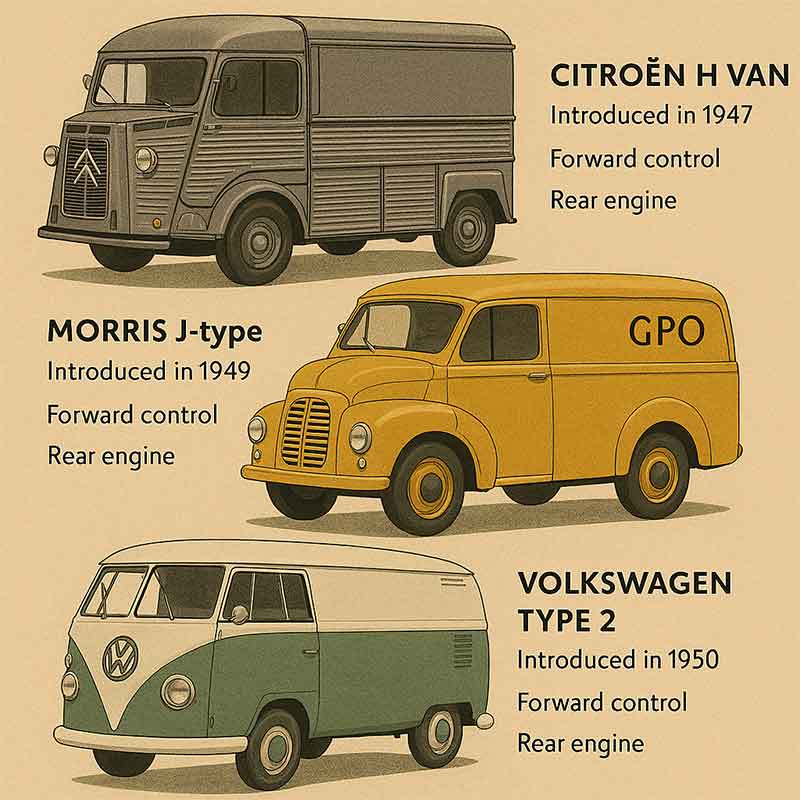
Postwar Pragmatism: Corrugations, Forward Control, and the Van as Icon – Europe in 1947 looked at its ruins and concluded that moving things, lots of things, very quickly, would be useful. Enter the Citroën H Van, a masterclass in making scarcity look clever. Its corrugated steel panels, inspired by aviation, were strong without being heavy, like a tin shed that had discovered purpose. Underneath, front-wheel drive liberated the floor—low, flat, and friendly to backs and dollies. Bakers, butchers, and baristas long before the word existed adored it. Mobile everything, in an age that needed everything.
Britain countered with the Morris J-type in 1949—a cheerful little forward-control box whose snub nose seemed determined to fit down streets designed for carts and cats. The J-type, and later the J2 and Austin/Bedford rivals, made “the Post Office van” an instantly recognizable national character. Sturdy, compact, and just posh enough inside that your knees didn’t stage walkouts.
Then Germany, via Wolfsburg, delivered the Volkswagen Type 2 in 1950. Using Beetle bones, it shoved the driver forward, hung the engine out back, and discovered space math. The Transporter/Bus/Kombi wore more hats than a royal wedding: panel van, pickup, camper, ambulance, ice-cream truck, rolling revolution. Westfalia conversions birthed a camper van subculture; surfers and students adopted it as a mascot. It was the Swiss Army knife of wheels—winsome, fixable, and game for anything.
Forward control was the era’s magic trick. Put the driver over the axle, not behind it, and you carved cubic meters out of thin air. Loading heights fell; turning circles shrank; city access improved. A van should be a room that moves, not a car awkwardly dragging a shed. Postwar designers got the memo and underlined it twice.
The materials were honest—pressed steel, flat panes of glass, rubber mats. Accessories came later: heaters that worked, radios that didn’t sulk. Reliability mattered more than romance. You could fix a Citroën H with pliers, a screwdriver, and enough Gallic patience to outlast a rainstorm. Parts circulated briskly; mechanics became fluent in the new grammar of flat floors and skinny noses.
These vans didn’t just help rebuild economies; they became part of pop culture. A VW Bus isn’t just a van; it’s shorthand for a worldview. Yet the majority led unsung lives, delivering bread at dawn, letters at lunch, and hope on hospital runs. The van matured into essential furniture. Not glamorous, but indispensable.
And looming on the horizon was America’s unmistakable contribution: the van as rolling room, a mobile living space with the square footage of a studio flat and the social life of a dive bar. The 1960s were about to discover that a box on wheels could be both workplace and lounge, sometimes simultaneously and occasionally regrettably.
do you have a van to sell? we buy vans