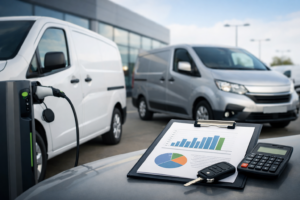

A free van valuation in the UK gives you an estimated market value for your van based on publicly available data and the details you provide — at no upfront cost to you. It is not a guaranteed offer, not a physical inspection, and not a legally binding figure. Think of it as a well-informed starting point, not a finish line.
Understanding what actually goes into that number — and what is quietly left out — can save you from nasty surprises when a buyer turns up and offers you several hundred pounds less than the online tool suggested.
What Is a Free Van Valuation?
A free van valuation is an estimate of your van’s current market worth, generated either instantly online or following a brief assessment by a buyer or dealer. No money changes hands to receive it.
There are two main types. An instant online valuation uses your registration number and a few inputs (mileage, condition, service history) to produce a figure in seconds. An in-person or physical appraisal involves someone actually looking at the vehicle — checking bodywork, tyres, load area, and mechanical condition — before confirming a number.
The word “free” refers to the absence of an upfront fee, not necessarily the absence of any obligation. Some platforms use a free valuation as the first step in a buying process; others are genuinely no-strings. We will come back to that distinction in section seven.
A valuation is always an estimate. Market conditions shift weekly, and no algorithm can see the crack in your nearside bumper or smell the damp in your load area.
What Information Does a Free Van Valuation Actually Use?
Most online tools pull the following data automatically from your registration number: make, model, year of manufacture, engine size, fuel type, and trim level. That part takes about two seconds.
What you then add manually matters enormously. Mileage is one of the single biggest value influencers — a Transit with 40,000 miles commands a noticeably different price from the same Transit with 140,000 on the clock. Service history and a valid MOT signal to buyers that the van has been looked after; platforms that ask about these will adjust their estimate accordingly, though they cannot verify what you tell them.
Condition self-assessment is where things get subjective. When a tool asks you to rate your van as “excellent”, “good”, “fair”, or “poor”, it is relying entirely on your honesty. Most sellers rate their van one band higher than a buyer would. The number of previous owners and whether you hold the V5C logbook also feed into the estimate.
Optional extras matter too — ply lining, roof racks, tow bars, and factory-fitted features can add real value. Which brings us to something most free tools handle badly.
Here is the gap most platforms quietly ignore: if your van is a refrigerated unit, a tipper, a Luton box van, or a curtainsider, a generic online valuation tool will almost certainly treat it as a standard panel van. The specialist body, the payload rating, the refrigeration compressor — none of that is captured. For tradespeople and small fleet operators running non-standard conversions, this means the figure you receive can be materially wrong, sometimes by thousands of pounds. A refrigerated van serving food distribution routes has a completely different buyer pool from a bare panel van, and pricing it as the latter does you a disservice.
If your van has a specialist body type, treat any generic online valuation as a rough floor, not a ceiling.
What Does the Valuation Figure Actually Represent?
The figure you receive represents an estimated market value at a specific point in time — but which market depends on the tool.
There are three common price points you will encounter:
- Trade value — what a dealer or specialist buyer would pay you. This is typically the lowest figure.
- Private sale value — what you might achieve selling directly to another individual. Usually higher, but slower and more effort.
- Part-exchange value — what a dealer credits you when you swap your van against another vehicle. Often the lowest of the three.
Most free tools return a range rather than a single number because the spread between these three points can be significant. The calculation draws on live market data: recent auction results, active dealer listings, and historical sale prices for comparable vehicles.
If you want to get a free van valuation online before approaching any buyer, it is worth understanding which of these three figures the tool is actually showing you — trade, private, or part-exchange — because conflating them leads to disappointment.
The same van can return different figures on different platforms because each platform weights its data sources differently. One may lean heavily on dealer listings; another on auction results. Neither is wrong — they are just measuring slightly different things.
What a Free Van Valuation Does NOT Include
This is the section most competitors skip, and it is arguably the most useful one.
A free online valuation does not include a physical inspection. Bodywork damage, tyre wear, interior condition, and the state of the load area are invisible to an algorithm. A van described as “good” condition with a dented side panel and a torn headliner is not a “good” condition van in a buyer’s eyes.
It does not include a mechanical assessment. Engine health, gearbox condition, DPF issues — these only surface when someone actually drives and inspects the vehicle. An online tool has no idea your van has been running on a cracked injector for six months.
It does not include an outstanding finance check. If there is finance secured against the van, that is your responsibility to disclose and settle. A valuation figure assumes a clean title.
It does not include a stolen vehicle or write-off history check. For that, you need a separate HPI or vehicle history report — a paid service that is entirely distinct from a valuation.
And as noted above, it does not accurately handle specialist body types or payload-rated conversions. Refrigerated vans, tippers, Luton box vans, and curtainsiders exist in a different market segment from panel vans. If your van has fitted racking, shelving systems, or a specialist conversion, a generic tool will almost certainly undervalue it.
Factors That Can Raise or Lower Your Van’s Valuation
Several factors move the needle significantly:
- Mileage relative to age — a high-mileage van for its age will be discounted; a low-mileage example commands a premium
- Full service history vs. partial or none — full stamped history is worth real money to buyers
- Euro emissions standard — Euro 6 vans are more desirable in and around clean air zones; older Euro 5 or Euro 4 vehicles face growing restrictions
- Payload capacity — higher-rated payload is genuinely useful to commercial buyers and priced accordingly
- Colour — white remains the most commercially desirable van colour in the UK; unusual colours narrow your buyer pool
- Tyre age and MOT validity — a van with fresh tyres and a long MOT is easier to sell at full value
- Sign-writing and livery — removing someone else’s branding costs money; buyers factor that in
If your van has fitted racking or shelving that a tradesperson could use immediately, mention it explicitly. Generic tools ignore it; specialist buyers may well pay for it.
How to Get the Most Accurate Free Van Valuation
Accuracy starts before you type a single character into a valuation tool.
Gather your documents first: V5C logbook, service history book or digital records, and your MOT certificate. Having these to hand means you can answer every question the tool asks without guessing.
Be honest about condition. It is genuinely tempting to tick “good” when “fair” is more accurate, but overvaluing your van at this stage only creates a gap between the online estimate and the offer a buyer makes after inspection. That gap is frustrating for everyone.
Use at least three different valuation sources and compare the figures. If they cluster around a similar number, you can feel reasonably confident. If one is wildly different from the others, find out why before relying on it.
Cross-check against live listings. Search for similar vans — same make, model, year, and approximate mileage — on commercial vehicle classified sites. What are private sellers actually asking? What are dealers listing them for? This sense-check takes ten minutes and is worth doing.
Finally, timing matters. Spring and early summer typically see stronger demand for commercial vans as building and trades work picks up. Valuations in January can be softer.
Free Valuation vs. Guaranteed Buying Price: Key Differences
A valuation is an estimate. A guaranteed buying price is a firm offer — subject to the vehicle matching the description you provided.
Here is what that means in practice. You receive an online valuation of, say, £8,500. A specialist buyer then inspects the van and finds the rear bumper has a crack you rated as “minor”, the rear tyres are below 3mm, and there is a DPF warning light that was not mentioned. The guaranteed offer may come in at £7,800. That is not a bait-and-switch — it is the inspection doing its job.
No obligation van valuation means exactly what it says: you are under no obligation to sell after receiving a free valuation. A reputable specialist buyer will not pressure you. You can take the figure away, compare it, sleep on it, and decline without consequence.
Turnaround times differ too. An instant online valuation takes under two minutes. A same-day or next-day guaranteed buying price requires someone to assess the vehicle, either remotely via photos and video or in person.
Which option suits you depends on your situation. A private seller with one van to sell may want to explore private sale value first. A sole trader who needs a quick, clean transaction will likely prefer a guaranteed buying price from a specialist buyer. A fleet manager disposing of multiple vehicles will want a structured process with firm offers against each unit.
What Happens After You Get Your Free Van Valuation?
You have three main routes once you have a valuation figure in hand.
Sell to a specialist buyer — typically the fastest route, with payment often within 24-48 hours of agreeing a price and completing paperwork. No advertising, no tyre-kickers, no waiting.
Sell privately — potentially more money, but you handle the advertising, viewings, and negotiation yourself. Budget time and patience.
Part-exchange at a dealer — convenient if you are buying another vehicle at the same time, but part-exchange values are usually the lowest of the three options. Use your free valuation figure as leverage: if a dealer’s part-exchange offer is significantly below it, you have a negotiating position.
Whichever route you choose, have the following ready: V5C logbook, service history, MOT certificate, and any finance settlement letter if applicable. Outstanding finance does not prevent a sale, but it must be settled — either by you beforehand or by the buyer deducting the settlement figure from the agreed price.
Transfer the V5C correctly on the day of sale and notify the DVLA. If the van is not being driven away immediately, a SORN (Statutory Off Road Notification) may be required. These are your legal responsibilities until the transfer is confirmed.
- A free van valuation is an estimate based on the data you provide — not a guaranteed price or a physical inspection
- Generic online tools routinely mis-value specialist body types including refrigerated vans, tippers, Luton box vans, and curtainsiders
- The valuation figure represents trade, private sale, or part-exchange value — knowing which one the tool is showing you matters
- A no-obligation valuation carries no legal or financial commitment; you are free to walk away
- Mileage, service history, Euro emissions standard, and condition are the biggest levers on the final figure
Frequently Asked Questions
Is a free van valuation in the UK legally binding?
No. A free van valuation is not legally binding on either party. It is an estimate of market value, not a contract. You are not obliged to sell, and the company providing the valuation is not obliged to buy at that figure. A legally binding commitment only arises when both parties sign a formal sale agreement.
How accurate are online van valuations compared to what dealers actually offer?
Online valuations are a reasonable starting point but typically run five to fifteen percent above what a dealer or specialist buyer will offer after physical inspection. The gap exists because the online tool cannot see bodywork condition, tyre wear, or mechanical issues. The more honestly you complete the condition inputs, the closer the online figure will be to a real-world offer.
Can I get a free van valuation without entering my personal details?
Many platforms allow you to generate an initial valuation using only your registration number and mileage, with no personal details required at that stage. Personal details — name, email, phone number — are usually requested when you want to progress to a firm offer or book an inspection. Check each platform’s privacy policy before entering contact information.
Does a free van valuation include a finance or HPI check?
No. A free van valuation does not include a finance check or a full vehicle history report. These are separate, paid services. An HPI check will reveal outstanding finance, write-off history, stolen status, and mileage discrepancies. If you are buying a van, an HPI check is essential. If you are selling, knowing your van’s history upfront avoids surprises during the buyer’s due diligence.
Why is my van valued differently on different websites?
Different platforms use different data sources — some weight dealer listing prices more heavily; others rely on recent auction results or trade data. Each also applies its own algorithms and market assumptions. A spread of a few hundred pounds between platforms is normal. A very large discrepancy usually means one platform is not handling your van’s body type or specification accurately.
Does mileage or condition affect a van valuation more?
Both matter significantly, but mileage tends to have a more consistent and predictable effect because it is a hard number. Condition is subjective and harder for an online tool to assess accurately — which is why the gap between an online valuation and a post-inspection offer is usually driven by condition factors rather than mileage disagreements.
Can I get a free valuation for a high-mileage or damaged van?
Yes. Most valuation tools will return a figure regardless of mileage or condition. Be accurate about both. A high-mileage or damaged van will receive a lower estimate, but that estimate is still useful as a starting point. Specialist buyers who purchase vans for repair and resale or salvage are often willing to make offers on vehicles that private buyers or dealers would decline.
How long does a free van valuation remain valid?
Most online valuations are valid for seven to fourteen days, though this varies by platform. Van market prices move with fuel costs, seasonal demand, and used vehicle supply — so a valuation from six weeks ago may no longer reflect current market conditions. If significant time has passed, run a fresh valuation before entering negotiations.
Will getting a free van valuation affect my credit score?
No. A van valuation does not involve a credit check of any kind and will have no effect on your credit score. Credit checks are only relevant if you are applying for finance to purchase a vehicle, not when you are selling one.
Is a free van valuation the same as a free van appraisal?
Not quite. A valuation produces a figure — an estimated market value — usually based on data inputs rather than physical examination. An appraisal typically involves a person inspecting the vehicle in person and assessing its condition, history, and market position before confirming a price. An appraisal is generally more accurate because it accounts for factors an algorithm cannot see. Some companies use the terms interchangeably, so it is worth asking whether the process involves a physical inspection or is purely data-driven.