
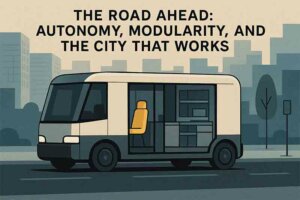
The Road Ahead
Autonomy, Modularity, and the City That Works. Tomorrow’s van cares less about badges and more about choreography. The big ideas are autonomy, modularity, and urban policy conspiring—ideally politely—to move people and parcels with fewer empty miles and less stress. Think of a city where curb space is scheduled like operating rooms, and the vehicles are adaptable rooms on standardized skateboards.
Concepts are already mapping the territory. Toyota’s e-Palette imagines a rectangular EV platform topped by swappable interiors: shuttle in the morning, clinic at noon, mobile shop at dusk. Mercedes’ Vision Urbanetic goes further, proposing autonomous base platforms that change bodies entirely—cargo pod out, passenger pod in—coordinated by a fleet brain that sees demand before it spikes. Kia’s PBV program sketches a family of configurable vans that treat fixtures like furniture, clipped onto rails and changed as easily as a living room layout.
Autonomy’s near-term reality is boring and therefore promising. Driver assistance reduces fatigue. Low-speed driverless pilots in geofenced zones handle repetitive routes: depot to microhub, campus shuttles, nocturnal street sweeping. As sensors get cheaper and algorithms go from prodigy to professional, responsibility will shift from a human with a high-vis vest to a remote supervisor with a dashboard full of feeds.
Energy will diversify. Batteries dominate city duty, but fuel cells may nibble at the heavier, longer-range edges—witness Renault Master H2-Tech and Stellantis’s hydrogen midsize vans (including Toyota Proace Hydrogen) aimed at fleets that can’t afford long charging downtimes. Charging itself will get smarter: dynamic pricing, bidirectional vans stabilizing depots, and curbside posts that retract so sidewalks aren’t turned into cable jungles.
Materials and serviceability will matter more. Recycled composites, bolt-on exterior panels, and standardized interior interfaces will let fleets repair, refresh, and redeploy vehicles quickly. Microfactories—the Arrival dream, bruised but not dead—may resurface as regional production aligns with shorter supply chains and policy carrots.
Policy is the real powertrain. Cities will trade access for behavior: quieter fleets get night delivery slots; zero-emission vans earn loading-bay privileges; operators with good safety records glide past bureaucracy. Data rules will evolve so the van’s sensors don’t turn streets into surveillance projects by accident. Human factors—seating that respects backs, climate control that respects biology, interfaces that respect attention—will split the difference between robot and room.
And culture won’t be left behind. Vans will still be campers, studios, and school shuttles—just with sockets where you expect silence and screens that don’t shout. The essence remains: a van is a room that moves. The future simply asks that the room be smarter, kinder to lungs and nerves, and better at sharing space in a city where everyone wants a piece of curb.
In other words, the most modest shape on the road is quietly becoming the most strategic. Not glamorous, but indispensable—the same verdict we’ve had since horses retired and invoices kept coming.
do you have a van to sell? we buy vans