
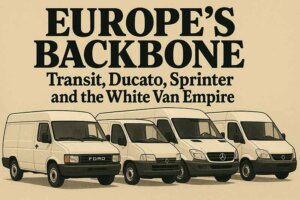
Europes Backbone: Transit, Ducato, Sprinter and the White Van Empire
Europe’s Backbone: Transit, Ducato, Sprinter and the White Van Empire – If America made vans into lounges, Europe kept them honest. From the mid-1960s onward, the continent perfected the panel van as an all-purpose tool. The Ford Transit arrived in 1965 and promptly became shorthand for “gets it done.” It was an adaptable mule: short and long wheelbases, roofs of varying optimism, petrol or diesel, and an options list that read like a tradesman’s wishbook. Entire industries ran on the Transit; tabloid stereotypes about “white van man” wrote themselves.
The Sevel alliance—Fiat and PSA (Peugeot/Citroën)—turned modularity into a religion. Beginning in the early 1980s, factories like Sevel Sud produced vans that were the same idea in different hats: Fiat Ducato, Peugeot J5/Boxer, Citroën C25/Jumper. Wheelbases, roof heights, and body lengths scaled neatly. Converters rejoiced. Ambulances, campers, reefers, cherry pickers—orderable from the same body-in-white with a catalog as thick as a French novel.
Mercedes’ T1, the “Bremer Transporter,” arrived in 1977 with square-jawed seriousness, later evolving into the Sprinter in 1995. The Sprinter professionalized the segment—high roofs tall enough for normal humans to stand, turbodiesels that racked up six figures of mileage without a therapy session, and safety features that suggested you could aim higher than “arrive eventually.” It was the darling of fleets and later the canvas of #vanlife.
Iveco Daily (since 1978) offered a truck-like ladder chassis for heavier duties, while Renault Master and later Opel/Vauxhall Movano filled the middle with distinctly French cleverness—front-drive for low floors, rear-drive for payload, and a face only a mother or a municipal buyer could love. Volkswagen’s Transporter marched from T3 to T4 and onward, gradually turning the iconic rear-engined Bus into a front-drive, modern LCV that still had a soft spot for camper conversions.
Europe’s trick was systems thinking. Motorways, ferries, and customs posts (later softened by Schengen) demanded vehicles that could sprint across borders, sip diesel, and slot into medieval streets on arrival. Parts commonality and service networks mattered; uptime was king. This was logistics as religion and sheet metal as scripture.
The aesthetic was utilitarian chic long before minimalists learned to monetize it: flat sides for signage, big mirrors, sliding doors that swallowed pallets, and interiors optimized for dog-eared clipboards. If you’ve moved house, bought a sofa, or received a parcel on the continent, you’ve likely offered a silent prayer to the gods of panel vans. They are Europe’s capillaries, delivering civilization one box at a time.
do you have a van to sell? we buy vans