Asias Compact Workhorses
HiAce Heroes, Kei Boxes, and the Global Hustle . Asia perfected a simple idea: make the van smaller, tougher, and absolutely everywhere. Toyota’s HiAce, born in 1967, is the patron saint of this approach. It has carried everything—schoolchildren, produce, hospital equipment, entire families’ aspirations—across continents on roads that appear and disappear with the weather. Versions with four-wheel drive climb mountains; ambulance conversions save lives in towns where the map gives up.
Nissan’s Caravan/Urvan and Mitsubishi’s Delica joined the roster. The Delica, especially in 4×4 “Space Gear” and later “D:5” guises, achieved cult status as an adventure egg on stilts. In Japan’s twitchy cityscapes, these one-box vans learned grace: tight turning circles, cab-forward visibility, engines built for abuse, and interiors that reconfigured with origami poise.
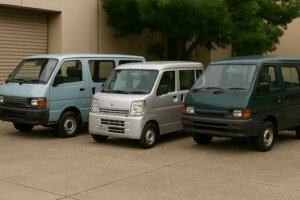
Then there are kei vans—Suzuki Every/Carry, Daihatsu Hijet, Honda Acty—tiny 660cc boxes that behave like TARDISes. They whip through alleys, bounce along farm tracks, park in spaces rejected by bicycles, and haul improbable cargo. Kei vans are proof that volume beats velocity for utility. They form the nervous system of Japanese logistics and, increasingly, export to markets that appreciate efficiency wrapped in modesty.
India’s Maruti Omni (a Suzuki Carry derivative) became the nation’s default small van for decades—school run, cargo shuttle, mobile shop, you name it. Southeast Asia embraced the multipurpose van as a minibus, moving people en masse where rail and bus networks were patchy. Across Africa, the HiAce is both lifeline and legend, operating as matatu, dala dala, trotro—every region with its own name and color scheme, all of them vital.
Why these vans dominate is obvious once you spend a day with one. They’re simple to fix, parts are available in markets where everything else is a special order, and their packaging makes cities feel larger than their maps suggest. Visibility reduces stress. Sliding doors keep traffic moving. The economics are mercilessly clear: a van that’s always running will out-earn a flashy car that can’t hold a goat and twelve sacks of onions.
There are downsides. Overloading and under-maintenance turn heroes into hazards. Informal transport can skirt safety and emissions rules. But the net effect is undeniable: compact vans democratize mobility and commerce. They are the stitches that hold daily life together in places where the infrastructure is still drawing breath. As electrification grows cheaper, expect Asian workhorses to plug in, particularly for urban routes where charging is feasible. The virtues—simplicity, space, serviceability—map neatly onto batteries and motors. The form that conquered the developing world isn’t going away; it’s just getting quieter and a bit smug about its electricity bill.
do you have a van to sell? we buy vans