For most of their history, vans were never meant to be beautiful. They were built to carry tools, haul cargo, and survive abuse. But somewhere along the way, a small group of builders looked at these boxy machines and saw something else: potential. Today, the idea of a van as a showpiece isn’t strange at all. In fact, some of the most striking custom vehicles in Britain aren’t cars—they’re vans transformed into rolling works of art.
The shift began quietly. Early customisers experimented with paint, interiors, and small styling tweaks. But as the mod scene grew, so did ambition. Builders started treating vans the same way hot‑rodders treated classic cars: as blank canvases. The boxy shape became an advantage. It offered space, surface area, and freedom. A van could be anything.
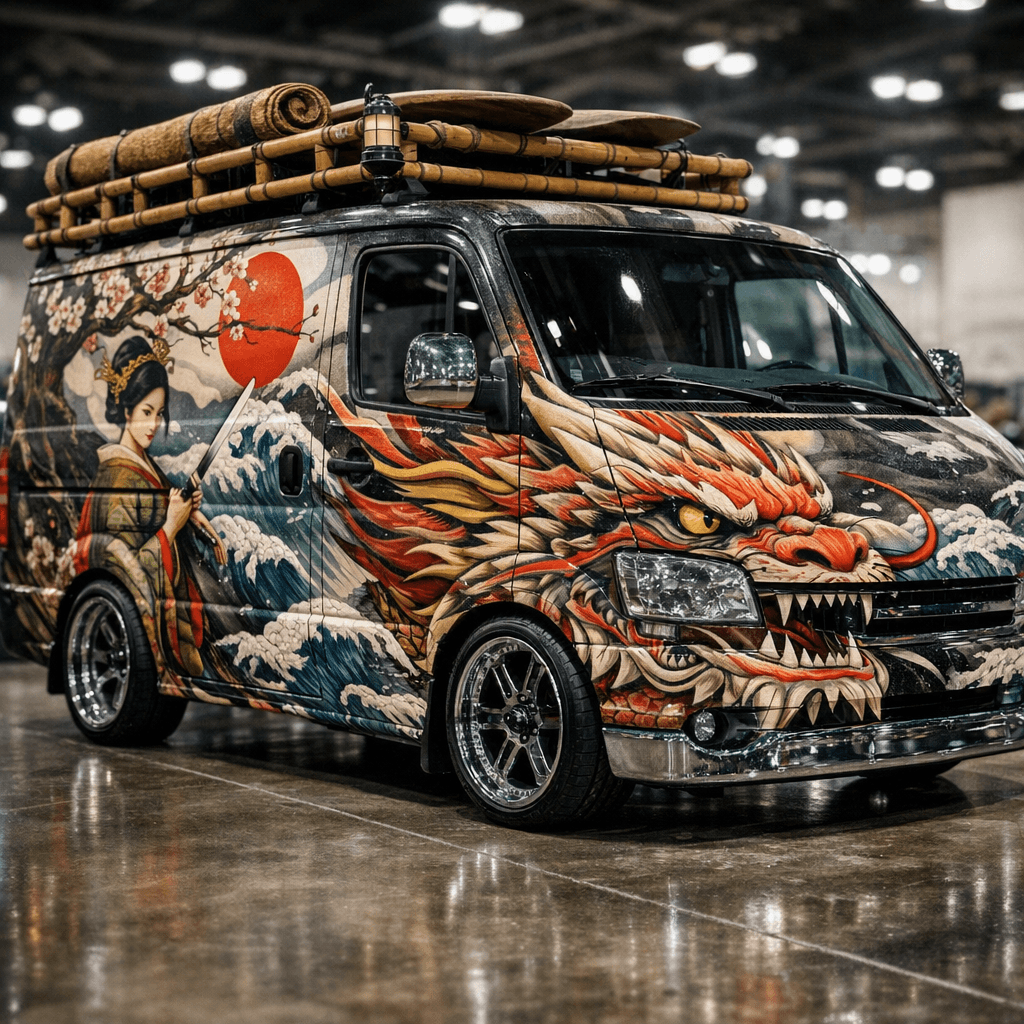
Paintwork is where many showpiece vans make their first statement. Full murals, airbrushed scenes, metallic fades, candy coats, and intricate patterns—these aren’t quick jobs. Some take weeks of layering, masking, and polishing. The best examples look like moving gallery pieces. They tell stories. They grab attention from across a car park. And they prove that a van doesn’t need curves to be beautiful; it just needs imagination.
Then there’s fabrication. Showpiece vans often feature custom bodywork that goes far beyond bolt‑on kits. Builders reshape arches, craft new bumpers, mould one‑off spoilers, and smooth entire panels until the van looks sculpted rather than assembled. Some even shave handles, badges, and seams to create a clean, uninterrupted form. It’s meticulous work, and it blurs the line between automotive design and sculpture.
Interiors are where the artistry becomes undeniable. A true show van doesn’t just look good from the outside—it’s a complete experience. Builders create spaces that feel more like lounges, studios, or boutique hotel rooms than vehicle cabins. Leather upholstery, hand‑stitched details, custom lighting, hardwood flooring, themed décor, and bespoke furniture all come together to create environments that feel unreal. Every surface is considered. Every detail is intentional.
Some show vans lean into themes. Retro 70s dens with shag carpet and neon. Futuristic pods with gloss black panels and hidden tech. Rustic cabins with reclaimed timber and warm lighting. Even fantasy‑inspired builds with dramatic colours and sculpted shapes. These aren’t practical interiors—they’re artistic statements. They exist to impress, not to commute.
Audio and visual setups also play a huge role. Many showpiece vans feature sound systems powerful enough to run small events. Multiple subs, custom enclosures, amplifiers, and LED‑lit speaker arrays turn the interior into a performance space. Screens, projectors, and integrated gaming setups add another layer of spectacle. It’s not just a van—it’s an experience.
What makes these builds special is the dedication behind them. Showpiece vans often take hundreds or even thousands of hours to complete. Builders pour themselves into the work, crafting details that most people will never notice. But that’s the point. It’s art for the sake of art. It’s passion made visible.
The culture around show vans is equally important. At meets and exhibitions, these builds become centrepieces. Crowds gather around them. People ask questions, take photos, and admire the craftsmanship. Builders share techniques, swap stories, and celebrate each other’s creativity. It’s a community built on respect for the craft.
In a world where vehicles are becoming more uniform and mass‑produced, showpiece vans stand out as reminders of what personal expression looks like. They prove that even the most utilitarian machine can become something extraordinary. A van doesn’t have to be just a workhorse. With vision, skill, and a bit of madness, it can become art.