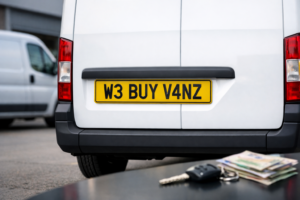

A used Ford Transit is typically worth between £4,000 and £35,000 in the UK, depending on age, mileage, body style, roof height, and condition. That’s a wide range — and the difference between landing at the top or the bottom of it often comes down to factors most sellers never think to check.
If you’re trying to nail your ford transit valuation uk, this guide is written specifically for Transit owners. Not generic van advice. Transit-specific factors, Transit-specific mileage bands, and the honest truth about why the number your online quote tool gives you and the number a dealer hands you can differ by thousands.
Key takeaways
- The Ford Transit range spans multiple body styles, roof heights, and nameplates — each sits in a different valuation bracket, and mixing them up is a costly mistake.
- Mileage bands matter enormously: Transit values tend to drop sharply beyond 100,000 miles, and again beyond 150,000.
- The launch of the 2023-generation Transit Custom is actively depressing prices of outgoing MK1 models right now — sellers who delay are losing real money.
- Trade value, part-exchange value, and private sale value can differ by 15–25% for the same van — understanding why that gap exists is how you close it.
- Electric Transits are valued differently from diesel ones, with battery health playing a role that has no diesel equivalent.
Why Ford Transit Valuation Matters in the UK Market
Getting your valuation right isn’t just useful — it’s financially significant. Whether you’re selling outright, part-exchanging for a new vehicle, insuring your fleet, or using your van as security for finance, an inaccurate figure costs you in every direction.
The Transit is the UK’s best-selling van by a significant margin, consistently accounting for a substantial share of light commercial vehicle registrations year after year. That dominance means there’s a deep, liquid used market — which is good news for liquidity, but also means buyers are well-informed and price-savvy. You need to be too.
The rise of the E-Transit adds a new layer of complexity. Electric vans depreciate differently from diesel ones, and as battery technology evolves rapidly, residual values for early E-Transit models are harder to predict. That uncertainty is already baked into the prices buyers are willing to pay.
The Ford Transit Range: Which Model Do You Have?
Before you seek any valuation, you need to know exactly which Transit you own. This sounds obvious. It isn’t — the Transit family is large, and each nameplate sits in a different valuation bracket.
Here’s the full family:
- Ford Transit — the full-size workhorse, available as panel van, minibus, kombi, chassis cab, and double cab
- Ford Transit Custom — the mid-size segment leader, available as panel van and kombi
- Ford Transit Connect — the compact tradesperson’s van
- Ford Transit Courier — the smallest van in the range, aimed at urban delivery
- E-Transit — the full-size electric version
- E-Transit Custom — electric mid-size, launched 2024
- E-Transit Courier — electric compact, growing in urban fleet demand
- Tourneo Custom — the people-carrier variant of the Custom platform
Body style also changes the valuation picture significantly. A panel van is the most common and most liquid body style — easy to value, easy to sell. A Luton box van conversion or a minibus body narrows your buyer pool, which affects price in ways we’ll cover shortly. Chassis cab and double cab models attract specific trade buyers, and their values reflect that specialist demand.
Pro tip
Check your V5C logbook before requesting any valuation. The model variant is listed there, and getting it wrong — even by something as simple as confusing a Transit Custom with a standard Transit — can produce a valuation that’s off by several thousand pounds.
Key Factors That Determine Ford Transit Value
Ford Transit value is determined by a combination of age, mileage, condition, history, and specification. Here’s how each one plays out in practice.
Age and Depreciation
New Transits depreciate fastest in their first three years — typically losing 40–50% of their original value by the time they hit the three-year mark. After that, the curve flattens. A well-maintained five-year-old Transit with reasonable mileage can represent genuinely strong value, which is exactly why the used market for them is so active.
Mileage and the Bands Where Values Fall Sharply
Average commercial van mileage in the UK runs at roughly 15,000–20,000 miles per year. A Transit sitting at 60,000 miles after three years is broadly in line with expectations. The mileage bands where values tend to drop sharply are:
- 100,000 miles — buyer confidence dips; perceived risk of major mechanical work increases
- 150,000 miles — significant price reduction; appeals mainly to buyers who can service their own vehicles
- 200,000+ miles — trade-only territory for most examples, unless the van has documented evidence of major work
The ford transit mileage value relationship isn’t linear — it’s stepped. A Transit at 98,000 miles and one at 105,000 miles can differ in perceived value by more than the raw mileage difference would suggest.
Condition: What Buyers Actually Look At
Buyers and traders inspect three things: bodywork, interior, and the load area. Dents, scuffs, and corrosion on the bodywork are expected on a working van — but excessive damage signals poor overall care. Interior wear matters more than sellers assume: a destroyed driver’s seat or a cracked dashboard tells a buyer the van has been worked hard. The load area is often the most telling: ply-lining in good condition protects value; an unlined load area with gouged metalwork is a negotiating tool for every buyer who walks around it.
Service History
A full Ford dealer service history adds measurable value — typically £500–£1,500 over an equivalent van with independent stamps, depending on age and mileage. A van with no service history at all is a significant red flag for buyers, and will be priced accordingly. Ford transit condition and price are directly linked through the service record: it’s the paper trail that proves the condition claim.
MOT Status and Previous Owners
A long MOT remaining (10–12 months) adds confidence and removes a buyer’s negotiating chip. A van with two months of MOT left invites aggressive chipping. Fleet-operated Transits — serviced on schedule, often with full history — frequently command more than privately owned examples with patchy records, even at higher mileages.
Specification and Trim Level Impact on Valuation
Trim level affects residual value more than most sellers realise. The Transit range runs from Base through Leader, Trend, Limited, Active, and Trail. Limited and Active trims hold their value better at retail, partly because they’re more desirable to private buyers and small business owners who want a van that doesn’t feel entirely spartan.
Engine and transmission matter too. Automatic gearboxes command a premium — typically £500–£1,500 over a manual equivalent — because they’re increasingly preferred for urban and multi-drop work. The EcoBlue diesel engines have a strong reputation for reliability when serviced correctly, which supports their residual values.
Roof height and body length directly affect ford transit sale price uk in the trade. Here’s why: an L2 H2 panel van is the most versatile and most commonly sought configuration, so it has the deepest buyer pool and the strongest pricing. An L3 H3 jumbo, while more capable, appeals to a narrower audience — and a narrower audience means less competition among buyers, which means lower prices.
Factory options that genuinely add value include:
- Reversing cameras and parking sensors
- Cruise control and lane-keeping assist
- DAB radio and Bluetooth connectivity
- Heated seats
- Ply-lining (factory or well-fitted aftermarket)
Aftermarket conversions are more complicated. A refrigeration unit or welfare conversion can add value — but only if the buyer needs exactly that conversion. If they don’t, it can actually reduce the van’s appeal and therefore its price.
Electric vs. Diesel: How E-Transit Valuation Differs
E-Transit residual values are currently less predictable than diesel equivalents, and that uncertainty is reflected in the prices buyers are willing to pay. The core issue is battery technology: as newer, longer-range E-Transits enter the market, earlier models with shorter ranges become less competitive, and their values soften faster than diesel depreciation curves would suggest.
Battery health is the unique valuation factor here — something with no diesel equivalent. A used E-Transit with a battery at 85% of original capacity is materially different from one at 95%, but establishing that figure requires a diagnostic check that not all sellers offer or buyers think to request.
Warning
If you’re selling an E-Transit, get a battery health report before listing. Buyers who discover degraded battery capacity during their own checks will use it to negotiate aggressively — or walk away entirely.
Government grants and plug-in van grants affected the original purchase price of many E-Transits. That grant doesn’t transfer to the used buyer, which is one reason why the used E-Transit market hasn’t yet found the same depth as the diesel market. Demand is growing — particularly for the E-Transit Courier and E-Transit Custom among urban delivery operators — but it’s still maturing.
How Market Conditions Affect Ford Transit Prices
The used Transit market doesn’t exist in a vacuum. Several external forces push prices up or down, and timing your sale around them is one of the most underused levers available to sellers.
Seasonal demand tends to peak in Q1 (January–March) as construction and trades businesses gear up for the new year, and again in Q3 (July–September). Selling into those peaks can add several hundred pounds to a realistic offer.
Supply chain disruptions since 2021 pushed new van lead times out significantly, which drove used Transit prices higher as buyers who couldn’t get new vehicles turned to the used market. That effect has partially unwound, but used Transit prices remain elevated compared to pre-2021 norms.
Regional differences are real. Transits in London and the South East typically command slightly higher prices than equivalent examples in the North or Scotland, reflecting both higher average incomes and stronger demand from dense urban trade and delivery markets.
Fleet disposals are the force that can suppress prices for specific age and mileage bands. When a large fleet operator disposes of 200 Transits of the same age and spec in a short period, it floods the market for that configuration and pushes prices down. This is particularly relevant for three-year-old, high-mileage examples — the most common fleet disposal profile.
How to Get an Accurate Ford Transit Valuation in the UK
The most accurate valuation comes from combining multiple sources — not relying on any single tool.
Trade guides — CAP HPI and Glass’s Guide — are the industry standard. Dealers and finance companies use them. They’re subscription services aimed at the trade, but they set the benchmark against which everything else is measured.
Free online tools — We Buy Vans, Motorway, AutoTrader Van — give you a useful starting point. They’re quick, they’re free, and they’re directionally accurate. But here’s what most valuation guides won’t tell you: the gap between an online instant offer and what a dealer will actually hand you at part-exchange can be 15–25% on the same van.
Why does that gap exist? Online tools use broad data averages. They can’t see your van’s actual condition, the state of the load area, whether the service history is complete, or whether there’s a recall outstanding. When a dealer physically inspects your van, every imperfection becomes a negotiating point. That’s not cynicism — it’s how the market works.
If you want to get a genuine valuation for your Ford Transit from specialists who understand the specific factors that affect Transit pricing, it’s worth going to a buyer who focuses on vans rather than a generalist platform.
The four values you need to understand:
- Trade value — what a dealer will pay to buy your van outright; the lowest number
- Part-exchange value — what a dealer credits you against a new purchase; typically slightly above trade, but often less than you expect
- Private sale value — what you can achieve selling directly; typically 10–20% above trade, but requires time, effort, and dealing with tyre-kickers
- Retail value — what a dealer sells your van for after reconditioning; the highest number, and not one you’ll see as a seller
Pro tip
Before requesting any valuation, gather your V5C, full service history folder, MOT certificates, and check your MOT history via the DVLA’s free online tool. A complete information pack signals a well-cared-for van and reduces the ammunition buyers have to negotiate you down.
Ford Transit Custom Valuation: The UK’s Best-Selling Van
The Transit Custom deserves its own section because it dominates the UK van market in a way that makes its valuation dynamics unique — and right now, those dynamics are shifting fast.
The launch of the new-generation Transit Custom in 2023 is actively depressing prices of outgoing MK1 models. This is the angle most valuation content misses entirely. When a new generation arrives with significantly updated technology, connectivity, and driver assistance features, buyers who can stretch their budget will do so — leaving outgoing models with a smaller, more price-sensitive audience. MK1 Custom values have softened noticeably since the new model arrived, and that trend is likely to continue as more new-generation examples enter the used market.
If you own an outgoing MK1 Transit Custom, this is not the time to wait. Every month you delay, the new-generation model becomes more established, more available, and more affordable — and your MK1 becomes relatively less desirable.
Sport and MS-RT variants hold their value better than standard trims at retail, because they appeal to buyers who actively seek them out and are willing to pay a premium. But the buyer pool is narrower, which means they can take longer to sell privately.
Against rivals, the Transit Custom holds its value well. It typically outperforms the Mercedes Vito in residuals, sits broadly in line with the Volkswagen Transporter (which has its own strong following), and beats most other mid-size competitors on liquidity — meaning it’s easier to sell quickly at a fair price.
Ford Transit Connect and Courier Valuation
The Transit Connect occupies a sweet spot for tradespeople and small business owners who need a proper van without full-size running costs. Its compact dimensions make it practical for urban work, and demand from couriers and sole traders keeps the used market reasonably active.
The Transit Courier — the smallest member of the family — benefits from strong urban delivery demand, particularly as e-commerce growth continues to drive last-mile logistics. Its compact size, which might seem like a limitation, is actually a selling point in congested city environments.
Note
The older Transit Connect model has reached end-of-production in its previous form. While this doesn’t immediately crater values, it does raise buyer concerns about long-term parts availability. If you’re selling an older Connect, be prepared for buyers to factor this in.
Maximising Your Ford Transit’s Value Before Selling
A little preparation before you sell can genuinely move the needle on your final price. Here’s what’s worth doing — and what isn’t.
Worth doing:
- Professional valet inside and out, including the load area. First impressions are disproportionately powerful.
- Minor dent and scratch repair via a mobile SMART repair specialist. The cost is typically £50–£150 per panel; the return in buyer confidence is usually worth more.
- Replace worn or mismatched tyres. Buyers notice, and uneven tyres signal neglect.
- Compile your complete service history folder — every stamp, every invoice, every receipt for work done.
- Check for outstanding recalls via the DVLA or Ford’s own recall checker. An outstanding recall is a legitimate reason for a buyer to chip your price.
Common faults to address proactively on higher-mileage diesel Transits include DPF (diesel particulate filter) issues and injector problems on certain EcoBlue engines. If you know about a fault, fixing it before sale almost always returns more than the repair cost. If you don’t fix it, a savvy buyer will find it and use it — and they’ll estimate the repair cost at the high end.
Timing matters. Listing your van in January or July, into the seasonal demand peaks, is a simple way to access a larger pool of motivated buyers.
Which selling route is right for you? Here’s the honest breakdown:
- Online buying platform (We Buy Vans, Motorway): fastest, most convenient, lowest price — typically trade value or just above
- Dealer part-exchange: convenient if you’re buying another vehicle, but the part-exchange credit often doesn’t reflect full trade value
- Private sale: highest potential return, but requires time, a good listing, and the patience to deal with buyers who will try to negotiate
Common Mistakes That Reduce Ford Transit Valuation
These are the errors that cost sellers real money — and most of them are entirely avoidable.
Overestimating aftermarket accessories. A £2,000 racking system or a custom roof rack has value to you. It may have zero value — or negative value — to a buyer who needs a clean load area for a different purpose. Price your van on its fundamental merits, not on what you spent fitting it out.
Failing to disclose outstanding finance. If there’s finance outstanding on your van, it must be settled before or as part of any sale. Selling a van with undisclosed finance is legally problematic and can result in the buyer losing the vehicle. Any reputable buying platform will do an HPI check — the finance will surface regardless.
Ignoring cosmetic damage. Every visible dent, scratch, or scuff is a negotiating tool in the buyer’s hands. Either repair it before sale, or price it in from the start. Don’t list at a price that assumes perfect condition and then be surprised when buyers chip you.
Pricing from retail listings, not sold prices. AutoTrader listings show asking prices, not sold prices. The gap between the two can be significant. Price against what comparable vans are actually selling for, not what optimistic sellers are hoping to achieve.
Missing outstanding recalls. Check before you list. An outstanding recall doesn’t necessarily mean the van is dangerous, but it’s a legitimate concern for buyers — and a reason to negotiate your price down.
Frequently Asked Questions
What is the average value of a used Ford Transit in the UK?
A used Ford Transit in the UK typically ranges from around £4,000 for a high-mileage, older example to £35,000 or more for a nearly new, low-mileage, well-specified model. The most common used Transit transaction prices sit in the £8,000–£20,000 range, depending on age, mileage, body style, and condition.
How much does high mileage reduce a Ford Transit’s value?
High mileage reduces Transit value in steps rather than linearly. Values tend to drop noticeably at 100,000 miles and again at 150,000 miles. A Transit at 100,000 miles might be worth 15–25% less than an equivalent example at 70,000 miles, all else being equal. Beyond 150,000 miles, the audience narrows significantly and prices reflect that reduced demand.
Is a Ford Transit Custom worth more than a standard Transit?
Not necessarily more in absolute terms — they serve different segments. The Transit Custom typically commands stronger residuals relative to its original purchase price, partly because of its enormous popularity and deep used-market liquidity. A standard full-size Transit in a specialist body style or high-spec trim can exceed Custom values in absolute price terms.
Does a full service history significantly increase a Ford Transit’s value?
Yes, meaningfully. A full Ford dealer service history typically adds £500–£1,500 over an equivalent van with independent stamps, and significantly more over a van with no history at all. Service history is the single most credible evidence of how a van has been maintained — buyers and traders price it accordingly.
How is an E-Transit valued differently from a diesel Transit?
E-Transit valuation includes battery health as a primary factor — something with no diesel equivalent. A battery at 85% capacity is materially less valuable than one at 95%, and buyers are increasingly aware of this. E-Transit residuals are also more volatile than diesel equivalents because rapidly evolving battery technology makes older, shorter-range models comparatively less attractive as newer ones arrive.
What is the difference between trade value and retail value for a Ford Transit?
Trade value is what a dealer pays to buy your van — the lowest number in the chain. Retail value is what that dealer sells it for after reconditioning — the highest. The gap between the two is typically 20–35%, representing the dealer’s reconditioning costs, overheads, and margin. Part-exchange value usually sits somewhere between trade and retail, but closer to trade than most sellers expect.
Which Ford Transit body size holds its value best?
The L2 H2 panel van configuration holds its value best because it has the widest buyer appeal and the deepest used-market liquidity. Jumbo (L3 H3) examples appeal to a narrower audience, and niche body styles like minibus or chassis cab have more specialist buyer pools — which generally means less competition among buyers and softer pricing.
Does a Luton or specialist conversion add value to a Ford Transit?
It depends entirely on whether your buyer needs that conversion. A well-maintained Luton box body adds value for a buyer who needs exactly that — and reduces appeal for everyone else. Specialist conversions (refrigeration, welfare, tail-lift) can command a premium from the right buyer, but they narrow your audience. Expect to wait longer for the right buyer, or accept a lower price for speed.
How do I find out what my Ford Transit is worth for free?
Start with free online tools — We Buy Vans, Motorway, and AutoTrader Van all offer instant estimates. Cross-reference at least two or three. Then check comparable sold listings (not just asking prices) on AutoTrader to sense-check the figure. Remember that online estimates are based on averages and will be adjusted after a physical inspection.
Does the Ford Transit hold its value well compared to rivals?
Yes, particularly the Transit Custom, which holds its value competitively against the Volkswagen Transporter and outperforms most other mid-size vans. The full-size Transit holds its value well relative to the Mercedes Sprinter and Vauxhall Movano. The Transit’s dominance in the UK market means there’s always buyer demand — and demand is what sustains residual values.
Knowing your Transit’s value is the first step. The second is choosing the right moment and the right route to sell. If you’re ready to move, get at least two or three valuations from reputable buyers, understand which number you’re being quoted (trade, part-exchange, or retail), and don’t let a van that’s losing value month-on-month sit on your driveway while you wait for a perfect price that may not materialise.