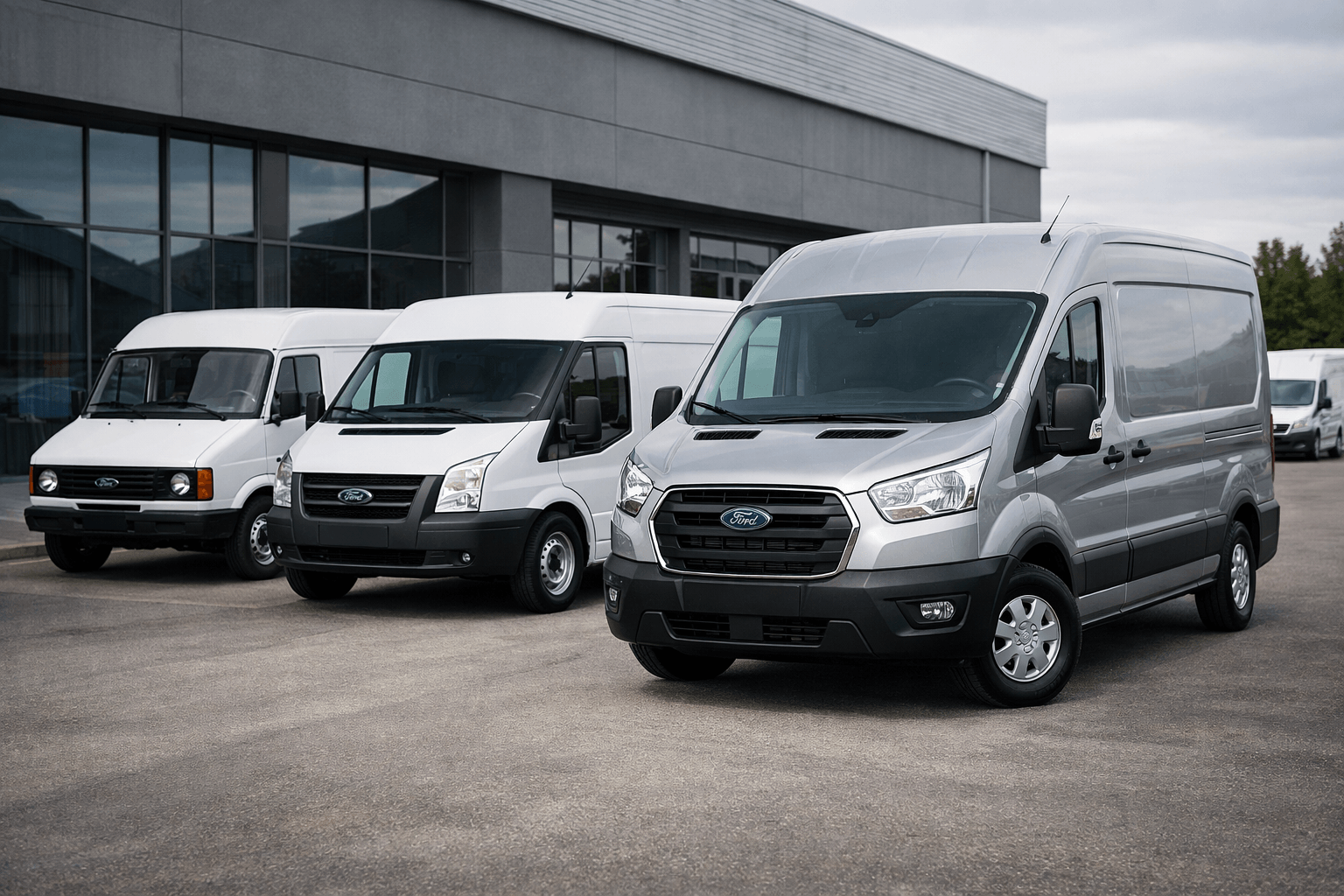
The Ford Transit has been Britain’s best-selling van for decades — but “buy a Transit” is about as useful as “buy a car.” There are six distinct generations spanning nearly 60 years, each with its own reliability quirks, running costs, and resale trajectory. Knowing which generation you’re actually looking at when you browse used listings could save you thousands. This guide maps every ford transit generation by year, flags the known trouble spots, and gives you a generation-specific cost-of-ownership verdict so you can make a genuinely informed decision.
Key takeaways
- There are six major Ford Transit generations (plus the E-Transit), each with meaningfully different platforms, engines, and ownership costs
- The Mk3 (1986–2000) and Mk5 (2006–2013) generations represent the strongest sweet spots for tradespeople buying used
- EGR valves, DPF blockages, and dual-mass flywheels are recurring fault themes from the Mk4 onward — budget accordingly
- The 2019–2022 US-market Transit is the most reliable modern build based on NHTSA recall frequency
- The Ford Transit Custom is a separate, smaller vehicle — not a trim level of the full-size Transit
A Brief History of the Ford Transit: Why Generations Matter
Understanding ford transit generations by year isn’t just trivia — it’s money. A 2004 Mk4 with a known dual-mass flywheel problem is a very different financial proposition from a 2019 Mk6 with updated mechanicals, even if both are priced similarly on a forecourt.
Ford has produced six distinct Transit generations globally since 1965, plus the all-electric E-Transit launched in 2022. North America only received the Transit from 2014 onward — before that, US buyers got the boxy E-Series instead. Each platform change brought new engines, new suspension architectures, and new failure modes.
Parts availability, specialist knowledge, and insurance costs all shift across generations. A Mk3 from the 1990s is cheap to fix because every independent mechanic knows it. A newer Mk6 with SYNC 4 infotainment is a different conversation entirely.
Quick-reference timeline:
- 1965–1978: Mk1 — the original
- 1978–1986: Mk2 — refined classic
- 1986–2000: Mk3 — the workhorse era
- 2000–2006: Mk4 — modern underpinnings
- 2006–2013: Mk5 — refinement and emissions
- 2013–present: Mk6 — global platform, US debut
- 2022–present: E-Transit — all-electric
First Generation Ford Transit (1965–1978): The Van That Started It All
The original Transit — developed internally as the ‘Redcap’ project — launched in the UK in 1965 and immediately redefined what a light commercial vehicle could be. It replaced the aging Thames 400E and offered something genuinely new: a forward-control cab that maximised load space without increasing the vehicle’s footprint.
Body styles included panel van, minibus, pickup, and chassis cab — a versatility that set the template every successor followed. Engine options were the Kent four-cylinder petrol, the Essex V4 petrol, and a Perkins diesel for buyers who needed economy.
Today, a working Mk1 is a collector’s item rather than a practical tool. Rust has claimed most survivors, and sourcing parts requires specialist suppliers. Restoration communities in the UK are active and enthusiastic, but budget realistically: a full Mk1 restoration routinely runs into five figures.
Note
If you find a Mk1 at a barn-find price, have a specialist assess the chassis before anything else. Floor pan and outrigger rust is almost universal on unrestored examples.
Second Generation Ford Transit (1978–1986): Refined but Still Classic
Ford Transit model changes between Mk1 and Mk2 were more evolutionary than revolutionary. The 1978 redesign brought cleaner aerodynamics, a more upright windscreen, and — crucially — the introduction of a high-roof variant that expanded cargo versatility significantly.
Engine updates included the 2.0 Pinto petrol (a well-understood unit that’s still easy to work on) and the York diesel, which was thirsty but virtually indestructible in low-mileage use. The Mk2 developed a strong reputation among smaller independent operators precisely because it was so straightforward to maintain.
The reliability reputation is broadly positive, but rust is the defining issue. Sill sections, rear wheel arches, and the floor behind the cab are the priority inspection areas. A clean Mk2 is increasingly rare and commands a premium among vintage fleet enthusiasts and film/TV prop hire companies.
Third Generation Ford Transit (1986–2000): The Van Britain Built Its Trades On
The Mk3 is the van that built modern Britain — quite literally. Launched in 1986 with a significant platform redesign, it introduced improved driver ergonomics, a more comfortable cab, and the engine lineup that would define commercial diesel for a generation.
The 2.5 DI (direct injection, naturally aspirated) and 2.5 TD (turbodiesel) engines are the workhorses of this era. Both are robust, well-understood, and cheap to maintain. The TD in particular offers a good balance of performance and economy for light commercial use. Ford Transit history UK really centres on this generation — it dominated European commercial vehicle sales for 14 consecutive years.
Common mechanical issues to know:
- Injector pump failures on high-mileage DI engines (rebuild kits are available)
- Rust on chassis rails, rear crossmember, and cab floor
- Gearbox wear on the MT75 five-speed, particularly on vehicles used in stop-start urban work
- Rear leaf spring corrosion and shackle wear
If you’re buying a surviving Mk3 for light work or a camper conversion, inspect the chassis rails with a torch and a screwdriver before anything else. A solid chassis on a tatty Mk3 is worth far more than a tidy body on a rotten one.
Fourth Generation Ford Transit (2000–2006): Modern Underpinnings Arrive
The Mk4 arrived in 2000 with the biggest engineering leap in the Transit’s history up to that point. An all-new platform brought independent front suspension — replacing the old beam axle — which transformed ride quality and handling. Drivers who moved from a Mk3 to a Mk4 noticed the difference immediately.
The Duratorq TDCi engine (a 2.4-litre common-rail diesel) was the headline powertrain. Common-rail injection (a system that delivers fuel at very high pressure for more efficient combustion) was a step change in efficiency and refinement. ABS became standard, and crumple zones improved meaningfully.
Known problems — budget for these:
- EGR valve (exhaust gas recirculation valve, which recirculates exhaust gases to reduce emissions) blockages are almost universal above 80,000 miles
- Dual-mass flywheel wear, particularly on vehicles used in urban stop-start conditions — replacement runs £600–£900 including labour
- Injector failures on the 2.4 TDCi, especially on pre-2004 builds
- Turbocharger failures on higher-mileage examples
Cost of ownership scorecard — Mk4:
Parts cost: moderate. Recall frequency: low-moderate. DPF/EGR risk: high (EGR particularly). Resale depreciation: steep — values have largely bottomed out, which actually makes this an affordable entry point if you buy carefully.
Fifth Generation Ford Transit (2006–2013): The Refinement Era
The 2006 update was a substantial facelift rather than a ground-up redesign — Ford updated the exterior, revised the interior, and crucially brought Euro 4 and then Euro 5 emissions compliance. The 2.2 TDCi engine replaced the 2.4 as the core powertrain, offering better fuel economy in real-world use.
This generation saw the Transit Tourneo people-carrier variant gain serious commercial traction, and payload ratings and towing capacity both improved. Technology additions — optional satellite navigation, Bluetooth connectivity, and parking sensors — started to appear on higher-spec builds.
For those considering selling a used Ford Transit, the Mk5 tends to hold its value better than the Mk4 at equivalent mileages, largely because the 2.2 TDCi is a more modern and better-supported engine.
Common faults on the Mk5:
- DPF (diesel particulate filter) blockages — a persistent problem on vans used predominantly for short urban runs
- Turbocharger failures on the 2.2 TDCi above 120,000 miles
- Timing chain stretch on early 2.2 TDCi units (pre-2010 builds are higher risk)
- EGR valve issues carry over from the Mk4
Cost of ownership scorecard — Mk5:
Parts cost: moderate-low. Recall frequency: low. DPF/EGR risk: high if used incorrectly. Resale depreciation: moderate — strong used-market demand from tradespeople keeps values relatively stable. This is arguably the best ford transit year to buy for a tradesperson on a budget who needs something usable today.
Pro tip
If you’re buying a Mk5 for urban work, budget £300–£500 for a DPF clean or replacement as a near-certainty within 12 months unless the previous owner has documented motorway use.
Sixth Generation Ford Transit (2013–Present): The US Market Debut
Ford pulled the E-Series from North America and introduced the Transit globally in 2013, with US sales beginning in 2014. It was a significant gamble — American buyers were used to body-on-frame, rear-wheel-drive cargo vans — and it paid off. The Transit became the best-selling full-size van in the US within two years.
The configuration matrix is genuinely complex. Three roof heights (low, medium, high), three body lengths (regular, long, extended), and three weight classes (150, 250, 350) produce a combinatorial range that covers everything from a small business courier to a 15-passenger shuttle. Add front-wheel drive, rear-wheel drive, and all-wheel drive (AWD available from 2020 onward on certain configurations), and you have real flexibility.
Engine lineup:
- 3.5L EcoBoost V6 petrol: the performance choice, strong for towing
- 3.5L naturally aspirated V6: lower running costs, adequate for most commercial use
- 2.0L EcoBlue diesel: the efficiency pick, particularly relevant for high-mileage fleet use
- E-Transit: all-electric (covered separately below)
The 2019 mid-cycle refresh brought an updated front end, revised interior, and the addition of the 2.0L EcoBlue diesel to the US lineup. The 2023 and 2024 model years added SYNC 4 infotainment, standard Ford Co-Pilot360 safety technology, and expanded AWD availability.
Cost of ownership scorecard — Mk6:
Parts cost: moderate (dealer network strong, independent parts catching up). Recall frequency: moderate (the 2015–2017 build years had more NHTSA recalls than post-2019 examples). DPF/EGR risk: moderate on diesel, low on petrol. Resale depreciation: fastest in years 1–3, then stabilises. The 2019–2022 build years represent the strongest reliability record in this generation.
E-Transit: The All-Electric Generation (2022–Present)
The E-Transit launched in North America in 2022 with a 68 kWh usable battery pack and an EPA-rated range of 126 miles. It’s available in cargo van, chassis cab, and cutaway configurations, and uses the same body dimensions as the Mk6 — so fleet operators can mix electric and diesel vehicles without retraining drivers.
Charging options cover Level 1 (standard 120V outlet, practical only for overnight top-ups), Level 2 (240V, roughly 8 hours for a full charge), and DC fast charging (up to 115 kW, adding approximately 45 miles in 15 minutes under ideal conditions).
Real-world range caveats:
- Cold weather (below 20°F / -7°C) reduces range by 20–30% in real-world fleet data
- Full payload reduces range by approximately 10–15%
- Running heating or air conditioning at full load costs roughly 10–15 miles of range
Payload capacity is competitive — up to 3,800 lbs depending on configuration — but towing is limited to 7,500 lbs maximum, which is lower than the diesel equivalent.
Total cost of ownership over 5 years (fleet estimate):
Fuel and energy savings versus a diesel Transit can reach $15,000–$20,000 over five years at current US energy prices, but this depends heavily on electricity costs, charging infrastructure, and annual mileage. The E-Transit makes strong economic sense for urban last-mile delivery operations running 80–100 miles per day. It makes less sense for rural operators, long-haul routes, or anyone without reliable overnight charging.
The E-Transit Custom — a smaller electric sibling based on the Transit Custom platform — is confirmed for European markets and represents the next step in Ford’s electrification roadmap.
Who the E-Transit is right for: Urban fleets, last-mile logistics, operators with depot charging, businesses with sustainability commitments.
Who it isn’t right for yet: Rural operators, high-mileage mixed routes, anyone without access to reliable Level 2 charging.
Ford Transit Custom: A Separate Lineage Worth Knowing
The Transit Custom is not a trim level of the full-size Transit — it’s a distinct vehicle on a different platform, with different dimensions, different engines, and a different target buyer. Confusing the two is one of the most common mistakes used van buyers make, and it matters because parts, insurance groups, and payload ratings are not interchangeable.
The Transit Custom sits between the Transit Connect and the full-size Transit in Ford’s commercial lineup. It launched in 2012 (Mk1) and received a full second-generation redesign in 2023, with the headline addition of a plug-in hybrid (PHEV) variant offering approximately 28 miles of pure electric range — enough for most urban tradespeople to complete a working day without using the petrol engine.
The PHEV Transit Custom makes particular sense for tradespeople in UK Clean Air Zones, where the electric-only capability avoids daily charges. Real-world use cases are clear: short urban runs on electric, longer motorway journeys on petrol.
Note
The Transit Custom is not sold in North America. US and Canadian buyers looking for a mid-size option have the Transit 150 as their entry point.
Ford Transit Generations by Year: Quick-Reference Comparison Table
| Generation | Years | Key Engine(s) | Approx. Payload | Notable Feature | Reliability Rating | Parts Availability |
|---|---|---|---|---|---|---|
| Mk1 | 1965–1978 | Essex V4, Perkins diesel | ~1,000 kg | Defined the segment | Collector-grade | Specialist only |
| Mk2 | 1978–1986 | 2.0 Pinto, York diesel | ~1,100 kg | High-roof variant | Good for age | Specialist/aftermarket |
| Mk3 | 1986–2000 | 2.5 DI, 2.5 TD | ~1,200 kg | Dominated EU sales | Very good | Excellent |
| Mk4 | 2000–2006 | 2.4 TDCi | ~1,300 kg | IFS, ABS standard | Moderate (EGR risk) | Good |
| Mk5 | 2006–2013 | 2.2 TDCi | ~1,360 kg | Euro 4/5 compliance | Good | Good |
| Mk6 | 2013–present | 2.0 EcoBlue, 3.5 EcoBoost | ~1,600 kg | AWD, three roof heights | Good (post-2019) | Strong |
| E-Transit | 2022–present | Electric (68 kWh) | ~1,724 kg | 126-mile EPA range | Early data positive | Developing |
Resale value trends: Mk3 values have stabilised as working vehicles become scarce. Mk4 values have largely bottomed out. Mk5 holds moderately well. Mk6 depreciates fastest in years 1–3, then plateaus. E-Transit resale data is still too early to be definitive.
Fuel economy in real-world terms:
- Mk3 2.5 TD: approximately 28–32 mpg in mixed use
- Mk4 2.4 TDCi: approximately 30–35 mpg
- Mk5 2.2 TDCi: approximately 32–38 mpg
- Mk6 2.0 EcoBlue: approximately 35–42 mpg
- E-Transit: approximately 2.0–2.4 miles per kWh in real-world commercial use
Which Ford Transit Year Should You Actually Buy?
Best for budget buyers (under £8,000 / $10,000): A 2008–2011 Mk5 2.2 TDCi with documented service history and evidence of DPF regeneration runs. Avoid anything with a patchy service record — the DPF and timing chain make provenance non-negotiable at this price point.
Best for reliability and low maintenance: A 2019–2021 Mk6 with the 2.0 EcoBlue diesel. Post-2019 builds benefit from the mid-cycle refresh and a stronger reliability record than the 2015–2017 examples. This is the sweet spot if your budget stretches to it.
Best for modern safety features: Any Mk6 from 2023 onward, which includes Ford Co-Pilot360 as standard — automatic emergency braking, lane-keeping assist, and blind-spot monitoring.
Best for high-mileage commercial use: Mk3 2.5 TD (if you need something bulletproof and cheap to fix) or Mk6 2.0 EcoBlue (if you need modern efficiency). The Mk4 2.4 TDCi can work but budget for injector and EGR maintenance.
Best for camper van conversions: Mk5 or Mk6 high-roof long-wheelbase. The Mk5 offers a lower purchase price; the Mk6 offers better electrical architecture for leisure battery integration and a more comfortable driving experience on long routes.
Best for towing: Mk6 3.5L EcoBoost V6 — rated up to 7,500 lbs, with the power delivery to match.
Years and configurations to avoid:
- 2015–2017 Mk6 (US): higher NHTSA recall frequency than pre- or post-refresh examples
- Mk4 2.4 TDCi pre-2004: early injector and EGR issues are well-documented
- Any generation with a missing or patchy DPF service record — the cost of a blocked DPF often exceeds the van’s value at lower price points
What to Inspect When Buying a Used Ford Transit (Any Generation)
Rust inspection checklist:
- Chassis rails (all generations): probe with a screwdriver, not just a visual check
- Rear wheel arches: Mk1–Mk3 are particularly vulnerable; Mk4 onward improved but not immune
- Sill sections: a known rust trap on Mk2 and Mk3
- Cab floor and bulkhead: water ingress from windscreen seals accelerates rust here
Engine-specific checks:
- Mk3: injector pump condition, oil leaks from rocker cover
- Mk4: EGR valve condition, dual-mass flywheel (ask for a clutch replacement history)
- Mk5: DPF condition (ask for regeneration history), timing chain (listen for rattle on cold start)
- Mk6: EcoBlue diesel — check for AdBlue system faults; EcoBoost — check for coolant leaks at the turbo
Mileage thresholds by generation:
- Mk3 2.5 TD: 200,000 miles is achievable with good maintenance; above 150,000 with no service history is high risk
- Mk4/Mk5 TDCi: 150,000 miles is a reasonable ceiling without known major work having been done
- Mk6: 200,000 miles is realistic on the EcoBlue with full service history
Pre-purchase inspection: An independent inspection typically costs £150–£250 in the UK and $150–$200 in the US. On a van priced at £5,000–£20,000, skipping it is a false economy. A single missed fault — a cracked DPF, a worn dual-mass flywheel, a rotten chassis rail — will cost multiples of the inspection fee.
Pro tip
Always request a VIN check before viewing. In the UK, a full HPI check (approximately £20) will flag outstanding finance, write-off history, and mileage discrepancies. In the US, a Carfax or AutoCheck report does the same job.
Frequently Asked Questions
How many generations of Ford Transit are there?
There are six main generations of Ford Transit, produced from 1965 to the present day, plus the E-Transit all-electric variant launched in 2022. Globally, the generations are designated Mk1 through Mk6, though Ford doesn’t always use those labels officially. The Transit Custom is a separate vehicle with its own two-generation history.
When did the Ford Transit come to the United States?
Ford introduced the Transit to the US market for the 2015 model year (on sale from 2014). Before that, North American buyers had access to the Ford E-Series (also called the Econoline), which Ford phased out of the passenger van market when the Transit arrived.
Which Ford Transit year is most reliable?
Based on NHTSA recall data and owner forum reports, the 2019–2021 Mk6 Transit with the 2.0L EcoBlue diesel is the most reliable modern build. The post-2019 mid-cycle refresh resolved several issues present in the 2015–2017 examples. For older generations, the Mk3 2.5 TD (1986–2000) has an exceptional long-term reliability reputation due to its mechanically simple design.
What years did the Ford Transit have the most problems?
The 2015–2017 US-market Mk6 Transit had a higher NHTSA recall frequency than other years in that generation. The Mk4 (2000–2006) is associated with EGR valve failures and dual-mass flywheel wear that can be expensive if not caught early. Any Mk5 (2006–2013) used predominantly on short urban runs is at high risk of DPF blockage.
Is a 2015 or 2019 Ford Transit a better buy?
The 2019 is the stronger buy. The 2019 mid-cycle refresh updated the front end, added the 2.0L EcoBlue diesel option, revised the interior, and produced a measurably better reliability record than the first-generation Mk6 builds. The 2015 is cheaper to buy, but the higher risk of recalls and known early-build issues makes the saving less compelling than it looks.
What is the difference between Ford Transit and Ford Transit Custom?
The Ford Transit Custom is a smaller, separate vehicle on a different platform — it is not a trim level or configuration of the full-size Transit. The Custom sits between the Transit Connect (small van) and the full-size Transit in Ford’s lineup. It has different dimensions, different engines, and different payload ratings. The Transit Custom is sold in the UK and Europe but is not available in North America.
How long do Ford Transit vans typically last in miles?
A well-maintained Ford Transit can realistically reach 200,000 miles and beyond. Mk3 2.5 TD engines are particularly long-lived — examples with documented maintenance above 250,000 miles are not unusual. Modern Mk6 EcoBlue diesels are designed for similar longevity, though the additional complexity of DPF, AdBlue, and EGR systems means maintenance discipline matters more than on older generations.
Does the Ford Transit have all-wheel drive, and which years offer it?
Yes. All-wheel drive became available on the Mk6 Transit from the 2020 model year onward in North America, on specific configurations (cargo van, passenger wagon). It is not available on every body style or weight class — check individual specifications carefully. AWD availability expanded further with the 2023 model year updates.
Ready to Move On From Your Transit?
If you’ve worked through this guide and decided your current van has done its miles, the process of selling doesn’t need to be complicated. Whether it’s a high-mileage Mk5 or a newer Mk6 that no longer fits your operation, getting a fair, reliable offer is straightforward when you know what you have — and now you do.