
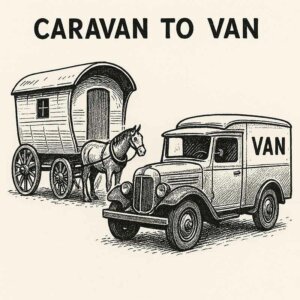
A Word Is Born: From Caravan to Van
“Van” is what happens when “caravan” trims the syllables, rolls up its sleeves, and gets a job. In 19th-century Britain, the term slid off the tongues of merchants and into the lexicon to describe covered wagons built for work not whimsy. These were the city’s pack mules, all box and no bonnet, plying cobbled streets with bread, beer, bolts of cloth, and the sort of packages that made you hope your insurance was paid up.
The silhouette was dictated by physics and pain. Height for stacking, a roof for rain, and a floor low enough that a human spine could survive a working week. Leaf springs bounced, wooden wheels rattled, and a horse did the emissions. If there was style, it existed on hand-painted signage—rolling billboards declaring “SOAP,” “TEA,” or “FURNITURE REMOVALS” in fonts ambitious enough to be visible from a zeppelin.
Two early subplots matter. First, the “pantechnicon,” a Victorian furniture depository whose name became shorthand for enormous removal vans. Picture a barn on wheels with manners. Second, the British habit of classifying anything with a roof and cargo space as a “van,” while heavier, open-bed brutes morphed toward “lorry.” The dividing lines weren’t precise, but the social role was: a van served trade, not leisure.
As cities swelled, the van became invisible infrastructure. Shopkeepers could reach new neighborhoods, bakers could cover early rounds before the pigeons stirred, and newspapers arrived so swiftly you could be disappointed by the headlines while still in your dressing gown. The job description hardened: keep goods dry, honest, and mostly in one piece.
Design evolved in tiny, practical increments. Better brakes so hills didn’t become morality plays. Weatherproofing so cheese didn’t become soup. Rear doors that didn’t require acrobatics. Everything was about uptime: if a van didn’t roll, someone’s business didn’t either. Romance belonged to phaetons and high-wheelers; respect attached to the box that made the city function.
Then the whisper began: what if we took away the horse and added explosions? The age of motive power was dawning, and every wheeled thing would be dragged into modernity, willingly or otherwise. The van, supremely pragmatic, would be first in line. Why? Because hauling is where engines pay back their sins fastest.
So the “van” enters the motor age with two core truths: it’s a room that moves, and it’s judged not by applause but by invoices. Keep that in your pocket as we march through the next century of corrugations, sliding doors, diesel rattle, shag carpeting, lithium ions, and the looming possibility that your parcels will arrive in a driverless lounge with better ambient lighting than your living room.
do you have a van to sell? we buy vans